
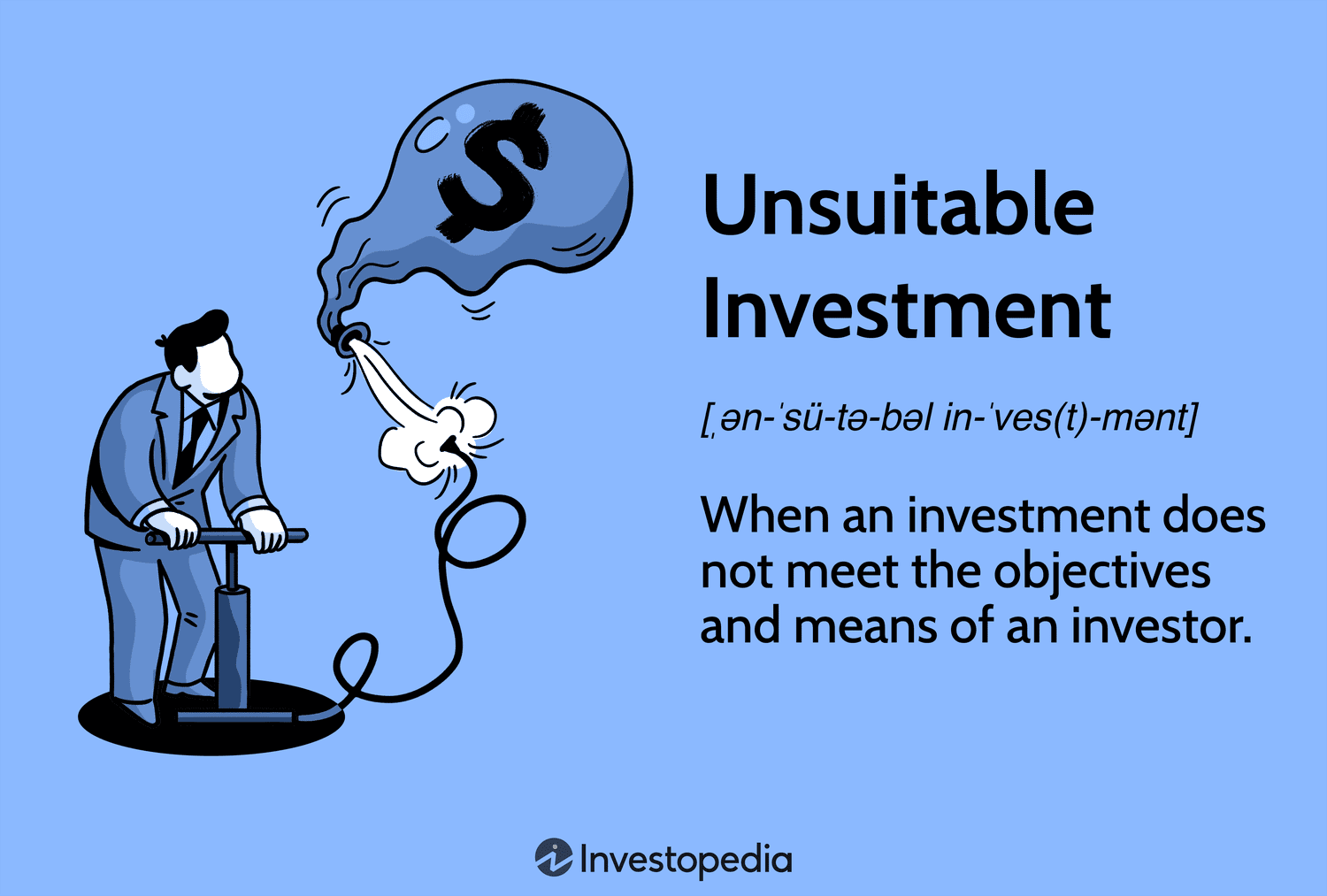
An unsuitable investment is when an investment—such as a stock or bond—does not meet the objectives and means of an investor. The investment strategy may also be unsuitable. For example, the portfolio asset mix could be wrong, or the investments purchased may be too aggressive or too low-risk for what the client needs or wants.
In most parts of the world, financial professionals have a duty to take steps that ensure an investment is suitable for a client. In the United States, these rules are enforced by the Financial Industry Regulatory Authority (FINRA). Suitability is not the same as a fiduciary responsibility.
Key Takeaways
- Unsuitable investments fail to meet an investor’s specific goals and financial needs.
- Financial professionals must generally recommend investments that align with a client’s objectives.
- Suitability is determined by various factors like age, income, and risk tolerance, and varies by investor.
- FINRA requires investment firms to gather relevant client information to ensure suitable investment offerings.
- Fiduciary duty differs from suitability; the latter does not always require the same level of client care.
How to Identify Unsuitable Investments
Unsuitable investments vary between market participants. No investment, other than outright scams, is inherently suitable or unsuitable. Suitability depends on the investor’s situation and will vary between investors based on their characteristics and goals.
In order to ensure that suitable investments are offered, FINRA rules require investment firms to seek information about a customer’s age, other investments, financial situation and needs, tax status, investment objectives, investment experience, investment time horizon, liquidity needs, and risk tolerance. Customers are not required to provide this information, so there is some flexibility if they do not. Having this information helps firms avoid offering unsuitable investments to customers.
For example, for an 85-year-old widow living on a fixed income, speculative investments such as options, futures, and penny stocks may be unsuitable because the widow has a low risk tolerance. She is using the capital in her investment accounts, along with the returns, to live. She and her investment advisor would likely be unwilling to put her capital at excessive risk, as there is minimal time left on her investment horizon to recoup losses should they occur.
On the other hand, a person in their twenties or thirties may be willing to take on more risk. They are still working and do not yet require their investments to live off. More risk could result in higher returns over the long run, and the longer investment horizon means they have time to recoup any short-term losses that may occur. Very low-risk investments may be unsuitable for this investor.
Age is not the only factor when determining which investments are unsuitable. Income, expected future income, financial knowledge, lifestyle, and personal preferences are a few of the other factors that must also be considered. For example, some people just prefer to play it safe, while others are risk-takers.
The sleep test is a simple concept that helps in this regard: if an investor can’t sleep because of their investments, something is wrong. Alter the risk level until comfortable. Risk is then combined and counterbalanced with the other factors to find suitable investments or to create the proper investment strategy.
Differentiating Suitability From Fiduciary Responsibility
Suitability and unsuitability are not the same as fiduciary responsibility. They are essentially different levels of client care, with fiduciary responsibility being the stricter protocol. A fee-based investment adviser has a fiduciary responsibility to find investments and investment strategies that are suitable for their client. A commission-based financial advisor or broker, maybe that you get on the phone with at your broker’s call center, typically doesn’t have a fiduciary responsibility to a client, but they will still seek out suitable investments.