

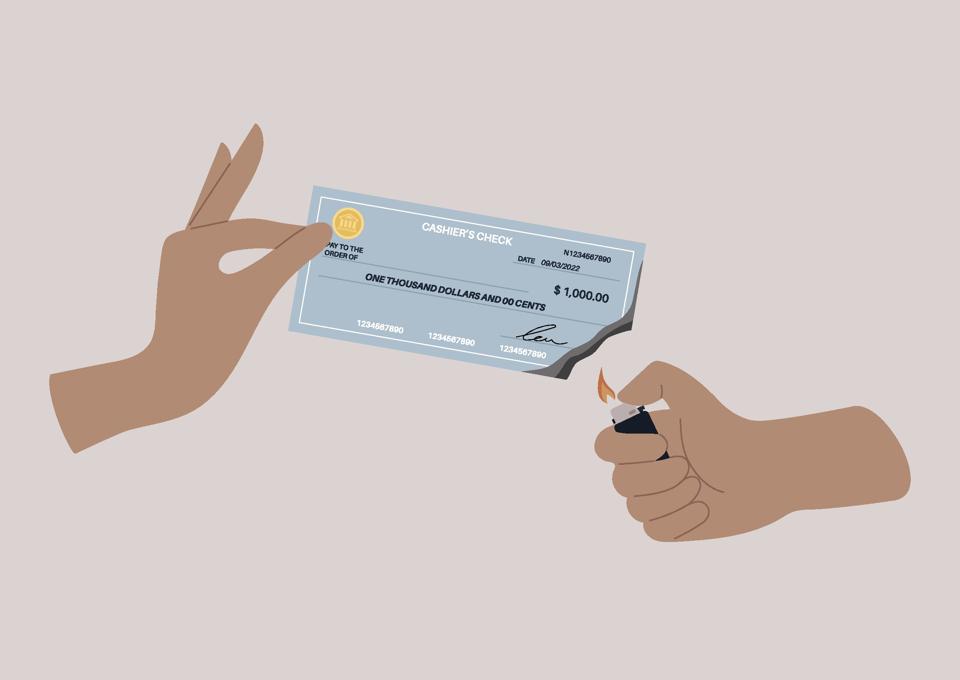
open banking replaces need for checks
getty
In 2023, Americans wrote 3.1 billion checks – more than the rest of the developed world combined. While we debate the future of digital currency and blockchain innovation, a quieter revolution is transforming our payment infrastructure one transaction at a time. The real story isn’t just about technology. It’s about unlocking the power of our financial data to determine who controls how money moves.
The shift became clear during a recent month of travel. At a nail salon in the U.S., the owner offered me a 10% discount for paying in cash and encouraged me to tip via app. Three weeks later in London, the same service required a bank transfer – no cash accepted, no cards processed, just account details exchanged securely and payment completed in seconds. Two identical services, two entirely different approaches, both pointing toward the same conclusion: the traditional payment ecosystem is evolving.
The American Payment Paradox
The United States presents a contradiction. We’ve built the world’s most sophisticated capital markets and exported fintech innovation globally, yet contractors working on my home repairs recently asked me to “just drop a check in the mail.”
This isn’t technological inability. It’s inertia reinforced by a legacy system that concentrates power in financial institutions, rather than in consumers. While Europe implemented open banking standards requiring banks to open their data APIs to authorized third parties, the United States is only beginning.
The contrast is striking. In the UK, Faster Payments processes over 5 billion transactions annually, mostly in seconds. Across Europe, SEPA Instant Payments enables real-time transfers across 36 countries. Meanwhile, American consumers still wait days for transactions to clear, and contractors wait by the mailbox.
The urgency extends beyond convenience. FinCEN reported a 201% increase in check fraud between 2018 and 2022, with criminals targeting mailboxes and reselling stolen checks online. In 2023 alone, banks flagged nearly 680,000 suspected cases of check fraud – a problem that doesn’t exist with properly implemented digital payment rails.
The Data Portability Effect
The real catalyst isn’t just new technology – it’s data portability. Open banking protocols shift control of financial information from institutions to consumers. When individuals can securely share their financial data with authorized third parties, it breaks the gatekeeping role of legacy institutions and frees us from outdated systems. The shift enables new, innovative payment methods for consumers.
For consumers, that means more choice and greater protection. For businesses, it becomes a competitive advantage. Contractors who cling to checks aren’t just inconveniencing customers; they’re also accepting a higher risk of fraud, slower cash flow, and manual overhead that digital alternatives eliminate.
Infrastructure and Regulation
The U.S. already has two real-time payment networks – FedNow and The Clearing House’s RTP. But unlike other regions, there are no requirements ensuring banks or credit unions actually use them. Nonbank fintech firms are also blocked from having direct access. The result is fragmentation: some institutions are connected, while others are not, leaving consumers confused about the availability of instant payments.
In August, the Treasury Department announced it would cease issuing paper checks for most federal payments, including benefits, tax refunds, and vendor disbursements. It is a clear signal that the government expects faster, safer, and more efficient payment methods.
The United States needs a comprehensive approach to payment modernization that prioritizes consumer data ownership and interoperability. This means finalizing an open banking rule that guarantees every American the right to access and share their financial data without prohibitive fees. It also means expanding direct access to Federal Reserve services by approving Tier 2 and Tier 3 chartered entities, creating a path for well-regulated non-bank firms, and prioritizing the widespread adoption of a real-time payment network.
The Road Ahead
We’re in the early stages of a payment revolution that will accelerate as data portability matures and consumer expectations rise. In a single month, I encountered three distinct payment worlds: a U.S. salon that incentivized cash and tips via an app, a London salon that insisted on bank transfers, and American contractors who were still clinging to checks. Each reflects the same underlying truth: payments are evolving, sometimes faster abroad than here at home.
With open banking and modern rails, consumers can prioritize speed, cost, or convenience. In doing so, we are not only modernizing payments but also rewriting the rules of trust and commerce.