
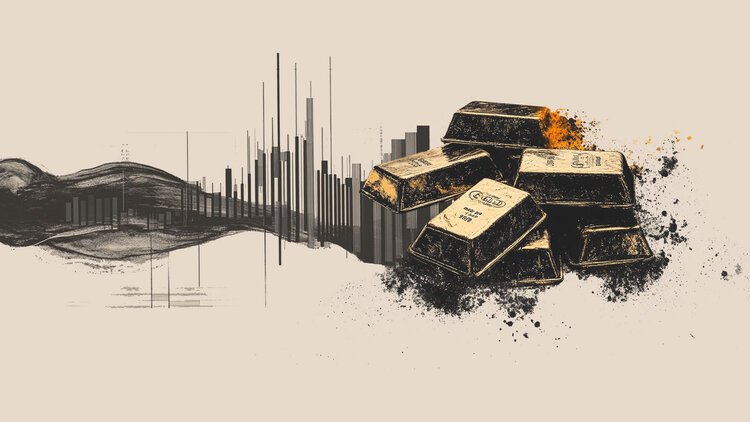
Gold has always been the first refuge when the ground under markets begins to split. Investors can spend months parsing central bank speeches and bond yield curves, but the real fractures often appear in the places policymakers can’t plaster over—supply chains, energy flows, and political choke points. That’s why gold is more than a hedge; it’s the anchor when the equity-bond fortress trembles, and it’s why the metal inevitably sits at the center whenever portfolios need protection from hidden fault lines.
The illusion of safety in a stock-and-bond mix breaks down in periods where growth stalls yet inflation refuses to yield( does that sound familiar?). In such moments, both assets bleed in tandem, leaving investors without cover. Gold has historically stepped into that vacuum. In the 1970s, when runaway fiscal spending collided with waning central bank credibility, gold wasn’t simply an asset class—it became a lifeboat above the flood of inflation. The instinct remains alive today: when trust in the monetary framework weakens, capital seeks the asset that sits outside the system.
Commodities more broadly play the role of shock absorbers when events overwhelm models and forecasts. When Russia turned off Europe’s gas in 2022, it wasn’t equities or bonds that saved portfolios; it was LNG tankers treated like sovereign bonds, vessels investors would chase at any cost. Commodities are finite, physical, and politically charged—real assets that don’t bend to narrative but to scarcity. Their function in portfolios is less about smooth returns and more about being the ballast when the economic sea grows violent.
The cycle of commodity geopolitics is almost mechanical. Governments first insulate themselves by reshoring production, stockpiling, and walling off supply chains. Once secure, they export surplus—often at premium prices. When markets soften, high-cost players exit, concentrating power in fewer hands. And inevitably, dominant suppliers use that leverage, tightening flows or attaching political strings, forcing importing nations back to the insulation phase. This cycle repeats with the rhythm of a drumbeat, leaving investors perpetually exposed to the next disruption.
Evidence is everywhere. By 2030, the U.S. could control more than a third of global LNG exports, already tying cargoes to trade negotiations. Europe, once dependent on Russian pipelines, now treats American LNG like oxygen. China’s grip on more than 90% of rare earth refining is another chokehold, ensuring that even technologies shaping the future—AI, EV batteries, renewable energy—are tethered to concentrated supply lines. These aren’t just commodities anymore; they’re tools of leverage in an era of economic statecraft.
But not every commodity offers the same defensive shield. Effective hedging requires a clear lens: does it feed into inflation directly, and is its supply chain fragile enough to break? Energy dominates both categories—it sits at the core of CPI and is the most politically manipulated lever. Industrial metals and rare earths weigh less directly on inflation baskets, but their extreme concentration means even indirect disruptions ripple across the global system. Their scarcity transforms them into multipliers of inflation rather than mere bystanders.
Gold, though, is timeless and unique. Unlike LNG, oil, or rare earths, it needs no pipelines or refineries, no geopolitical partnership to flow. It is self-contained, immune to tariffs and sanctions, and universally recognized as value. Gold doesn’t just protect against inflation; it protects against disbelief in the system itself. When every other compass spins wildly, it remains true north.
A portfolio without commodities is a fortress without a keep. The towers of equities and the walls of bonds may look imposing, but when siege engines arrive—inflationary shocks, energy disruptions, or political brinkmanship—they crumble quickly. What survives is the keep: gold as the eternal storehouse of value, LNG as the bloodstream of economies, and rare earths as the ammunition of the modern industrial race. The cracks in the system don’t announce themselves until they widen. When they do, it’s the commodity anchor—gold above all—that prevents the whole structure from giving way.