

The world cannot avoid dangerous climate change without moving to “near zero emissions” before the end of the century, according to the Intergovernmental Panel on Climate Change.
Zero-carbon sources of energy will be key to this transition and in the power sector they are already being added more quickly than fossil fuels.
So just how much energy does the world get from renewables? Carbon Brief has two charts to show where we are today, and how far we’ve come over the past half century.
Fossil free
Last week, Mark Carney, governor of the Bank of England, warned that fossil fuel assets could become unburnable, stranded assets that no longer have value — with broad implications for financial stability. His comments continue to divide opinion.
Yet if the world is to successfully avoid dangerous warming, fossil fuels must ultimately be either replaced by zero-carbon alternatives or used with carbon capture and storage.
Not everyone believes this to be a plausible future. In an article in the Telegraph on 1 October, Jeremy Warner wrote:
“Thirty years of extraordinarily costly research and development has resulted in a renewables industry that today accounts for a stunning wait for it 1 per cent of global energy supply.”
In the Sunday Times on 4 October, Rod Liddle wrote:
“Carney, with wind turbine nailed to his forehead, has decided he doesnt like hydrocarbons. Coal, gas and oil. He thinks we should probably leave one third of the worlds reserves of hydrocarbons right there where they are, in the ground. Leave it where it is and invest in what are euphemistically called renewables, which contribute 1% of the worlds energy needs. Right-ho, Mark thats the entire basis of the western economic system well and truly buggered, then.”
Renewable share
The two columnists are scathing of renewables, giving identical figures for the renewable share of world energy. Are they right? In short, no.
Last year, renewable sources of energy contributed 9.3% of the world’s energy needs, according to data from BP’s Statistical Review, reproduced in the chart below.
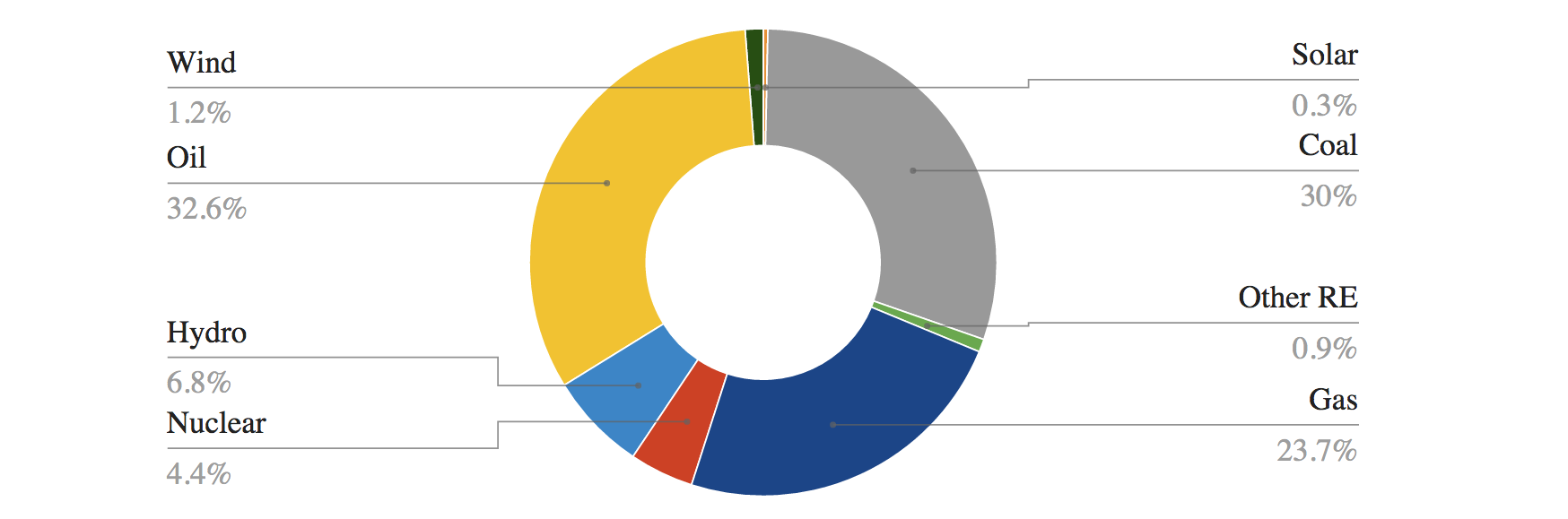
Shares of world demand met by different sources of energy in 2014. Other RE includes geothermal, biomass, biofuels wave and tidal energy. Source: BP Statistical Review of World Energy 2015. Chart by Carbon Brief.
As the chart above makes clear, much of the world’s renewable energy comes from hydroelectric dams, meeting 6.8% of global energy demand. That’s nearly enough to meet the combined needs of Germany, the UK and Japan — three of the world’s five largest economies.
Wind and solar also exceed the 1% mark set by Liddle and Warner, contributing a combined 1.6% of global energy in 2014 — enough to cover the UK’s needs. Other renewables, including things such as geothermal plants, biomass power, biofuels and so on account for another 0.9%.
It’s not unusual for commentators to mistakenly use the term “renewables” to mean only wind and solar. On this measure, Liddle and Warner’s claim is nearer to the true figure.
Looking beyond renewables, the world met 13.7% of its energy needs from zero-carbon sources in 2014. Solar and wind, in particular, are growing fast, with output more than doubling in the five years to 2014. A quarter century ago, wind and solar energy provided 0.1% of global needs.
The rapid rise of renewables has been somewhat overshadowed, though, by huge increases in global energy demand in recent decades (chart, below).
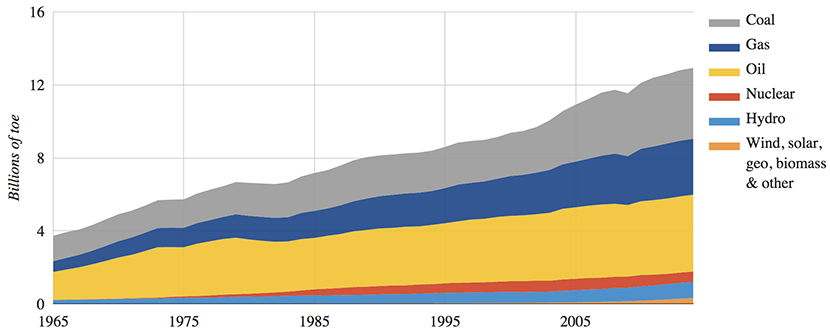
World energy use by source, 1965-2014. Source: BP Statistical Review of World Energy 2015. Chart by Carbon Brief.
These charts show how far zero carbon energy has come, and how far there is to go if the world is to avoid dangerous warming. Yes, the global energy mix is still overwhelmingly based on fossil fuels — but renewables are growing up fast.
Sharelines from this story
-
Factcheck: How much energy does the world get from renewables?
-
The world cannot avoid dangerous climate change without moving to “near zero emissions” before the end of the century, says IPCC