
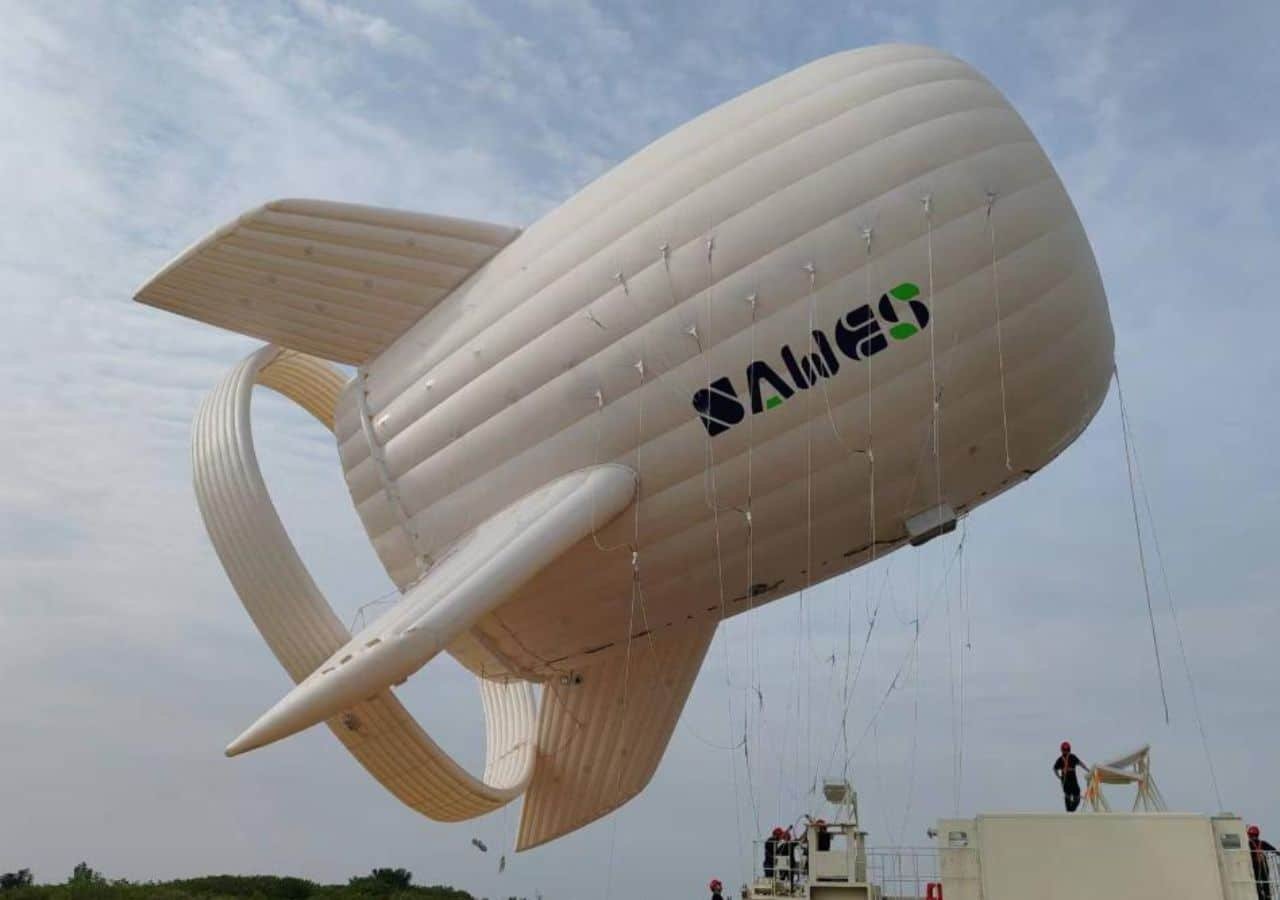

A Chinese energy company has completed a successful test of the world’s first megawatt-class airborne wind energy system, a major step toward alternative power generation technologies. The system, which resembles a large airship, reached an altitude of 2,000 meters (6,562 feet) during a trial in Yibin, Sichuan Province, and fed 385 kilowatt-hours of electricity into the grid.
The S2000 model is designed for high-altitude power generation in urban and remote environments. With the ability to harness wind energy from elevated airspace, the system uses a helium-filled aerostat to lift a lightweight generation unit. Electricity is transmitted to the ground through a tethered cable, allowing continuous power delivery.
Helium-lifted turbine uses air ducts to maximize wind capture
The airborne wind energy system is built with a ducted structure to optimize wind flow. This design, created by the hollow space between the main envelope and its surrounding ring-shaped wing, directs airflow toward 12 small wind turbines mounted on the duct.
Company CTO Weng Hanke explained that this setup helps capture more wind from all directions, improving energy efficiency by concentrating airflow through the turbines.
The S2000 measures 60 meters (197 feet) long, 40 meters (131 feet) wide, and 40 meters (131 feet) high, with a total volume of nearly 20,000 cubic meters (706,000 cubic feet).
It has a rated power capacity of 3 megawatts, according to the company. During the test, the system hovered stably after ascending for about 30 minutes.
Dual-purpose design targets remote and urban energy needs
Company officials say the system is suited for two main applications. One involves off-grid scenarios such as remote border posts, where traditional infrastructure may not exist.
The other focuses on supplementing ground-based wind farms to create a more layered energy supply model.
The research cited by Zhejiang-based Tide News explains that wind energy potential increases with the cube of wind speed, meaning high-altitude systems like the S2000 can generate multiple times more electricity than conventional turbines, while remaining clean and low-emission.
Scaling production to meet demand for airborne wind energy systems
The company has already started small-scale production of the S2000 and signed letters of intent with several coastal and high-altitude regions for future deployment. To support large-scale manufacturing and reduce reliance on imported components, a production base for high-performance envelope materials is under construction in Zhoushan, Zhejiang Province.
The plant is expected to produce 200,000 linear meters (656,168 linear feet) annually by 2026 and expand to 800,000 (2.62 million linear feet) by 2028. Company representatives say this effort aims to establish a fully domestic supply chain.
Lin Boqiang, director of the China Center for Energy Economics Research at Xiamen University, described the project as a significant advancement in renewable energy. He also noted that the system is still in an early phase, and its stability, safety and cost-effectiveness require further evaluation.