

This new study raises questions that go beyond sharks or even the open ocean. How much of animal movement across ecosystems is internally driven rather than externally imposed? Could variations in energy reserves explain why some individuals thrive while others fail, even in the same habitat? If internal state determines movement, then what does this mean for how we model species’ responses to climate change, habitat loss, or shifting prey populations? Could populations with greater physiological diversity be more resilient because some individuals are equipped to exploit changing conditions while others are not?
getty
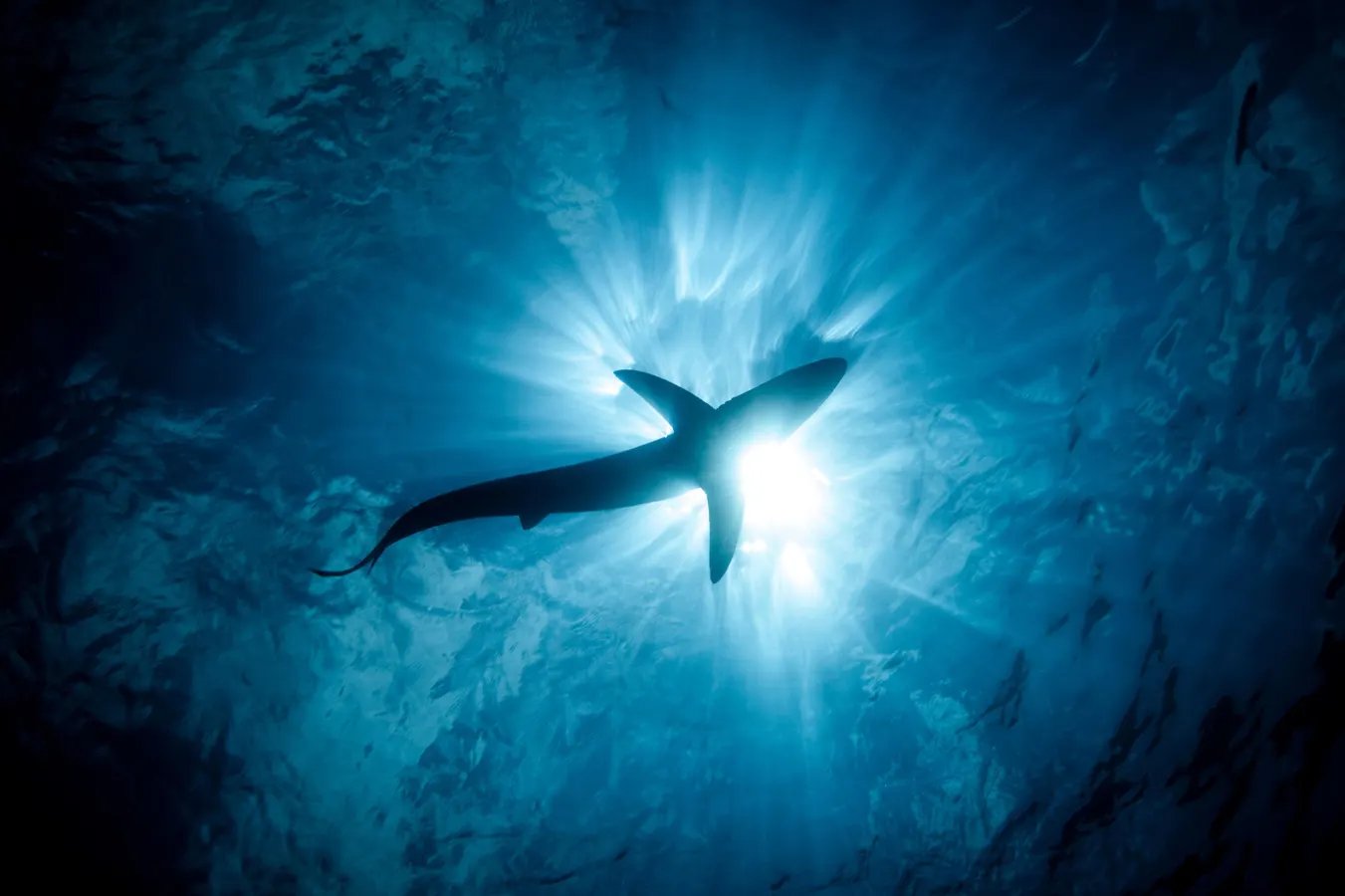
The open ocean is vast, dynamic, and unpredictable. For animals living there, movement is both a necessity and a challenge. Blue sharks (Prionace glauca), like other pelagic predators, must navigate the harsh reality of the open ocean: patchy environments, climate change, chasing prey while balancing the metabolic costs of sustained swimming. And while recent advances in satellite tagging have transformed our ability to observe these movements in real time, it has opened up far more quesitons that answered. One of the questions we have yet to answer is why do some sharks roam farther or more efficiently than others? And new research suggests the answer may lie not in size or strength… but energy stored within their bodies.
In a study tracking 13 male blue sharks off the coast of Rhode Island, researchers led by Founder and Chief Science Officer of Beneath the Waves Dr. Austin J. Gallagher paired satellite telemetry with physiological measurements to explore links between movement behavior and metabolic condition. Before release, each shark’s body condition was calculated using detailed morphometric measurements, and blood samples were analyzed for plasma triglycerides, a key indicator of lipid energy reserves. Sharks were then tracked for up to 82 days to monitor distance traveled, activity space, behavioral state, and movement tortuosity (i.e., how convoluted or “twisty” an animal’s path is as it moves through its environment). The results were clear: sharks with higher triglyceride levels and better overall body condition traveled farther, explored larger areas, and displayed more directed, transient behavior.
See, triglycerides serve as an accessible proxy for the energy available to sharks by reflecting lipid reserves in the liver. These reserves are crucial for supporting long-distance movement, as the liver provides both fuel and buoyancy, reducing the energetic cost of swimming. Body condition (a broader measure of overall health) similarly influences how freely a shark can explore the open ocean. So sharks that are “well-stocked” metabolically can move more, reach distant prey patches, and engage in behaviors that might be too costly for individuals with lower energy stores. These new findings resonate with movement ecology concepts established in other species, too. Migratory birds, for example, accumulate fat reserves before long flights to fuel endurance, and salmon physiology can predict migratory success and mortality. By integrating internal state metrics with high-resolution movement data, this new study provides one of the few direct links between physiology and oceanic predator behavior, suggesting that individual variation in energy reserves may explain why some sharks take longer exploratory trips while others remain near local feeding areas.
Individuals with higher triglycerides and better condition exhibited more “transient” behavior, moving more directly between areas, presumably to exploit distant resources. Sharks with lower energy reserves, in contrast, exhibited more tortuous or localized movements, likely reflecting a strategy constrained by limited metabolic capacity. But this raises questions about how physiological condition interacts with environmental variability: are energy-rich sharks more likely to take risks by venturing into unfamiliar waters? Could low-condition sharks be forced into local foraging strategies that expose them to predation or competition?
A shark with abundant lipid reserves can move boldly, explore distant patches, and take advantage of transient opportunities. A shark with lower energy stores may be forced into localized, cautious movement, constrained by its own physiological limits.
getty
Interestingly, though, body size was largely irrelevant in determining movement in this study. Bigger sharks didn’t necessarily travel farther or have more complex movement patterns, highlighting the importance of considering metabolic state and energetic flexibility rather than just morphology when predicting animal movements in the open ocean. Triglycerides and body condition together explained up to 79% of the variation in movement patterns among the tracked sharks; remarkable for a wild, free-ranging species, suggesting that physiological metrics could be a powerful tool in understanding the ecology of migratory predators.
But if physiological state drives movement in oceanic predators, the implications ripple far beyond the behavior of a single animal. Energy reserves, metabolic flexibility, and overall health don’t just determine where a shark swims—they can shape entire ecological dynamics. A shark with abundant energy can travel to distant feeding grounds, linking prey populations across vast areas, influencing predator-prey interactions in multiple ecosystems, and even affecting nutrient cycling through the redistribution of biomass. Conversely, individuals with limited energy may concentrate their activity in smaller areas, intensifying local predation pressure or competition. In this sense, the internal state of predators is a hidden but powerful driver of ecosystem structure, connectivity, and resilience. And from a conservation perspective, these insights are equally transformative. Think about it: if we can measure which individuals or populations have the physiological capacity for long-distance movements, we may be able to gain a predictive window into how species might respond to environmental change, habitat fragmentation, or human pressures like fishing. Could monitoring physiological traits become as important as tracking population numbers for conservation planning? Might we one day manage oceans not just by mapping where animals go, but by mapping their metabolic potential and capacity to move? Understanding the physiological underpinnings of movement transforms our view of marine predators from passive actors reacting to the environment to active participants whose internal condition determines the scale, timing, and consequences of their interactions with the ocean. It suggests a more nuanced and predictive approach to conservation, one that considers not just where animals go, but why they can go there, and how their health and energy shape the oceans they inhabit.
The internal world of an individual (their energy stores, metabolic flexibility, and overall physiological condition) shapes how they navigate, exploit, and survive in the unpredictable ocean just as much as any external factor like currents, prey distribution, or temperature. It reminds us that the choices an animal makes are not purely reactive to the environment because they are constrained and enabled by what’s happening inside its own body. Blue sharks illustrate this beautifully; their seemingly unpredictable movements, weaving across hundreds of kilometers, are actually guided by a hidden engine of stored energy and metabolic capacity. Thinking on a broader scale, the link between physiology and behavior thus challenges the way we define “adaptation” in wild animals. Are we overlooking the subtle ways that internal condition interacts with environmental opportunities to shape life histories, foraging strategies, and even migration patterns? And if an animal’s internal state can determine its fate, what does that imply for conservation strategies?
The ocean may appear chaotic from above… but the invisible forces within each animal say it is anything but.