
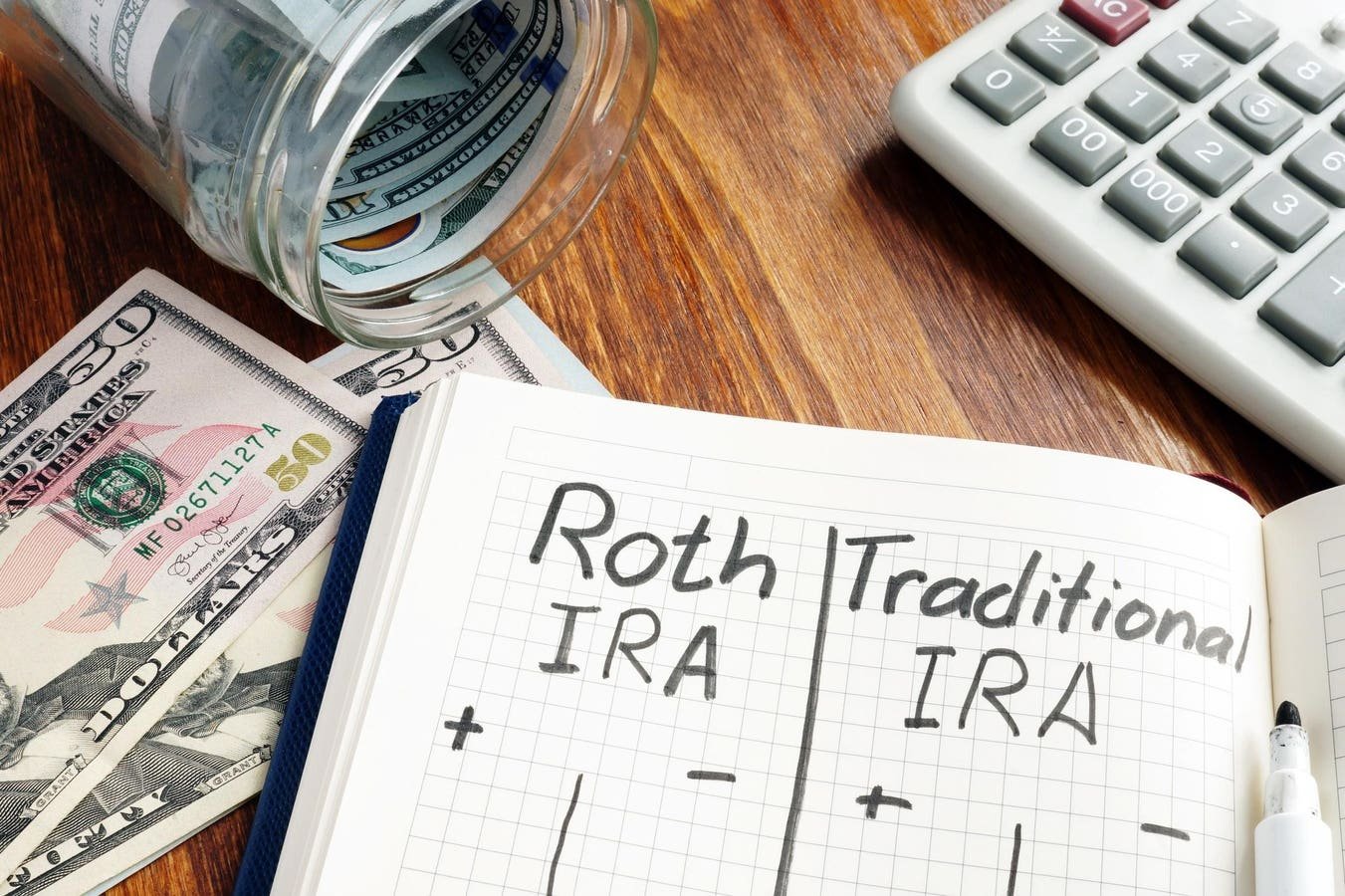
Roth IRA vs Traditional IRA written in the notepad.
getty
A common decision that many individuals face when contributing to their retirement accounts is whether to contribute using a traditional or Roth account. The SECURE 2.0 Act redefined saving for retirement by altering numerous aspects of retirement contributions like the mandatory withdrawal date and catch-up contribution limits. However, it also introduced a wrinkle that will now require some taxpayers to contribute on a Roth basis using their after-tax funds. This article discusses the differences between saving for retirement using traditional vs. Roth basis and how the SECURE 2.0 Act affects that decision.
Traditional Vs. Roth Retirement Contributions
Upon saving money for retirement, most Americans choose whether their contributions will be made via a traditional vs. Roth account. This seemingly simple choice may not appear consequential, but it can actually have a significant tax impact, according to Forbes.
Under the traditional retirement account, contributions are made on a pre-tax basis. This means that the money comes out of your earnings before taxes are taken. In turn, the taxpayer will pay taxes when the money is withdrawn, including on the retirement earnings.
Under the Roth retirement account, contributors fund their account on an after-tax basis. This means that taxpayers first pay taxes on their earnings, and then they contribute those after-tax earnings to their account. While it might seem implausible for a taxpayer to do a Roth retirement account due to the upfront tax burden, there is a silver lining to the Roth in that the contributors withdraw their money from the account without paying taxes.
To help illustrate the differences, consider a taxpayer in a marginal tax bracket of 22% who wishes to save $100 for retirement. Under the traditional retirement account, this taxpayer will contribute $100 and not pay any taxes on the contributions. Meanwhile, if the taxpayer were to make a Roth contribution, the taxpayer would first pay $22 in taxes on this income and only contribute $78 to retirement.
The benefit for a Roth ultimately lies in the fact that the distributions are made without paying taxes. Thus, if that $78 grows to $200, then those funds are withdrawn tax-free. Meanwhile, if the traditional contribution funds grow from $100 to $250, then it will depend on the taxpayer’s income tax rate upon retirement to determine whether they were better off saving for retirement using a traditional or Roth account.
According to Forbes, there are many reasons why a taxpayer would want to select a traditional vs. Roth retirement account, including the taxpayer’s income tax bracket (as shown above), upcoming tax law changes, how much income the taxpayer can put into retirement, and state tax laws.
SECURE 2.0 Act And Its Impact On Retirement Contributions
The SECURE 2.0 Act was signed into law on December 29, 2022. It includes many retirement-related provisions, including higher catch-up contributions, later ages for required minimum distributions, allowing employers to match contributions to Roth accounts, and automatic enrollments in retirement plans, among other provisions.
As it pertains to the catch-up contributions, starting January 1, 2025, individuals ages 60 and older can make an additional contribution to their retirement accounts of $11,250, according to Fidelity Viewpoints. However, a key piece of this legislation was the requirement that if the taxpayer is high-income (defined as earning more than $145,000), then any catch-up contributions made will need to be done so using the Roth basis (i.e., after-tax), rather than the traditional pre-tax basis.
The IRS has now released final regulations clarifying these rules, including setting the applicability date to contributions beginning after December 31, 2026. Thus, for the time being, retirement contributors do not need to tussle with any changes to their retirement contributions. Other changes under these final regulations include allowing SIMPLE plans to also get higher catch-up limits under certain conditions and correcting guidance related to how plan administrators aggregate wages from certain common law employers when determining whether the high-income Roth catch-up requirement is being met.
Starting in 2027, contributors later in their careers will need to consider their retirement contributions more carefully. While the taxpayers are still permitted to make their normal contributions using traditional or Roth basis (up to $23,500 in 2025), the additional $7,500 catch-up will now be restricted to just Roth basis if the taxpayer makes over $145,000. This means that a significantly higher number of taxpayers will be turning to the Roth retirement accounts.
As these taxpayers make higher amounts of money, they will be inherently less benefited by the Roth’s after-tax advantage, relative to taxpayers making lower amounts of money who can choose between traditional or Roth. These issues might potentially become compounded among contributors ages 60 to 63, who are able to contribute and even a larger amount for their catch-up.
While retirement contributions continue to be an important and complex topic, the SECURE 2.0 Act seemingly advances taxpayers’ goals by allowing for and enhancing the ability to save for retirement. Furthermore, the provision to require some savings among higher-income taxpayers aims to promote equity among taxpayers. The IRS’s recent update clarifies these rules, setting the stage for 2027 when high-income contributors will be forced to make some of their contributions on a Roth basis using after-tax earnings.