
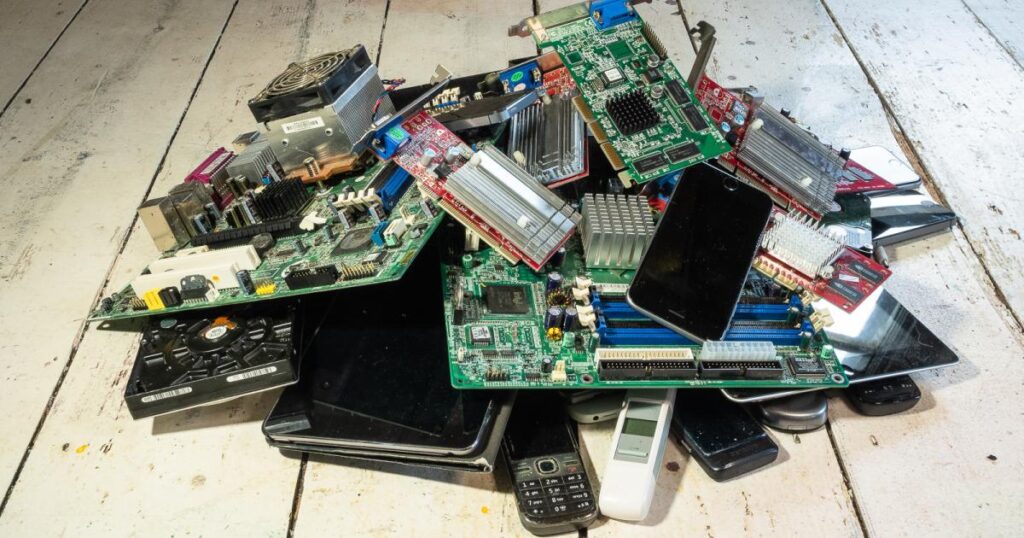
But while it might be hard to see much monetary value in an old Nokia 3310, for the Scottish university researchers involved in a pioneering project, they are a glittering prize.
In their hands, our old tech has potential to be reborn as beautiful new jewellery box treasures and trinkets, and may even help boost dying crafts thousands of miles away.
Gold jewellery for sale in Varanasi (Image: Adwait Bhale)
Currently only around 15% of precious metals from e-waste in the UK is recycled, with concerns growing over pressure on natural resources and warnings that the clock is ticking before they run out.
The typical process to extract the metals they contain however, is time-consuming and costly, often involving the waste being exported abroad to smelters and then shipped back or, worse, being dumped in landfill.
To combat the problem, academics at the University of Dundee and the University of Edinburgh looked at new ways of using chemicals to tease out the precious gold, silver and other metals lurking inside gadgets in a way that’s cleaner and less dangerous.
They then examined how their alcohol-based hydrometallurgy process might work in community settings, and how the extracted metals could be put to fresh use to make jewellery.
A key challenge for the jewellery industry is the provenance of metals and being able to track and trace their source and the journey they have taken.
Their two-year partnership also focused on how their methods could work in India, the world’s fifth largest e-waste generator.
Researchers at University of Edinburgh have looked at how to use chemicals to extract gold from e-waste (Image: Sandra Wilson)
Despite producing more than 2 million tonnes of e-waste a year and taking in more from other countries, only 1.5% of precious metals from its e-waste is recycled. With much of it ending up in landfill, India’s e-waste dumps attract child scavengers and pose serious health challenges.
With Indian culture prizing high quality gold jewellery for dowries and traditional craft and jewellery-making techniques identified as ‘at risk’, it was hoped the new extraction process might solve a raft of problems.
Closer to home, meanwhile, using an alcohol-based hydrometallurgy method – less dangerous than other acid alternatives – offers a fresh approach to dealing with our own household tech waste, and the possibility of an end to the cluttered kitchen drawer stuffed with old phones.
Read more by Sandra Dick:
The results of the team’s two-year international project have just been presented in a new publication, Brick, Bread and Biscuit, which explores the journey of accessing gold from e-waste, the chemistry to recover its precious metals and how it can be given new life by jewellers.
It concludes that far from being kitchen drawer junk, pressure on natural resources and demand for more traceable and sustainable metals means our old phones and gadgets have potential to spark a new ‘urban gold rush’.
“The next gold rush is not in the hills of California, it’ll be at landfill sites,” predicts Professor Emerita Sandra Wilson, of the University of Dundee’s Duncan of Jordanstone College of Art & Design, who has created artworks in silver and gold using recycled e-waste metals.
(Image: Julie Joyce)
“In the UK we generate something like 6 million tonnes of electronic waste a year – a huge quantity. But only around 12% to 15% of the precious materials it contains are being recovered.
“The rest is sitting in someone’s kitchen drawer or ends up in landfill sites.
“Yet the average mobile phone contains over 40 different metals, including copper, gold and palladium.
“The European Chemicals Society has said if we continue to mine precious metals such as copper and silver at the current rate, they’re likely to run out in the next 100 years.
“It’s quite a scary thought and it’s crucial to get it back into circulation.”
Computer circuit board fingers before and after metal leaching (Image: Sandra Wilson)
It is estimated that around 190,000 tonnes of the world’s gold resources have been mined, with 50% of that extracted in the last 50 years.
Although estimates vary as to just how much is left underground, it’s been suggested that there may be just 54,000 tonnes left.
Although making good use of what is already in circulation is becoming increasingly important, according to a House of Commons environmental audit committee report, approximately 40% of the UK’s e-waste is illegally exported to be disposed of in other countries.
That leads to e-waste dumps and fuels scavenging in developing countries.
Read more by Sandra Dick
Finding new ways to easily extract precious metals would be particularly useful for the jewellery sector which accounts for around 52% of the global use of precious metals and is under pressure from consumers to show that it is adopting sustainable and non-exploitative methods to source materials.
Around 80% of precious metal used in jewellery has already been recycled from other sources such as old jewellery, while it’s also been claimed that most gold jewellery made in the UK post-1983 has direct links to the £26 million Brink’s-Mat robbery.
Professor Sandra Wilson of Emerita Sandra Wilson, of the University of Dundee’s Duncan of Jordanstone College of Art & Design (Image: Sandra Wilson)
The research project, funded by the Engineering and Physical Sciences Research Council, involved the Edinburgh and Dundee collaborators visiting jewellery makers in Varanasi and Ahmedabad in India.
They gauged how their extraction methods might support a new and more direct e-waste recycling system, in turn helping rural and mainly female jewellers avoid traditional and exploitative precious metal suppliers.
They also explored how new chemical recycling methods could create metal solutions, powders, and foils which could be supplied to designers and makers.
One element looked at how to make precious materials go further, by mixing gold powder with pomegranate seeds to create a pink coloured gold enamelling material, used in a traditional technique known as meenakari.
According to Professor Wilson, e-waste is not only an urban problem. As part of the project, she visited an artists’ residency in rural Ireland and called for locals to hand in old gadgets.
Among a haul of dozens of old phones, tablets, circuit boards, remote controls and cables retrieved from drawers and cupboards, was a coil of gold from an old computer donated by a recycling company.
Hand raised silver bowl with concentrated solution of gold chloride, made using recycled e-waste (Image: Diarmid Weir)
It was melted and, working with the Edinburgh University team, turned it into 2.3g of pure gold powder.
Throughout the course of the project, the chemical method to extract e-waste metals evolved, with the scientists moving from acid-based techniques to more environmentally benign alcohol and exploring jewellers’ techniques.
Professor Jason Love, Personal Chair of Molecular Inorganic Chemistry and Head of the School of Chemistry, University of Edinburgh, said: “This project showed how chemists, metallurgists, makers, and designers can learn from each other and deliver new insight into this important challenge.”
Read more by Sandra Dick:
For the rest of us, however, the individual value of each piece of old tech is not likely to be life-changing: it takes 41 mobile phones to obtain around 1g of gold, with older models – like the old-fashioned Nokia – said to contain larger quantities of precious metals than slimline new versions.
With the average wedding ring containing between 2-3g of gold, more than 120 phones would be needed to retrieve enough for a single band.
But, adds Professor Wilson, some see the value of gathering old tech to make new glittering prizes.
“Young people often meet their partner online, and their devices are a big part of their relationship.
“We have seen a couple of examples of young couples who have asked family members to donate e-waste items so they could get the gold for their wedding rings.”
The project is now hoping to develop an app which would enable jewellers and makers to have direct links to e-waste that can be recycled into raw materials.
Framed artwork made by Prof. Sandra Wilson using recycled sterling silver and 24 carat gold , (Image: Diarmid Weir)
While extracting old and unwanted gadgets from the nation’s kitchen drawers is another issue to be addressed: “One colleague has an idea of a mobile van that would tour Scotland, and people can return their waste to the van and see a little bit of the process that’s involved,” adds Professor Wilson.
“It would at least help people understand the process.
“Our precious metals are running out,” she stresses.
“The amount of gold we can mine is finite, we don’t have an ongoing amount, which means it’s vitally important that we recover as much as we can.”
“We hope more jewellery designers will take up metals from old technology as a way of protecting this precious resource and to encourage more people to recycle their electronic waste.
“Most people have one or two old phones sitting about in drawers, or maybe even an old laptop.
“We could be sitting on the next gold rush here – an urban gold rush.”