Venture investors bet unprecedentedly big on generative AI | Technology
11 Mins Read
The venture-capital industry has seen plenty of hype-driven investment cycles before, but the generative artificial intelligence craze might top them all.
Rarely, if ever, have so few startups raised so much money — and garnered such enormous valuations — in so little time. And with the companies burning through billions of dollars, this could just be the start.
Even longtime venture watchers say they’re astounded by what they’re seeing.
“We’ve seen momentum [investing] before, where all of a sudden a sector gets hot,” said Rob Siegel, a lecturer in management at Stanford Graduate School of Business. But, he said, “we’ve never kind of seen anything like this before.”
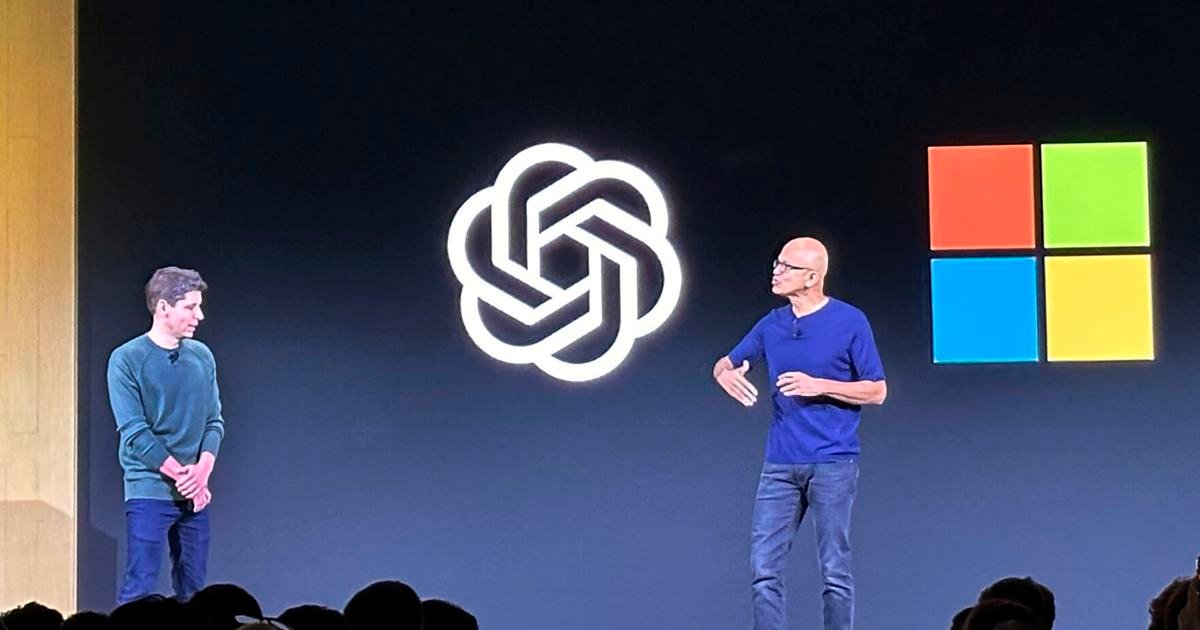
OpenAI and CEO Sam Altman, left, received a massive $10 billion investment from Microsoft and CEO Satya Nadella in January 2023.
Barbara Ortutay/Associated Press, File
Generative AI is the flavor of the technology mimicking human speech or human-created text, images or software code. OpenAI’s ChatGPT is the most prominent generative AI application, but many more have become available since it launched. Google’s new NotebookLM Audio Overview, for instance, can create a podcast with AI voices from a page of notes or a presentation.
San Francisco-based OpenAI kicked off the generative AI boom in late 2022 when it launched ChatGPT. The breakthrough capabilities of that chatbot, which allowed it to interact and respond to a much wider range of queries in a much more sophisticated way, quickly attracted attention. Within two months of its launch, it had attracted 100 million users, making it the fastest-growing consumer application in history.
Rapid adoption, along with the technology’s capabilities and promise, lured in investors. Microsoft committed a whopping $10 billion — the second-biggest venture-funding round in history — to OpenAI in January 2023. And that was just the start.
From the beginning of 2023 until Oct. 18, venture outfits invested $48 billion into U.S.-based generative AI startups, according to PitchBook, an industry-research firm. That’s nearly one in every six venture dollars invested over that time period.
Much of that went to three local companies in particular: OpenAI; Anthropic, which is also based in The City; and Elon Musk’s xAI, which is based in Burlingame but recently opened a San Francisco office.
From the start of last year until the beginning of this month, those three companies had raised a combined $31 billion in venture capital. That’s one in 10 dollars invested in all startups across the U.S. during that time period — and that tally doesn’t include the $4 billion line of credit OpenAI secured earlier this month.
“The current level of investment in private companies is unprecedented,” said Brendan Burke, a senior analyst at PitchBook who focuses on AI startups.
And more investment is likely on the way. All three of those companies are working on so-called foundational models. Those are general-purpose AI models with the potential to be used across a wide range of fields.
FILE – The OpenAI logo appears on a mobile phone in front of a computer screen with random binary data, March 9, 2023, in Boston.
Michael Dwyer/Associated Press, File
It’s not alone in the red ink. Anthropic expects to burn $2.7 billion in cash this year, according to The Information. To sustain those kinds of losses, the companies will almost certainly have to raise more money. Indeed, The Information reported Anthropic was in the market for more cash, even though it has raised about $7 billion over the last year.
All told, the money startups, tech giants and other businesses are expected to spend in the next few years — to buy AI chips from companies such as Nvidia, build out data centers with computers using those chips, pay for new electrical infrastructure to power the data centers, and train AI models and other applications in those centers — will be in the neighborhood of $1 trillion, Goldman Sachs estimated recently.
That magnitude of investment is comparable only to things such as the building of the continental railroad networks in the late 1800s, the electrical and telephone grids in the 1900s, and the internet in the late 1990s and early 2000s, analysts said.
“Certainly, we’re looking at something that’s very rare,” said Robert Hendershott, an associate professor of finance at Santa Clara University’s Leavey School of Business. “If it’s not unique, it’s very rare.”
Despite their large losses, the recent investments in the big three generative AI companies have sent their valuations soaring. As part of its funding round this month, OpenAI’s investors pegged its worth at $157 billion, making it the third most-valuable startup around the globe after TikTok owner ByteDance and Musk’s SpaceX. That was up from $29 billion in April of last year.
The recent funding round by xAI valued it at $24 billion, making it the 12th-most valuable startup worldwide. Anthropic’s investors valued it at $19 billion in January, but it’s seeking a valuation of as much as $40 billion as part of a prospective funding round, according to The Information.
OpenAI subleased the buildings at 1455-1515 3rd St. in Mission Bay, pictured above, from Uber in October 2023.
Craig Lee/The Examiner
San Francisco has benefited from the AI boom. Office vacancies remain at record highs in The City in the wake of the COVID-19 pandemic, the widespread embrace of remote work by local companies and the departure of a few high-profile businesses. But the AI sector in general — and the generative AI companies in particular — have been among the few bright spots for the real-estate market, gobbling up space.
OpenAI took over space from Uber in Mission Bay last year and has recently expanded there, while xAI recently moved into OpenAI’s former space in the Mission. Anthropic signed a big lease in SoMa last year.
Dozens demonstrated in front of Uber’s headquarters, saying that drivers frequently cancel rides, particularly for people with guide dogs
After nearly 40 years in the Pacific Heights Residents Association, Lynne Newhouse Segal sees plenty of work left to do
Wayne’s resignation comes days after the mayor said she had “no confidence” in the district school-closures process and his ability to execute it
The AI sector hasn’t yet sparked a new boom for San Francisco, said Ted Egan, The City’s chief economist. But given what’s already happening in terms of the investment in such companies that are based here and the fact that the Bay Area has been ground zero for nearly all of the tech booms of the last half century or more, he said it wouldn’t be surprising if it did.
“It looks like AI is the start of one of those cycles,” Egan said, calling it “good news for the long haul.”
But there are definitely big risks that are coming with all that investment — for venture investors, the tech industry, San Francisco and the wider economy.
The venture-capital industry model assumes that many investments will fail. Firms bank on having one investment in every 10 pay off in a big way — 10 or more times what they put into it — to make up for the losses on their other investments.
But given how much money is at risk with the generative-AI companies — and with AI in general — it’s really hard to see how those investments will pay off, skeptics say. For OpenAI to pay off for its latest investors — at least on a venture scale — it probably needs to see its value hit $1 trillion, Siegel said.
“It’s unclear how the math plays out that you get these enormous returns that you look for in venture,” Siegel said.
A person stands in front of a Meta sign outside of the company’s headquarters in Menlo Park, March 7, 2023.
Jeff Chiu/Associated Press, File
Part of the difficulty the generative AI startups face is that there’s intense competition — and not just from each other or other startups. Tech behemoths Meta, Google and Microsoft are all investing heavily in developing their own generative AI systems, as are Apple and Salesforce.
The challenge of going toe to toe with such giants has already forced some promising startups, including Inflection AI, out of the market. The danger for the companies is that even if they are able to stay in business, they might never be able to charge the kind of prices for their products that will generate the kind of return on investment they need to show investors. That could happen if there remain multiple competitors in the market and none of their models is clearly superior to the others, as a pair of Goldman Sachs analysts noted in a recent interview.
There’s also the danger that costs continue to rise for developing new models, making it even harder for the generative-AI companies to build sustainable business models.
Many in the industry expect costs will come down dramatically, as they often do in technology, Jim Covello, the head of equity research at Goldman Sachs said in an interview in a recent newsletter from the company. But that’s not a certainty.
And Nvidia’s continued dominance of the AI chip market, its ability to charge premium prices for those chips, and the creation of ever-larger models that rely on ever more AI chips suggest costs may not come down anytime soon, Covello said.
That might make AI technologies too expensive to use, even if they prove faster or better at tasks than humans — and that itself isn’t clear.
“The question of whether AI technology will ever deliver on the promise many people are excited about today is certainly debatable,” Covello said in the interview. “The less-debatable point is that AI technology is exceptionally expensive, and to justify those costs, the technology must be able to solve complex problems, which it isn’t designed to do.”
Even if AI does reach its potential, it’s almost a certainty that a lot of money is going to be wasted along the way.
“There’s a 99% chance that you get overinvestment,” Hendershott said.
Early morning moonset over the San Francisco skyline pictured from Alameda on Thursday, Oct. 17, 2024.
Craig Lee/The Examiner
And if boom turns to bust, that could have big implications for the local, if not national, economy. It took years for the Bay Area to recover from the dot-com bust of the early 2000s, for example, as well as to rebound from the Great Recession. San Francisco is still contending with the aftereffects of the stock-market plunge that started in late 2021, helping spark a downturn in venture-capital investment the following year and led to thousands of local layoffs.
Despite such risks and the scale of the generative-AI bet, some venture experts cite reasons to be bullish. Siegel said he consults with companies around the world, and every company he’s meeting with is talking about and using AI.
It’s still very early days with the technology, Siegel said, and we won’t know for a while how the bets play out.
But, he said, “this one feels much more real than a lot of the other stuff that we’ve hyped up over the last 10, 15 years.”
Sean Foote, a venture capitalist and a professional faculty member at UC Berkeley’s Haas School of Business, said he understands the skepticism about the investment in generative AI and the concern about the large losses. He said he, too, thinks that the scale of the investment would traditionally make it a bad bet for venture capital.
But he said he also understands AI investors’ optimism. OpenAI’s sales are growing rapidly, for example. The company’s sales in August were more than three times higher than the same month a year earlier, The New York Times reported. It expects to post $3.7 billion in revenue this year and $11.6 billion next year.
If it continues to grow at that rate, it could easily grow into its valuation, Foote said. But how the sector and the investment into it plays out overall is anyone’s guess, he said.
“I don’t think anybody is being an idiot here,” Foote said. “They are making a rational bet, but there’s a number of things that could happen that will either make that [bet] amazing or make it seem foolish.”
If you have a tip about tech, startups or the venture industry, contact Troy Wolverton at twolverton@sfexaminer.com or via text or Signal at 415.515.5594.