

Feeding Families Today and Uniting Them to a Healthier Tomorrow
U.S. Hunger
When most people think about hunger in America, they picture food drives, canned goods, and charity. The story is usually told in terms of scarcity and shame – who does not have enough, and how others can give.
U.S. Hunger is trying to tell a different story.
The nonprofit has spent the past few years using data, household-level stories, and technology to surface a quieter reality – working, insured families who look stable on paper but are still struggling with food insecurity, often for complex reasons that go far beyond a lack of food. That work has led them to ask harder questions about root causes, coordination, and what real dignity looks like.
At the center of this shift is Rick Whitted, President and CEO of U.S. Hunger. His aim is to move away from an unspoken ‘I feel sorry for you’ view of poverty toward a narrative of resilience – one that recognizes families as everyday heroes doing everything they can to make life work, even when the system around them is not.
A worsening problem in unexpected places
Around 2020, U.S. Hunger began looking at its data in a more systematic way. It was a period of record government spending and emergency relief, but the numbers told a more unsettling story.
Instead of demand easing, the organization saw more people from what Whitted calls the ‘working insured class’ turning to U.S. Hunger for help – people with jobs and insurance who still could not keep up with the cost of living.
He explains, “The trend line we see is that working insured class continuing to need help more and more, a bleeding up of insecurities into the working middle class. I would characterize that as seeing the trend go in the wrong direction.”
These were families who, on paper, looked fine – but in reality were one rent increase, medical bill, or car repair away from a crisis. “There is an invisible group that on paper looks fine and works every day,” Whitted says. “For them, dignity is just as important as the need itself, and having a need is less scary than being labeled needy.”
Those are the people U.S. Hunger wants the rest of the system to see.
Rick Whitted, President and CEO of U.S. Hunger
U.S. Hunger
Beyond data that stops at the front yard
One of the clearest insights from U.S. Hunger’s work is that hunger almost never shows up alone. In practice, when someone says they need food, it usually means several parts of their life are under pressure at the same time.
Looking at its Full Cart program data, Whitted notes, “More than ninety two percent of the time someone comes to U.S. Hunger, it is not about one thing. It is two to five needs – food, housing, transportation, access to health care, economic stability. It is never just one thing.”
Despite that, most of the data used in policy and program design still looks at life from the curb, not from inside the home.
“We are typically looking at what I call data that stops at the front yard and does not go in the house,” Whitted explains. “Census data tells you about jobs in an area and whether there is access to things like grocery stores, pharmacies, hospitals, or schools.”
He warns that “our view today tends to summarize that as the lived experience.” In other words, the system often sees the neighborhood statistics but not the daily trade-offs families make around the kitchen table.
He often reaches back to his own childhood to illustrate the gap. “I did not grow up with a lot of means. I did not grow up hungry either. I lived here, my aunts lived next to me, my grandma lived right here, and there was a village, so everybody always ate. Until you were about ten in school, you did not know you were poor. You just did not know.”
No spreadsheet can capture that kind of community safety net. For Whitted, this is “where we miss the hero story of vulnerable populations” when we rely only on outside, aggregate data.
From packing meals to unpacking root causes
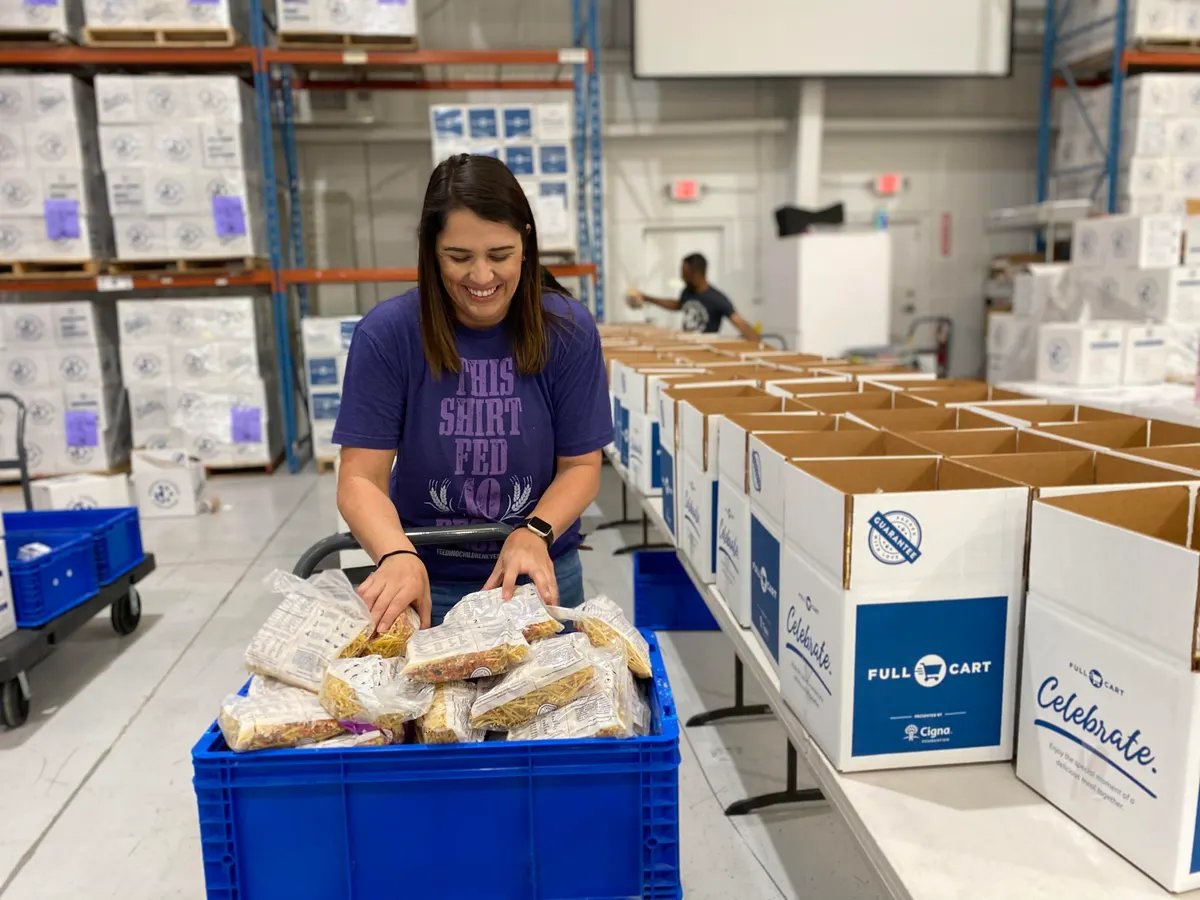
For many, U.S. Hunger is synonymous with volunteer events and high-energy meal-packing lines. “We pack millions of meals every year through the community,” Whitted says. “Since 2010, over a million volunteers have packed more than two hundred million meals.”
Those events meet immediate needs, but they also raised a question: if millions of meals have been packed, why is hunger still so persistent?
Through Full Cart, which ships food boxes directly to households and captures short narratives from applicants, the team began uncovering deeper patterns. “Our Full Cart program is beginning to, through story, unpack why we are packing food, and why we have had to pack food this long and it has not solved the problem,” Whitted explains. “The concept is to unpack the root causes driving the need for us to distribute food in the first place.”
That insight led to Voices Unpacked, a storytelling and data platform that brings those root causes into the light and places lived experience at the center of how solutions are designed. “Front and center in this discussion has to be the voice of the person you want to help,” Whitted insists. “Voices Unpacked highlights our methodology for giving people a platform to instruct us on what that help needs to be.”
In other words, U.S. Hunger does not just want to talk about people. It wants to listen to them – and let their voices shape the response.
U.S. Hunger volunteer packing line
Mackenzie Hudson
Interoperability and rebuilding the village
As U.S. Hunger has leaned further into data and technology, Whitted’s view of impact has evolved. “The data and the technology itself is an impact,” he reflects. “The greatest impact U.S. Hunger can make is figuring out how to scale that voice and put it at the solutioning table, because it is not there today.”
The goal is to make sure the stories they collect do not stay locked inside one organization but can inform decisions across the wider system.
One example is healthcare. When Full Cart data showed that most people asking for help were insured, Whitted saw a blind spot he could help address. “When we saw that eighty percent of the folks coming to us have insurance, I am going to talk to the insurance companies,” he says. “Their members are reaching out to us for help, and most of the time the insurance company does not know it.”
U.S. Hunger often sees early warning signs – financial and social strain – long before those same individuals show up as medical problems. “These are individuals that do not know there is a problem with until they show up in the ER multiple times and they realize, wait a minute, we’re using the emergency room for primary care,” Whitted explains.
The goal is not to suggest hunger alone causes health emergencies, but to reveal how pressures like missed work, transport issues, or skipped meals compound into larger crises. By sharing those insights, U.S. Hunger helps healthcare partners respond earlier and more holistically.
“We engage to say to healthcare, they trust us, help us help them, and we can help you understand what is creating that need,” Whitted says. The idea is to act as a bridge – turning the trust families place in U.S. Hunger into early insight that can trigger better, coordinated support.
For him, this is ultimately about rebuilding something that has been lost. “My grandma was right here, my aunt was right here. You could not get in trouble because everybody told on you and everybody disciplined you,” he recalls. “We have lost that village in many ways.”
Interoperability, in his mind, is one way to rebuild that village – not with relatives on the same street, but with institutions that share responsibility for making sure no one faces those pressures alone.
Hunger may be what brings people to U.S. Hunger. The deeper work, in Whitted’s view, is making sure those voices are heard – and using data, storytelling, and interoperability to help build a modern village of partners around every family they serve.