
Unlock the Editor’s Digest for free
Roula Khalaf, Editor of the FT, selects her favourite stories in this weekly newsletter.
A fusion energy company backed by Google and Chevron is establishing a joint venture with the UK government’s atomic laboratory as it aims to commercialise elements of its technology for medical and industrial uses within two years.
US-based TAE Technologies, one of the world’s oldest private fusion ventures, has struck a deal with the UK Atomic Energy Authority, which will contribute £5.6mn in equity to the new venture, based in Oxfordshire.
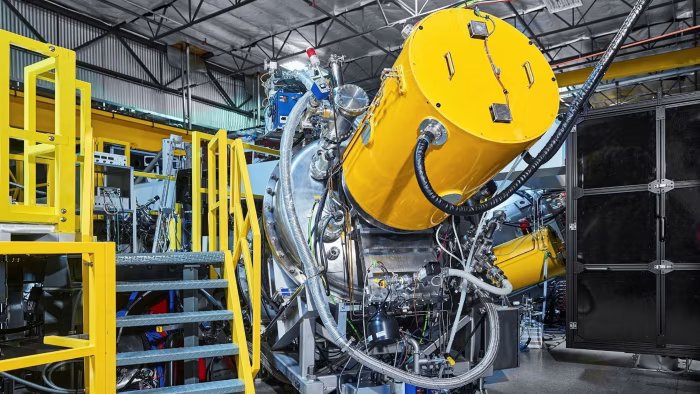
While scientists say that reliable fusion power remains decades away, the neutral-beam technology it uses to keep superheated hydrogen fuel hot inside fusion devices has promising secondary applications such as cancer treatment.
The Oxfordshire venture aims to deliver its first short-pulse neutral-beam product for potential clinical and industrial settings within two years, TAE said on Tuesday.

Michl Binderbauer, TAE chief executive, said it was vital for the company, founded in 1998, to tap into markets that generated revenues as it and others worked to commercialise fusion power.
While the market for fusion energy is potentially enormous, fusion power plants are still not commercially viable.
Binderbauer said the technology encompassed “all the things that make financing harder”, whether it was the high cost of development or the lengthy timescales. As such it was “critical” to find ways to “offset that or to create intermediate milestones that are tractable”, he told the Financial Times.
TAE has secured $1.3bn from backers as it aims to produce electricity from fusion in a pre-commercial phase by the early 2030s.
“These things are harder than you think. And they take more time,” Binderbauer said.
While the fission reactors that drive nuclear power stations generate energy by splitting atoms, fusion does this by forcing nuclei to combine.
The neutral-beam acts like a precision gun to fire high-speed neutral atoms that deliver energy to the hydrogen fuel. The fuel must be heated to temperatures of more than 100mn Celsius so the nuclei move fast enough to fuse.
Because no material can withstand such temperatures, fusion reactors use strong magnetic fields to keep the fuel away from the vessel walls. The high-energy beam can pass through the magnetic field without deflection.
Physicists achieved fusion in the 1930s, but to date, no fusion experiment has produced more energy than it consumes.
Fusion companies raised a total of $2.64bn in the 12 months ending July, according to the Fusion Industry Association, a non-profit comprised of private fusion companies.
Much of the funding has come from companies seeking long-term decarbonised power supply to fuel energy-hungry artificial intelligence. Google is in a race with OpenAI and others to develop more advanced AI, while Chevron also sees opportunities in powering data centres.
The technology behind the neutral-beam can also be targeted to kill tumours, and is already being used in some countries.
The UK Atomic Energy Authority said the TAE partnership “fits very fair and square into UK fusion strategy”, which is to build up a fusion supply chain in the country.