

Would you live in an abandoned police station, a deserted hospital or a disused office building? What if it saved you hundreds of pounds a month?
You may not have heard of property guardianship but it’s a route a growing number of Britons, faced with exorbitant rents, are taking.
And it could play a role in solving the country’s housing crisis. Of the 754,000 properties standing empty across the UK, around half could be used to house people, one management firm told Money.
Clearly, it’s not an option that suits everyone. Children are banned, you could be told to leave every 28 days and you have fewer legal protections.
So, is it something you should consider? Here we explain what property guardianship is, hear residents’ stories and speak to landlords about how it works for them.
Pic: iStock
What is property guardianship?
Property guardianship is an arrangement where people live in otherwise vacant buildings under a licence agreement.
It is usually cheaper than traditional renting because the occupants also act as security for the property owner.
Find tips, deals and personal finance news in the Money blog
Owners tend to use either a security company or a property guardianship company to find people who are suited to living in their building, similar to how a landlord uses an estate agent.
Unlike tenants, guardians do not sign a standard lease agreement or pay monthly rent. Instead they usually sign a 28-day rolling licence agreement and pay a licence fee.
Ten years ago, partly thanks to the Channel 4 series Crashing, the concept made headlines everywhere, but it was horror stories about substandard living conditions that got attention.
In the following years, companies were taken to court, campaigners asked for better regulation and at least one city council banned the practice.
The rights of guardians have since become less murky and companies have taken steps to improve standards, some signing up to the Property Guardian Providers Association, which sets industry standards.
Yet there are no rules to be met beyond basic housing standards and health and safety measures. We’ve heard of guardians living in morgues, hospitals, cathedrals, schools and former office blocks.
Guardians don’t have the same legal protections as tenants: they can be evicted with 28 days’ notice, half the minimum of two months for renters under a section 21 notice, and owners can carry out inspections at any time.
They usually have to pay a deposit, but landlords don’t have to place it in a protection scheme, and they don’t have the right to request repairs unless there is a safety concern.
Let’s meet some guardians…
Cherise Woods turned to property guardianship in 2024 after she was evicted under a section 21 notice due to a rat infestation. She wanted to save for a house deposit and found a nearby property in Somerset that was looking for a guardian.
For security purposes, the owner asked Money not to disclose what the building was used for.
Cherise told us it was a listed building, with several floors and two car parks. Her room, which is big at around 20 square metres, used to be an office: plastic casing housing wires and plug sockets once used for computers runs down the walls, a pinboard has been left behind and the carpet is dark blue.
It was empty when she moved in, but she’s added a bed, clothes rail, a fridge and a desk.
She doesn’t have her own bathroom or kitchen, but has access to several that she shares with at least 15 other people living on her floor.
“It’s pretty basic, but at the same time nicer than how I lived at university,” Cherise, 30, told Money. “The kitchens are really nice. Obviously, they are not five-star luxury, but they are clean and hygienic.
“It just lacks home comforts. We’re talking shared bathrooms. Both genders go in there, and some of them are makeshift, with pop-up plastic showers. You have to wear waterproof flip-flops in the shower so you don’t get verrucas.
“There’s no microwave in the kitchen on my level, so I have to go down a few flights of stairs to use one. There is just a lack of appliances.”
All in, she pays £614 a month to live there, which includes allocated parking and a cleaner for the communal areas. Her only expense is a Wi-Fi dongle; she has no council tax to pay and no electricity bills.
“I would never ever want to go back to renting,” Cherise, an artist and designer who runs her own company, Trippy Creations, said.
The average room rent for the area is £679 a month plus bills, according to SpareRoom, but Cherise saw places going for much more. “Some were charging like £800 or £900 a month for one bedroom and the rooms would be so small,” she said.

Cherise doesn’t have to pay any council tax or no electricity bills
Her time as a guardian has allowed her to save enough to get on the housing ladder, and she is due to move into her first home soon.
For all the benefits, there are some things she won’t miss. Occupants have an app rather than keys to unlock the doors using Bluetooth, which is “annoying if your phone dies and you’ve got no way of getting in unless you bang on some windows and hope for the best”.
There are other rules: no air fryers in bedrooms, no children, no pets, no guests to stay for more than two days and no open flames.
Anyone who moves in is vetted, but ultimately Cherise doesn’t have a say on the other guardians living in the building.
“There was someone who was drinking outside but quite late at night so I had to tell them to shut up out of the window and they swore at me,” she said.
“You do get those people that have a hierarchy complex about them as well. You’re always going to get that one guardian that thinks they run the show, but they really don’t.”
This one comes with another catch…
For Sam Whelan Curtin, 38, property guardianship was the solution to unaffordable rent when he moved to London from Dublin three years ago.
The licence fee for the property he found in Poplar, east London – a one-bed 1970s council flat – is £720 a month, hundreds less than the average rent in the area of £1,031.

“It was really nice when I moved in,” Sam, a social justice worker, said, “but you have to make it your own, you have to fix it up, you need to buy an oven.
“There’s that kind of investment and you don’t know how long you’re going to have it. You could move in and get a notice a week later, so it’s a calculated risk.”
There’s another catch: DotDotDot, the property guardianship company, requires its residents to volunteer for at least 12 hours a month. Sam works with Friends of the Joiners Arms, an organisation focused on protecting and creating LGBTQ+ spaces.
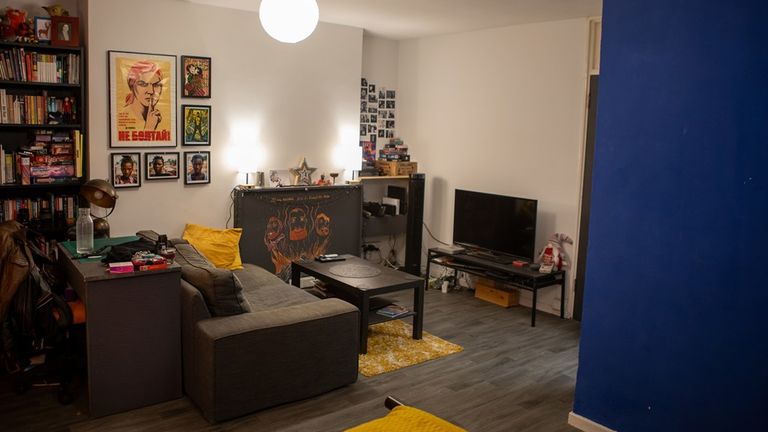
There have been some general wear and tear issues given it’s an old building, including the boiler breaking down, Sam said, but DotDotDot has been “quite good” at fixing them.
It took him time to cope with knowing that he could be kicked out at any moment, with his licence renewing every 28 days.
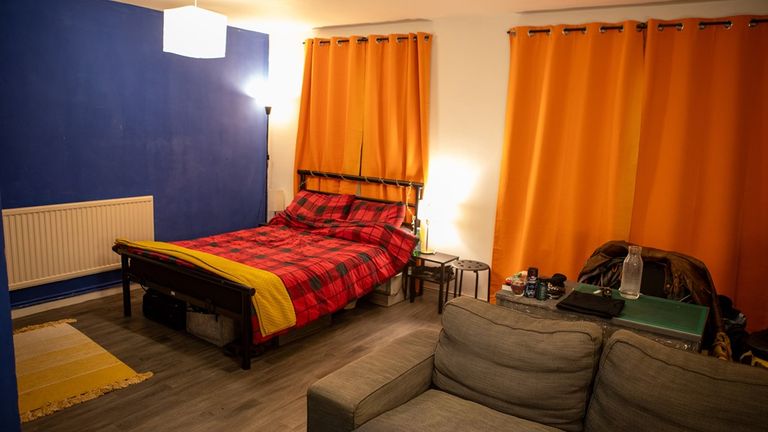
“It weighed heavily on my mind… you’re kind of going, well I could get an email or a phone call tomorrow saying I’m out and you just have to be ready. I had to learn to live with that reality and the risk that you could kit it all out and then you have to leave,” Sam said.
He is expecting redevelopment to start on the building in the next six months, so is preparing to move.
“Ideally I would like to shift into another guardianship but you also have to deal with the reality of going back into the private rental market and the fact that you are going to be paying more,” he said.
‘Everyone who lives in London knows it’s a nightmare’
Adriana Faria, 49, also lives in east London and has been property guardian for the past two and a half years.
The freelance set designer lives in an old council estate building that is due to be demolished in 2028.

Adriana Faria say the restrictions on the property don’t affect her
The cheaper bills were attractive, but the main reason she picked a guardianship property was to get more space to work, finding rentals were too small, too expensive or too crowded.
“Everyone who lives in London knows it is a nightmare,” she said. “It is difficult to find a suitable place, especially for me being a freelancer. My income is sometimes stable and sometimes not so much.”
Her one bed-flat has a big kitchen, a living room, a small balcony and a windowless bathroom. All in, it costs her £1,025 a month, £825 on the licence fee and £200 on bills.
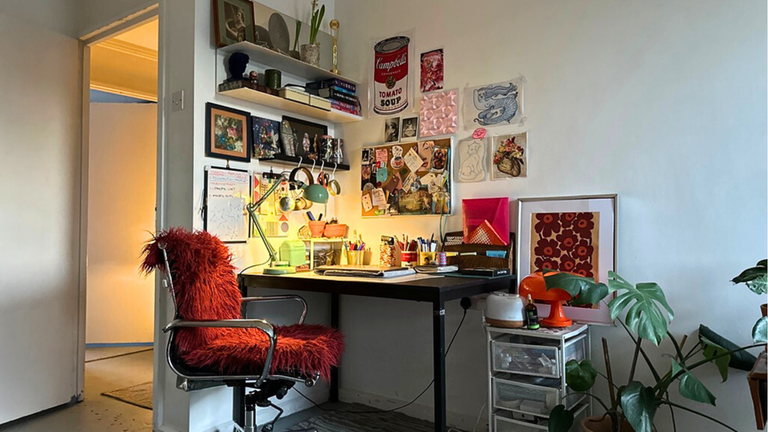
When she moved in, “nothing was broken but it was completely empty and you have to buy everything. I didn’t want to spend a lot of money because you are going to lose it,” she said.
The floor was in a “very bad state”, covered in patches of red carpet, so she removed the carpet herself and painted the hard floor underneath grey.
A plumber was sent to fix an issue with the water pressure, and she hasn’t had any problems since.
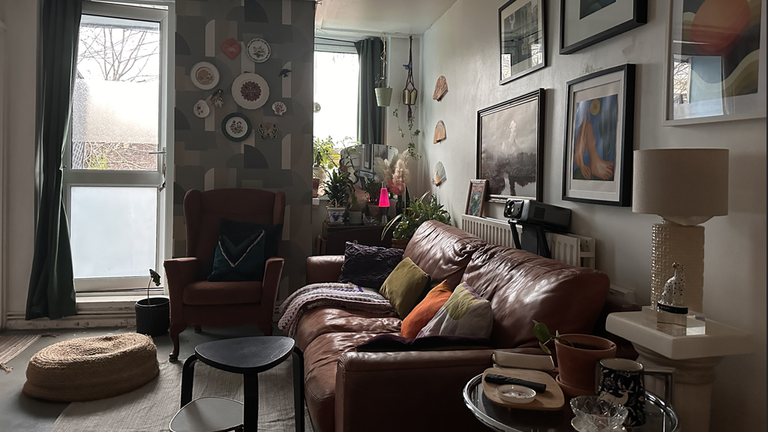
There are restrictions – no pets, children, old dependents staying, smoking, open flames or groups of people over – but they haven’t affected her life negatively.
“To be honest, I don’t have so many friends so it’s not a problem for me,” Adriana said.
“I have more space, and I’ve had the opportunity to meet new people and create a relationship with where I live. It’s created a bond with the place and the people.”
She plans to move to another guardianship property next: “There is no reason to go back to renting. If I can’t keep being a guardian, I will try to find a place to buy for myself.”
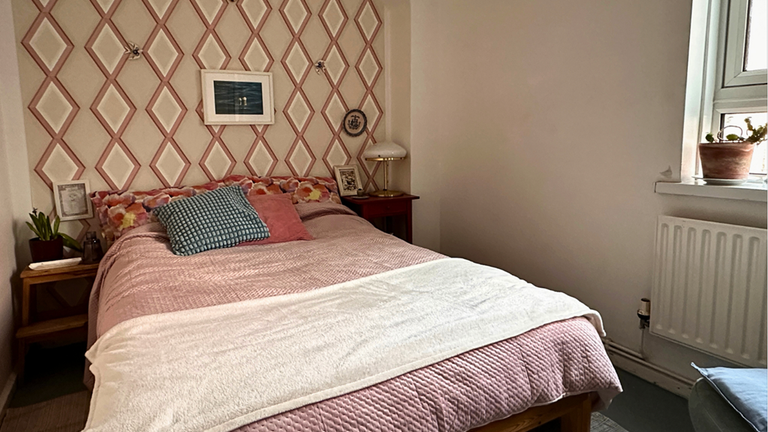
Could guardianships solve the housing crisis?
As rents, house prices and mortgage rates have soared in the UK’s deepening housing crisis, demand for property guardianship has also increased – both from people looking for a home and property owners seeking security solutions.
Advocates for guardianship say it’s an option for those who can’t afford record rents, pointing to data from homelessness charity Shelter that shows there are at least 382,000 people without a home in England.
Critics argue, however, that it legitimises a two-tiered system of tenants’ rights.
The numbers
There is no official country-wide data on the number of property guardian, but estimates range from 5,000 to 10,000.
In all, 754,264 properties in England are vacant, according to the Office for National Statistics. Of those, 34,635 are owned by local authorities and 303,185 have been vacant for six months or more.
Natasha Taylor, managing director of AdHoc, a property management and security firm, told Money that around half of those properties could be used to house guardians.
“The vast amount of vacant properties seems like a waste to me,” she said. “There are so many things… you could do with your vacant properties rather than just leaving them empty.”
But, she added, “there are things that prevent us sometimes as we are bound by local authorities, so HMO [house in multiple occupancy] licences, planning, all of that comes into play.”
While Natasha agreed that guardianship could help people access housing, she stressed that ultimately it is a security solution and occupants are there to protect a landlord’s asset.
In recent years, guardians have been used to stop anti-social behaviour or prevent squatters from moving in.
“There’s a whole squatters movement at the moment in the UK which has great followings on Instagram or Facebook showing how they get into these big buildings when they know it’s vacant. It’s dangerous,” Natasha said.
In one case, a property AdHoc manages in the London borough of Lambeth was occupied by squatters within four hours of security measures being removed.
It can be a costly process for the owner, with some squatters dumping waste or damaging the property, she said. Having guardians inside is a huge deterrent.
Arthur Duke, founder and chairman at Live-in Guardians, said his company had had a “steady and significant increase” in enquiries from property owners in both the private and public sectors looking for guardians.
“More and more businesses are actively looking at how their property strategies align with their environmental, social and governance commitments,” he said. “Property guardianship reduces waste, prevents high street decline and provides affordable housing at a time when it’s badly needed.”
Read more from Money:
Millions could be paying too much tax – here’s what you need to know
Tips to save money on gym memberships – including best time of month to join
‘We can’t sell our house – and it’s our neighbour’s fault’
Turning empty properties into guardian homes won’t solve the housing crisis on its own, he said, but it could “absolutely” be part of the solution.
“In reality, almost any building can be suitable for guardianship if it’s managed properly,” he said.
“Guardianship helps ease pressure at the lower end of the rental market by providing genuinely affordable accommodation, particularly for key workers and young professionals.”
“However, it’s not a substitute for long-term housebuilding or structural reform. What it does very well is bridge the gap – reducing waste, improving security for owners and offering people a roof over their heads at a time when affordability has become critical.”
Professor Chris Bevan, a property law expert, has spent years researching the sector and largely agrees that vacant properties could be used to house people in guardianships.
But he stressed the need for more regulation and data collection to make sure people aren’t living in poor conditions.
To start with, he said, the ombudsman should take a more active role in the sector and local authorities should survey guardianship properties.
“Whatever form the accommodation takes, it has to meet decent home standards and I would like local authorities to be proactive in ensuring that if there are vacant properties in their area, and they are to be occupied by guardians. I would like them to be inspected and tested to that decent home standard,” he said.
“If the regulation is not put in place, then there is the threat of this sort of development of a substandard housing regime that sits under private accommodation which is left for people who can’t afford anything else.
“We’ve got to avoid that. We should regulate the system to realise its potential.”