

Peter HoskinsBusiness reporter, BBC News

 AFP via Getty Images
Chinese property giant Evergrande’s shares were taken off the Hong Kong stock market on Monday after more than a decade and a half of trading.
It marks a grim milestone for what was once China’s biggest real estate firm, with a stock market valuation of more than $50bn (£37.1bn). That was before its spectacular collapse under the weight of the huge debts that had powered its meteoric rise.
Experts say the delisting was both inevitable and final.
“Once delisted, there is no coming back,” says Dan Wang, China director at political risk consultancy Eurasia Group.
Evergrande is now best-known for its part in a crisis that has for years dragged on the world’s second-largest economy.
What happened to Evergrande?
Just a few years ago Evergrande Group was a shining example of China’s economic miracle.
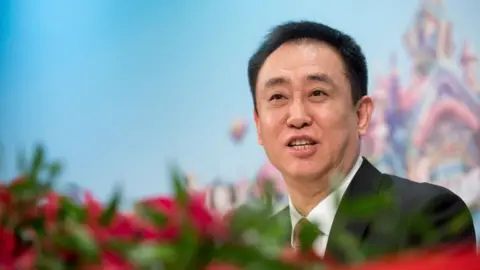
Its founder and chairman Hui Ka Yan rose from humble beginnings in rural China to top the Forbes list of Asia’s wealthiest people in 2017.
His fortune has since plummeted from an estimated $45bn in 2017 to less than a billion, his fall from grace as extraordinary as his company’s.
In March 2024, Mr Hui was fined $6.5m and banned from China’s capital market for life for his company overstating its revenue by $78bn.
Liquidators are also exploring whether they can recover cash for creditors from Mr Hui’s personal property.
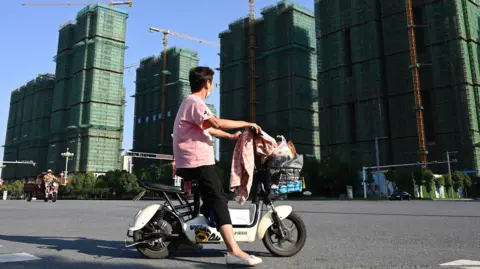
At the time of its collapse, Evergrande had some 1,300 projects under development in 280 cities across China.
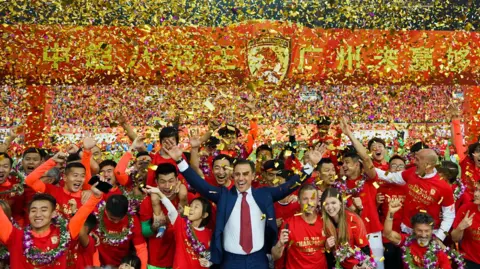
The sprawling empire also included an electric carmaker and China’s most successful football team, Guangzhou FC, which was kicked out of the football league earlier this year after failing to pay off enough of its debts.
 AFP via Getty Images
Evergrande was built on $300bn (£222bn) of borrowed money, earning it the unenviable title of the world’s most indebted property developer.
The rot set in after Beijing brought in new rules in 2020 to control the amount big developers could borrow.
The new measures led Evergrande to offer its properties at major discounts to ensure money was coming in to keep the business afloat.
Struggling to meet interest payments, the firm soon defaulted on some of its overseas debts.
After years of legal wrangling, the Hong Kong High Court ordered the company to be wound up in January 2024.
Evergrande’s shares had been under threat of delisting ever since because they were suspended from trading after the court order.
By that point the crisis engulfing the firm had wiped more than 99% from its stock market valuation.
The liquidation order came after the company was unable to offer a workable plan to shed billions of dollars of overseas liabilities.
Earlier this month, liquidators revealed that Evergrande’s debts currently stand at $45bn and that it had so far sold just $255m of assets. They also said they believe a complete overhaul of the business “will prove out of reach”.
The “delisting now is surely symbolic but it’s such a milestone,” Ms Wang says.
All that remains is which creditors are paid and how much they can get in the bankruptcy process, says Professor Shitong Qiao from Duke University.
The next liquidation hearing is due to take place in September.
How was China’s economy impacted?
China is facing a number of major problems, including US President Donald Trump’s tariffs, high local government debt, weak consumer spending, unemployment and an ageing population.
But experts say Evergrande’s collapse, along with the serious problems faced by other developers, has hit the country hardest.
“The property slump has been the biggest drag on the economy, and the ultimate reason why consumption is suppressed,” Ms Wang says.
 Getty Images
This is particularly problematic as the industry accounted for about a third of the Chinese economy and was a major source of income for local governments.
“I don’t think China has found a viable alternative to support its economy at a similar scale,” Professor Qiao says.
The property crisis has led to “massive layoffs” by heavily-indebted developers, Jackson Chan from financial markets research platform Bondsupermart says.
And many real estate industry employees that kept their jobs have seen big pay cuts, he adds.
The crisis is also having a major impact on many households as they tend to put their savings into property.
With housing prices dropping by at least 30%, many Chinese families have seen their savings fall in value, says Alicia Garcia-Herrero, chief economist for Asia Pacific at French bank Natixis.
This means they are less likely to spend and invest, she adds.
In response, Beijing has announced a raft of initiatives aimed at reviving the housing market, stimulating consumer spending and boosting the wider economy.
They range from measures to help new home owners and support the stock market to incentives to buy electric cars and household goods.
Despite the hundreds of billions of dollars Beijing has poured into the economy, China’s once-blistering growth has eased to “around 5%”.
While most Western countries would be more than happy with that, it’s slow for a country that saw growth of more than 10% a year as recently as 2010.
Is the property crisis over yet?
In short, probably not.
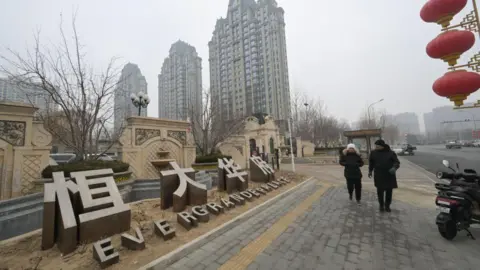
Even as Evergrande continues to grab headlines, several other Chinese property firms are still facing major challenges.
Earlier this month, China South City Holdings was handed a winding up order by Hong Kong’s High Court, making it the biggest developer to be forced into liquidation since Evergrande.
Meanwhile, rival real estate giant Country Garden is still trying to secure a deal with its creditors to write off more than $14bn of outstanding foreign debt.
After a series of postponements, its next High Court liquidation hearing in Hong Kong is due to take place in January 2026.
“The whole property sector has been in trouble. More Chinese property firms will collapse,” Professor Qiao says.
 AFP via Getty Images
While the Chinese government has taken a number of measures to help shore up the property market and support the economy as a whole it has not swooped in to directly bail out developers.
Mr Chan says these initiatives seem to be having a positive impact on the property market: “We think the bottom [has been reached] and it should be in a slow recovery. However, we probably don’t expect the recovery to be very strong.”
Wall Street investment giant Goldman Sachs warned in June that property prices in China will continue to fall until 2027.
Ms Wang agrees, and estimates that China’s stricken property market will “hit the bottom” in around two years when demand finally catches up with supply.
But Ms Garcia-Herrero puts it in starker terms: “there is no real light at the end of the tunnel.”
Beijing has sent a “clear message on its intention of not bailing out the housing sector,” Ms Wang adds.
The Chinese government has been careful to avoid the kind of measures that could encourage further risky behaviour by an already heavily indebted industry.
And while in the boom times, the property market was a key driver of China’s economic growth, the ruling Communist Party’s priorities now lie elsewhere.
President Xi Jinping is more focussed on high-tech industries like renewable energy, electric cars and robotics.
As Ms Wang puts it, “China is in a deep transition to a new age of development.”