
For those of us old enough to remember, as 2025 reached autumn, it began to feel like a déjà vu moment.
Suddenly, the value, the price of silver, began to climb unexpectedly.
A year before, in 2024, the market price was around £12–£15 per troy ounce, which had been steady for some time.
Was somebody trying to corner the market, causing an upsurge in demand?
Have we been here once before?
Suddenly, I was informed that many dealers in silver had become mobile with their scales and were buying silver wherever possible.
Was it to be another ‘Bunker Hunt’ moment?
For a fiasco like that, how do you prepare?
Nobody likes an unstable market, but that appeared to be happening.
In 1980 (as stated in my Silver Part One, last week), the world price of silver rose from six dollars a troy ounce to fifty, causing panic in the world market.
The guide showing silver quality in the 16th century; Still the benchmark today; almost fifty years later. By 1544 the use of the “Lion” emblem was the sign of .925 quality. (Image: Supplied)
God forbid that this was going to be the start of such an episode.
After much talk with experts and dealers in the trade, it was obvious that, in the short-term, the advent of higher market prices had enabled many traders to sell their long-held stock more quickly.
That’s great news, but what about replacing it?
The market price continued to climb throughout 2025, reaching some forty-five pounds per troy ounce, compared with £12–£15 at the start of the year.
So, if this is not speculation, why the rise in value?
After much searching, it appears that industry is requiring more silver than previously experienced, particularly in the world car market.
I am reliably informed that one Chinese maker, for one model, for which they make a hundred thousand vehicles a year, uses some three ounces of silver in each one; that’s a third of a million ounces for one car from one manufacturer.
Clearly, the four main countries producing silver are unable to keep pace with the world market, which therefore means that the market in domestic items, such as challenge cups, medals, and so on, are being melted down to add to the supply that is running short, and therefore, the recycled material is helping to quench the demand.
This is only part of the problem of high silver prices.
Virgin silver, needed for the manufacture of all new silver objects, such as jewellery, tea ware, cups, medals etc., is some twice the price of scrap, around £80 per ounce, making it very difficult for the small jewellery manufacturer, or any manufacturer, to pay such a high price for the raw material.
2026 may see things settle down, but compared with the ‘Bunker Hunt’, this looks more sustainable, albeit at the cost of losing new silver items on the market in the future.
When talking about silver, I am talking about a metal that is graded to 0.925 purity.
There are grades higher than this, such as the Britannia standard, and even 90% fine silver, that is used in manufacturing certain things, but, on the bulk, the price I have quoted refers to 0.925.
This quality has actually been in place in Great Britain since the 16th century when the ‘Lion’ was the indication of the quality of silver, and after all those centuries, we are seeing such an upturn and turmoil in the market.
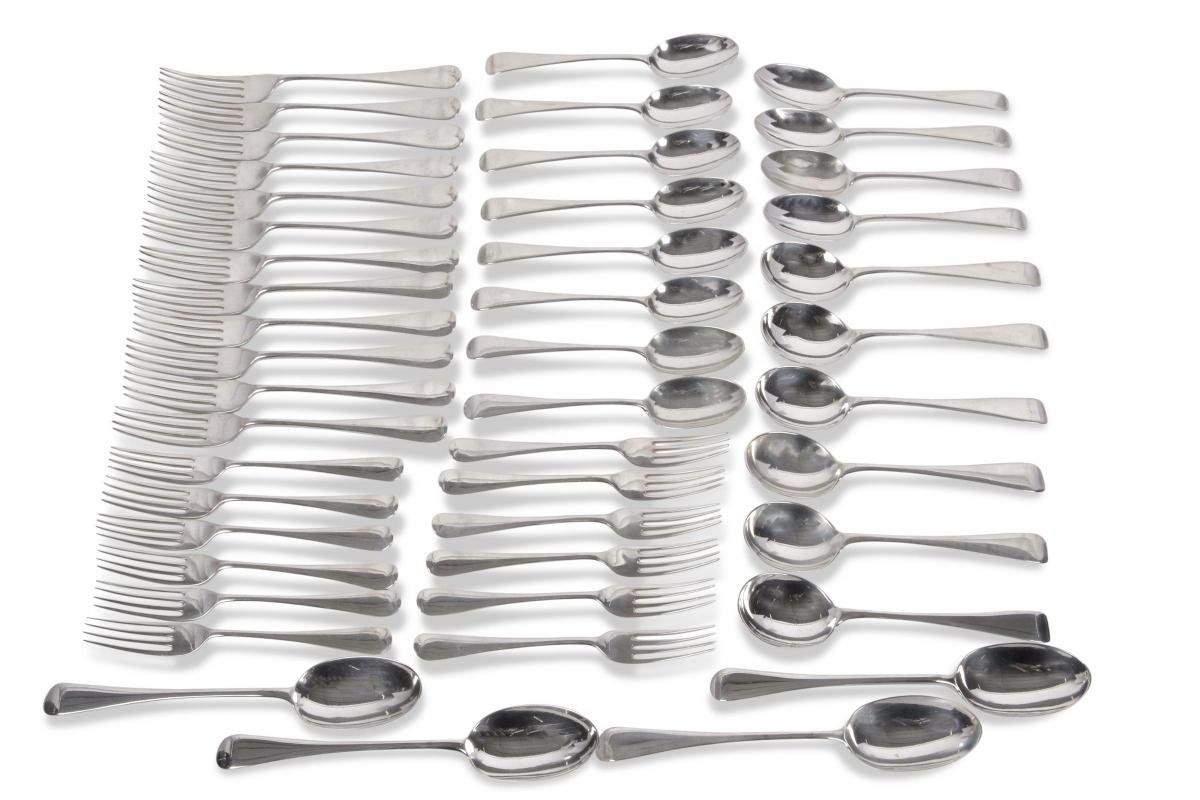
Our thanks to Keys Auctioneers for the images of the silver.
Mike Hicks has run Stalham Antique Gallery at 29 High Street, Stalham (NR12 9AH) for more than 30 years. His business is open Mondays to Fridays from 9am-1pm and 2-4.30pm, and on Saturdays from 9am-1pm. You can contact Mike on 01692 580636 or info@mikehicksantiques.co.uk or www.mikehicksantiques.co.uk