
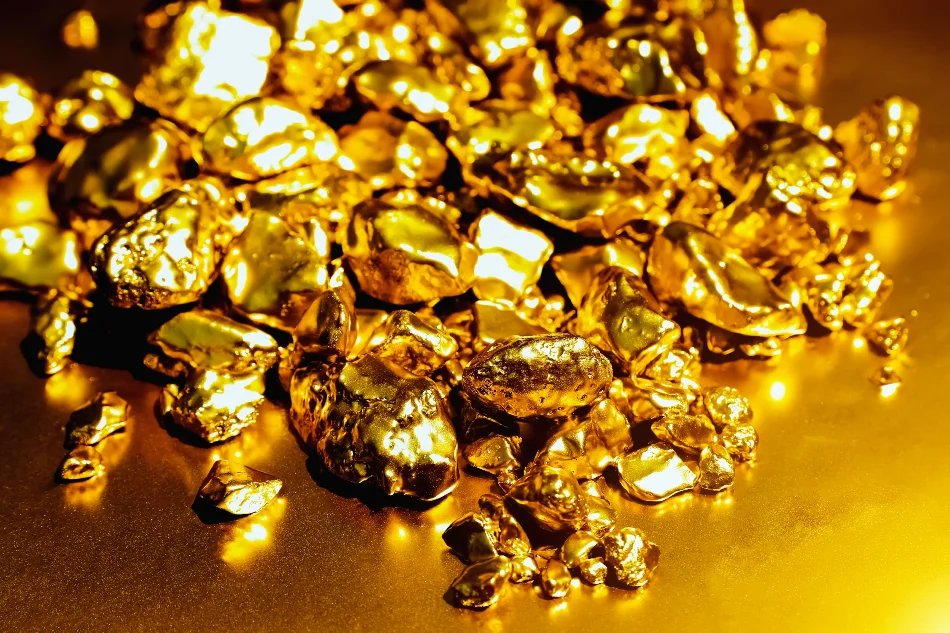
This article aims to provide a better understanding of gold’s unique physical and chemical properties that enable it to be used in a wide range of practical applications.

Image Credit: pamas / Shutterstock
Gold (Au) has an atomic number of 79, which means each gold atom contains 79 protons in its nucleus. Gold’s atomic mass is 196.967, and its atomic radius is 0.1442 nm. Notably, this figure is smaller than the theoretical prediction.
Origin of Color
The way the outer electrons are arranged around the gold nucleus is associated with the characteristic yellow color of gold. A metal’s color is based on the movement of electrons between energy bands.
The conditions for the strong absorption of light at the wavelengths that are essential to creating the characteristic gold color are met by a transition from the d-band to vacant positions in the conduction band. The warm and attractive color of gold has led to its extensive use in ornaments alongside other precious metals.
Isotopes of Gold
While the number of protons in a gold nucleus is fixed at 79, the number of neutrons can differ from one atom to the other, offering several isotopes of gold. However, there is only one stable non-radioactive isotope that makes up for all naturally found gold.
Crystal Structure of Gold
Metallic gold has a crystal structure that is a face-centered cubic FCC. This crystal structure is responsible for the very high ductility of gold, as FCC lattices are mainly suited for enabling the movement of dislocations in the lattice. Such a dislocation movement is important to accomplish high ductility.
Density of Gold
The density of gold is 19.3 gcm-3, and this relies on its atomic mass as well as its crystal structure. This makes gold quite heavy than certain other common materials. For instance, aluminum’s density is 2.7 gcm-3 and steel’s density is just 7.87 gcm-3.
Melting and Boiling Points of Gold
Pure gold has a melting temperature of 1064 °C. However, when alloyed with other elements like copper or silver, the gold alloy melting process will occur over a variety of temperatures. The boiling point of gold, where gold changes from a liquid state to a gaseous state, is 2860 degrees Celsius or 5,173 degrees Fahrenheit.
The Conductivity of Heat and Electricity
Gold can efficiently transfer heat and electricity, and this ability is surpassed only by silver and copper, but unlike these metals, gold does not tarnish, making it crucial in electronics.
Gold’s electrical resistivity is 0.022 micro-ohm m at 20 °C, and its thermal conductivity is 310 W m-1 K-1 at the same temperature. The corrosion resistance of gold is possibly one of its most valuable properties. Electrode potentials are a beneficial technique for signifying the propensity of metal to corrode.
Electrode potentials are measured with respect to hydrogen, and an electrochemical series can be prepared for metals as shown below. It is no surprise that gold takes the top place in the series, signifying its high corrosion resistance. In practice, this metal is corroded only by a mixture of nitric acid and hydrochloric acid (aqua regia). Gold does not tarnish even when used on a daily basis.
Table 1. The electrode potential of gold and related elements
| Electrode Potential (V) | Element |
|---|---|
| +1.5 | Gold |
| +0.8 | Silver |
| -0.4 | Iron |
| -0.8 | Zinc |
| -1.66 | Aluminum |
Malleability
Gold is highly malleable (the degree to which a material can experience deformation in compression before failure). In the annealed state, gold can be hammered cold into a translucent wafer with a thickness of 0.000013 cm. One ounce of gold can be hammered into a sheet covering over 9 m2 and 0.000018 cm thick.
Ductility
Gold is ductile (the level of extension that takes place before the failure of a material in tension), and one ounce can be drawn into 80 km (50 miles) of thin gold wire (5-µm diameter), to create electrical contacts and bonding wire.
Young’s Modulus
The Young’s modulus of elasticity of a material is associated with stiffness or rigidity and is defined as the ratio between the stress applied and the elastic strain it creates. Gold has Young’s modulus of 79 GPa, which is quite similar to silver but considerably lower than steel or iron.
Hardness of Gold
Hardness can be defined as a material’s ability to resist surface abrasion. The relative hardness of materials was traditionally evaluated using a list of materials set in such an order that any material in the list will scrape any material below it. Thus, diamond, the hardest substance known, tops the list with a hardness index of 10, while talc is at the bottom with a hardness index of 1.
On this scale, gold has a value of 2.5 to 3, meaning it is a soft metal. For more exact measurements, the Vickers hardness measurement is applied, which shows that gold has a value of about 25 Hv in the annealed condition.
Biocompatibility
Gold exhibits superior biocompatibility within the human body (the key reason for its use as a dental alloy), and, consequently, there are several direct applications of gold as a medical material. Gold also has a high degree of resistance to bacterial colonization, and hence it is the preferred material for implants that are at risk of infection, such as the inner ear.
Oxidation States
Gold forms several interesting compounds based on the known oxidation states +1 and +3. Gold-based chemicals comprise cyanides, halides, and sulfides.
Table 2. Summary of properties of gold
| Property | |
|---|---|
| Atomic weight | 196.97 |
| Atomic number | 79 |
| Number of naturally occuring isotopes | 1 |
| Melting point °C | 1064 |
| Crystal structure | FCC |
| Density gcm-3 | 19.3 |
| Thermal conductivity W m-1 K-1 | 310 |
| Electrical resistivity micro-ohm m at 20 °C | 0.022 |
| Young’s modulus E GPa | 79 |
| Hardness Hv | 25 |
| Tensile stress MPa | 124 |
| 0.2% proof stress MPa | 30 |
| Poissons ratio | 0.42 |
Gold’s Properties at the Nanoscale
It is vital to draw a distinction between the properties of gold in the bulk form and the properties it displays when present in the form of minute nanoparticles. At the nanoscale, the properties of gold can be noticeably different. These differences have been explained in a paper from Professor Mike Cortie of the University of Technology, in Sydney.
The exclusive properties of gold at the nanoscale enable its use in an increasing number of applications, including catalysts in chemical processing and pollution control, and colloids for biomedical marking.
More from AZoM: Acid Method for the Digestion of Gold Ore Samples