

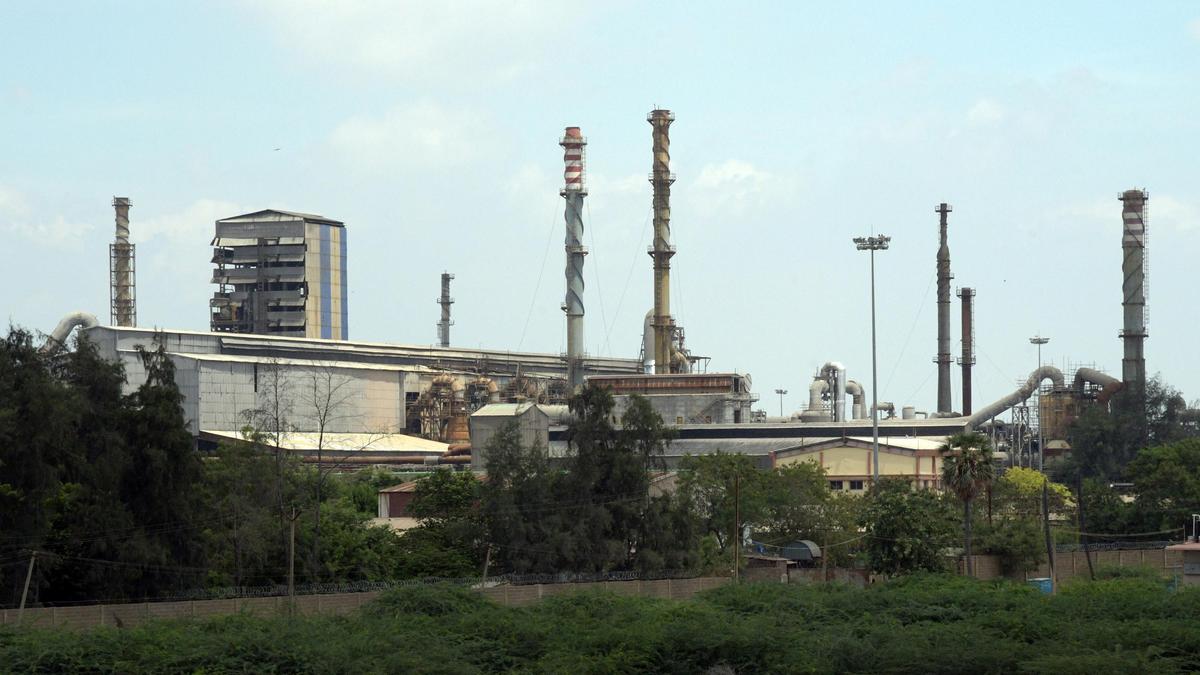
A view of the Sterlite copper plant in Thoothukudi. File
| Photo Credit: N. Rajesh
Establishing a ‘green copper’ facility, in the same place where the now-sealed Sterlite copper smelting plant in Thoothukudi was once functioning, would help in environmental remediation of the site and also strengthen the nation’s copper security by boosting domestic production through environmentally—sustainable practices in the future, Vedanta Limited has claimed before the Madras High Court.
In a writ petition seeking a direction to Tamil Nadu government to consider its new proposal, the business conglomerate said, its present proposal rests on newer technologies that were fundamentally different and distinct from the previous manufacturing process and that it would utilise an environmentally superior process designed to be an exemplar of sustainable and responsible industry.

Filing a detailed affidavit, through its counsel Rahul Balaji, Vedanta Limited also said: “The new initiative involves a significant technological overhaul with substantial financial investment aligned with the goal of technologically advanced operations which will contribute in achieving a harmonious balance between safeguarding the environment and public health, and fostering economic growth and employment.”
Copper was a key raw material in the renewable energy industry as well as the electric vehicles (EV) sector and hence, it was essential for the nation to ensure adequate domestic production without depending much upon imports, the conglomerate said. It highlighted that its new proposal would also create downstream industrial opportunities for the micro, small and medium enterprises (MSMEs) in the region.
What is green copper?
It went on to state that ‘green copper’ refers to copper produced with a significantly lower carbon footprint compared to conventional smelting processes. The reduction would be achieved by maximising the use of recycled copper as input. “Using recycled copper minimises the need for copper concentrate processing, which was the primary source of slag generation in smelting operation,” it added.
Apart from the projected reduction of 15% in slag generation, approximately 40% of reducation was expected in hazardous waste generation too. Through utilisation of 30% recycled input, the proposed green copper plant was projected to achieve 34% reduction in carbon footprint because less fossil fuel would be consumed in the energy-intensive smelting and converting processes, Vedanta claimed.

“Furthermore, round-the-clock renewable energy will be utilised for hybrid operations. The suspension of the phosphoric acid plant and adoption of advanced air and water management technologies will further minimise environmental impact and enable the company to produce copper cathode with less than 0.9 kg of CO₂ emissions per kg of copper, i.e., about 50% less than the global average,” its affidavit read.
Court order
Chief Justice Manindra Mohan Shrivastava and Justice G. Arul Murugan have directed the High Court Registry to list Vedanta’s latest writ petition on January 29, 2026 along with a 2019 writ petition filed by environmental activist R. Fatima who had sought a direction to the State to restore the sealed copper smelting plant site to its original state by remediating the damage caused to the soil and underground water.
In the meantime, since Additional Government Pleader E. Vijay Anand told the court that Vedanta had so far sent representations regarding its new proposal only to the Industries and Environment secretaries and not submitted requisite applications before the competent authorities, the judges granted liberty to the conglomerate to make the applications before statutory authorities such as the Pollution Control Board.
“The pendency of this petition shall not come in the way of the petitioner in moving fresh application before the competent authorities and it will be open for the authorities to take a decision thereon,” the first Division Bench clarified.
History of Sterlite plant
Recalling the history of Sterlite, Vedanta said, the copper smelting plant commenced its operations at the SIPCOT industrial complex in Thoothukudi in 1997 after obtaining environmental clearances in 1995. During its operational period, the plant was a key contributor to the nation’s copper industry and met over 36% of the national copper requirement. It contributed ₹13,500 crore the public exchequer between 2014 and 2018.

“At the State level, the plant contributed about 1.6% of the State’s GDP and provided over 20,000 direct and indirect employment opportunities which supported over one lakh families. However, following orders of this honourable court, which were subsequently upheld by the honourable Supreme Court, the petitioner ceased its operations and the plant has remained idle/non-operational since 2018,” it said.
Claiming that the closure had a cascading impact on the nation’s copper requirements, resulting in heightened demand and increased dependence on imports, Vedanta said, that it was in this backdrop, it had made a request to the Industries and Environment Secretaries in Tamil Nadu to permit a ‘green copper’ plant on the same site but lamented that there was no response from the officials for the last four months.

Published – January 17, 2026 02:41 pm IST