
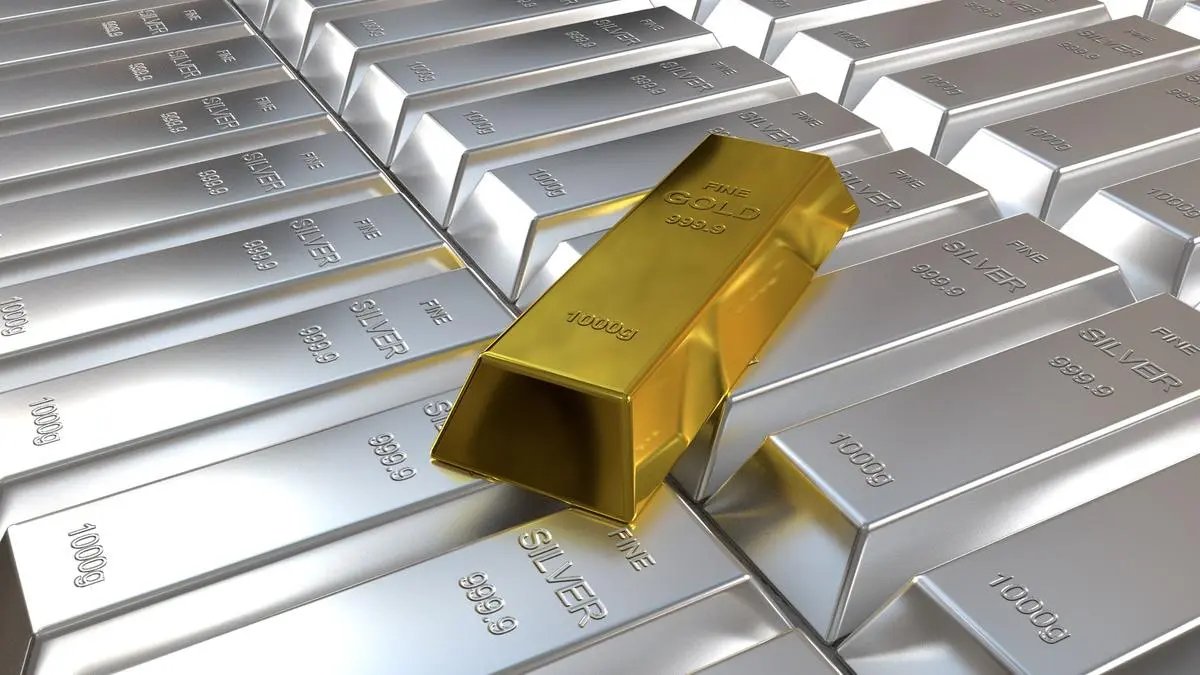
Silver has been stealing the limelight in India, up more than 200 per cent in a year, while gold is up over 80 per cent. Two friends meet near a jewellery store window and decide to decode one number that quietly links both metals, the gold-silver ratio.
Sonakshi: Look at this newspaper article. Silver (domestic price) up over 200 per cent in a year! Gold is up over 80 per cent!
Chandni: Poor man’s gold is acting like the main character!
Sonakshi: This is where the gold-silver ratio helps. It captures how the two prices relate.
Chandni: Hang on. Which ratio? How is it computed?
Sonakshi: It’s quite simple. The ratio equals gold price divided by silver price, using the same unit. Since both prices update through the day, the ratio updates through the day too and you can also check a daily close. If the ratio is 100, one unit of gold is priced like 100 units of silver.
Chandni: So when silver outperforms, the ratio falls. When gold outperforms, it rises.
Sonakshi: Exactly, you are quick to pick that up. It is a relative price gauge, not a return forecast.
Chandni: Where is the ratio now?
Sonakshi:Bloomberg’s gold-silver ratio series from early March 1998 to January 22, 2026 puts the latest reading at 50.89. 1 ounce (oz) of gold is equal to 50.89 oz of silver (computed as gold price per oz divided by silver price per oz).

Chandni: Is that low?
Sonakshi: Historically, yes. The long run average, for that period, roughly three decades, is about 67.8 and the median (the middle value) is about 66.4. Today’s level sits around the 8.4th percentile, meaning only about 8 per cent of days were lower.
Chandni: So in plain language, silver is relatively expensive versus gold, because it takes fewer ounces of silver to match an ounce of gold.
Sonakshi: Yes, you may say that if your only yardstick is that ratio, though I would be very careful about saying ‘expensive’ or ‘cheap’.
Chandni: Give me the normal zone of the ratio.
Sonakshi: If you take the middle 80 per cent of history, the 10th to 90th percentile band is roughly 51.4 to 85.5. So 50.89 is right at the low edge.
Chandni: And the tails?
Sonakshi: The lowest the ratio was 31.71 on April 28, 2011. The highest was 123.74 on March 18, 2020. That 2020 spike shows how far the ratio can stretch when gold surges and silver lags.
Chandni: But the real drama is recent, isn’t it?
Sonakshi: Yes. At the end of CY 2024 the ratio was 90.90. By the end of CY 2025 it had fallen to 60.28. And by January 22, 2026 it was 50.89.
Chandni: So the ratio collapsed because silver outran gold.
Sonakshi: That is the clean reading. Important nuance, though. The ratio says nothing about whether both metals are cheap or expensive. It only says who is winning relative to the other.
Chandni: Can people turn this into a rule? Low ratio means gold will now catch up?
Sonakshi: That is a hypothesis, not a law. The polite version is mean reversion, which is basically the idea that extremes drift back towards the middle over time.
Chandni: Does history back mean reversion?
Sonakshi: Often. When the gold-silver ratio has been in the bottom ten per cent of history, it rose later most of the time over the next six to twenty four months. A rising ratio simply means gold did better than silver over that period.
Chandni: But it can rise because silver falls, not because gold rallies?
Sonakshi: Exactly. And it can stay low for long stretches if silver keeps outperforming, whether due to industrial use or investor sentiment.
Chandni: So how does an ordinary investor use this without making it a trading toy?
Sonakshi: Think in layers. First, overall asset allocation decides how much exposure, if any, belongs in precious metals. Second, within that sleeve, the ratio is a dashboard dial. After a big rally, it flags when one metal has run much harder than the other.
Chandni: Oh, that connects to rebalancing then?
Sonakshi: Yes. If someone started with a planned split between gold and silver, a sharp ratio move can distort that split. Rebalancing is bringing it back towards the plan, rather than letting momentum silently rewrite the portfolio.
Chandni: And any caveats?
Sonakshi: There are three actually. One, relative does not mean cheap. Two, extremes can persist, because gold and silver are cousins, not twins. Gold is often driven by currency and risk sentiment. Silver also carries an industrial cycle. Three, people who forecast gold and silver prices look at far more than this ratio, like interest rates, the dollar, inflation, demand, and market positioning.
Chandni: Okay. So the ratio is less a prediction machine and more a way to keep your thinking honest after a headline rally.
Published on January 24, 2026