
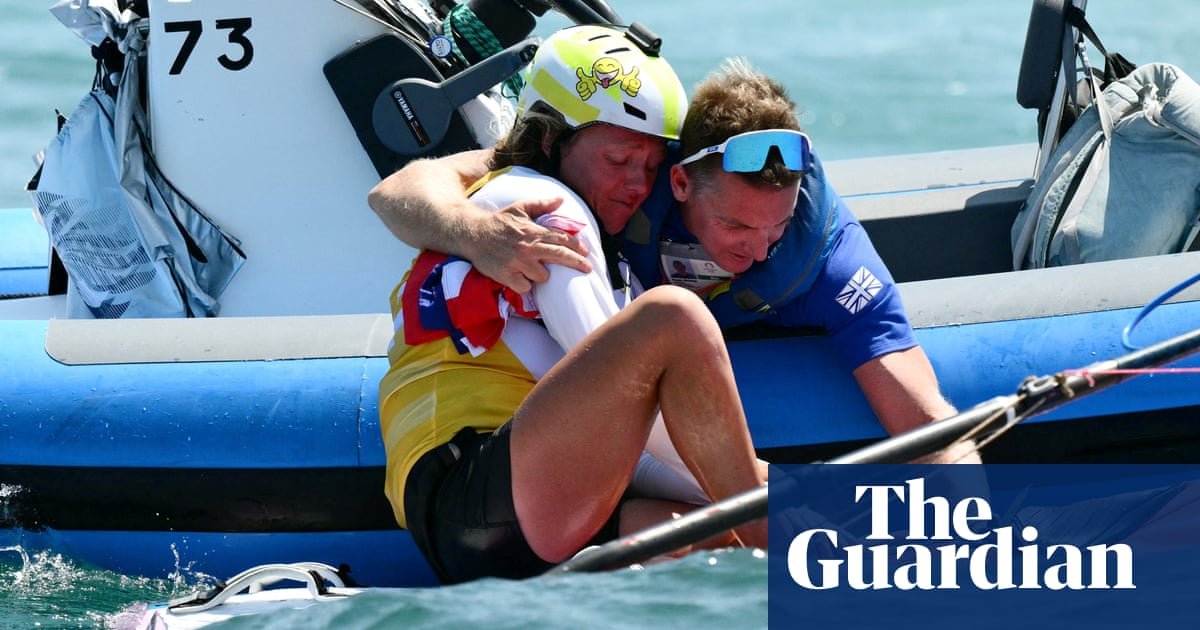
By any objective measure, Great Britain’s Emma Wilson dominated the women’s Olympic windsurfing competition in Marseille. She won eight of her 14 races, took second in two more and was third in another three. Her net score of 18 was 31 points ahead of second-placed Sharon Kantor of Israel. But in the convoluted windsurfing format this year, her work merely earned her a bye to the final, in which she was up against competitors who had already developed a feel for the conditions.
Wilson took bronze, one year after taking silver in similar circumstances in the world championships. She wasn’t shy about criticizing the format, saying that seeing all her previous efforts in the competition count for nothing in the final affected her mental health.
A lot of Olympic athletes can empathize. Three-time BMX world champion Alise Willoughby, who has featured heavily in US television ads telling the story of her husband and the cycling accident that left him paralyzed, won all three of her heats at Paris 2024, then took second in two of three semi-final runs. But the final comes down to one run, and after being beaten to the first corner, Willoughby missed out on the medals. Again. Team GB’s Beth Shriever had it even worse in the same event. She won all six of her quarter-final and semi-final heats, then had a slow start in the final and finished last.
It’s even tougher for gymnasts. While their acrobatic counterparts on skateboards and surfboards get multiple attempts to show their stuff, gymnastics meets can be lost with one bad landing on a four-inch balance beam or one failure to latch on to a thin bar.
It’s an age-old question in many sports. What is more important – rewarding consistency, or rewarding performance under the highest possible pressure?
Going with the latter is usually the most exciting. In football, the Champions League and World Cup end with must-watch finals. But domestic leagues, such as the Premier League and La Liga, where teams play each other twice over the course of a season, are more accurate reflections of which club is the best.
Unless we go back to the schedule of the 1900s and spread out the Olympics over five or six months, the IOC can’t possibly schedule anything so grandiose. The calendar already forces Olympic football medalists to endure a brutal gauntlet of six games over 16 or 17 days. Giving gymnasts multiple attempts may be less impractical but may also go against the very nature of a sport that is often a quest for perfection. On the track, no one wants to see the 100m final followed by an IOC official announcing: “OK, now line up and do it again.”
And perfection – or the pursuit of it – is at the heart of the Olympics, and it provides signature moments that make the Games special. The men’s archery final between South Korea’s Kim Woo-jin and the USA’s Brady Ellison is one of the best examples from this year’s competition. Kim and Ellison were tied, each winning two sets, setting up a winner-take-all fifth set. The top score either archer had posted in those first four sets was 29 – two perfect 10s and a nine. The fifth set: Kim 10, Ellison 10, Kim 10, Ellison 10, Kim 10 – the last shot prompting the Korean archer to drop his stoic demeanor and celebrate. But Ellison, who has won everything in the sport except an Olympic gold, calmly took aim, fired, and got a 10.
Final set score: a doubly perfect 30-30.
A tiebreaker was needed in which each archer shot one arrow and measurements were taken. Kim won by less than 5mm.
Ellison didn’t break into sobs or moan in disgust. He broke into a big smile and congratulated the rival who had brought out his best. Afterwards, he said the final was a great advertisement for the sport.
But what happened in sailing isn’t the equivalent of that final, with momentum swinging back and forth and both archers being at their best at the end. It was the equivalent of having the top archer in qualifying sit out while nine other archers shoot and get a feel for the conditions, then bringing all 10 archers out to shoot one arrow each. Or perhaps having the decathlon’s first nine events whittle the pack down to eight runners, then having them all come in on equal points for one throw of the javelin.
Pressure is and always will be part of the Olympics. The unnecessary part is artificially ramping up that pressure with a gimmicky format, when there are better options. Windsurfing could use the same format as other sailing classifications, where scores from the prior races carry over, but points are doubled in the final. BMX could consider limiting the final race to the four cyclists who have truly excelled in the prior rounds, limiting the chances that a worthy winner will be trapped in the pack. The potential for upsets will still be there. They just won’t be artificially created.
In the movie Miracle, based on the US men’s ice hockey team’s upset of the Soviet Union in the 1980 Winter Olympics, coach Herb Brooks gives a powerful speech – and, as far as can be determined, at least partially true to the actual speech given in Lake Placid – with the classic line, “If we played them 10 times, they might win nine. But not this game. Not tonight.”
But let’s rewind a bit. First Brooks says: “Great moments are born from great opportunity. And that’s what you have here tonight, boys … That’s what you’ve earned here tonight.”
To get to that point, the US men won four games and drew one in the group stage. The format featured a four-team final group, and after beating the mighty Soviets, they had to beat Finland to clinch gold. They trailed 2-1 after two periods. But after a less printable Herb Brooks speech, they went out and overwhelmed Finland.
Maybe the USA weren’t the best team in the world in 1980. But they were the best team at the Olympics. And there were no Emma Wilsons and Beth Shrievers, knowing they deserved a better prize than the one they took home.