

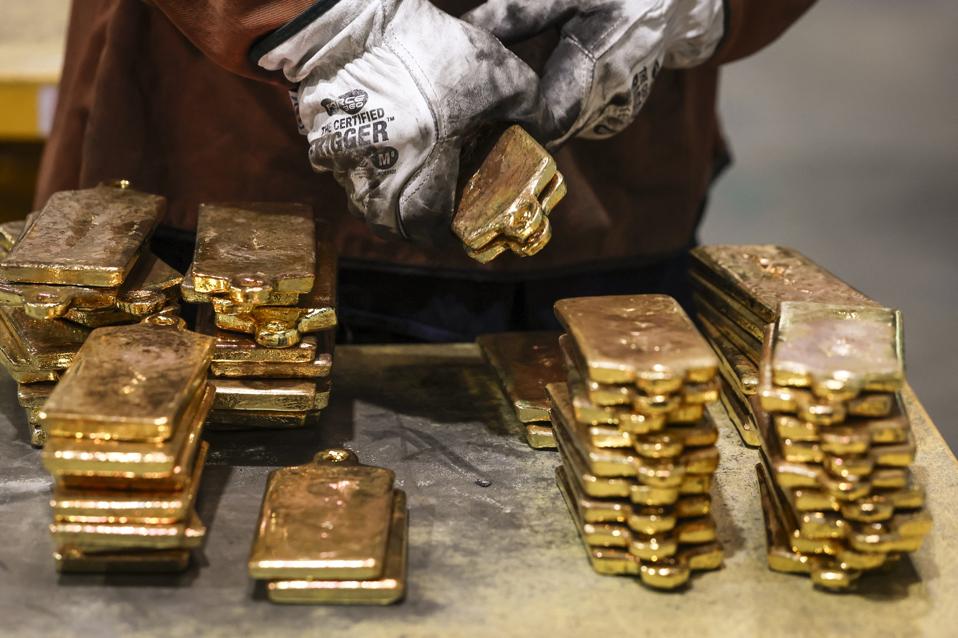
A refiner stacks gold bullion after being removed from casts at the ABC Refinery smelter in Sydney on April 29, 2025. (Photo by DAVID GRAY / AFP) (Photo by DAVID GRAY/AFP via Getty Images)
AFP via Getty Images
Gold has recently surpassed the $3,550 per ounce threshold, breaking records and taking even the most optimistic forecasters by surprise. But here’s the intriguing twist—what if we informed you that the metal could increase by another 20%, possibly pushing it above $4,250 per ounce in the upcoming months? For a commodity often labeled as “boring,” gold has suddenly become one of the most captivating narratives in global markets.
A Historic Outperformance
To provide some context, gold has increased fourteen-fold since 2000, transforming every $10,000 invested into $140,000 today. Even more surprising is its comparative strength: over the last five years, gold has outperformed the Nasdaq 100, surpassing the world’s leading technology companies regarding percentage returns. For an asset that yields no dividends, that is indeed remarkable.
Central Banks Are Leading the Charge
The largest purchasers of gold globally are not hedge funds—they are central banks. In 2024, they added over 1,200 tonnes to their reserves, marking the fastest growth in more than fifty years. China has recorded 16 consecutive months of net gold acquisitions, indicating a proactive shift away from the U.S. dollar. Should this pattern persist, even a modest increase in purchases from the official sector could propel gold to the anticipated 20% rise.
Supply Is Stuck in the Past
Another unexpected fact is this: despite record-high prices, global gold mine production has scarcely risen in the last ten years. Unlike oil, gold cannot be “drilled faster.” On average, it takes 10 to 15 years to establish a new mine, and some of the most significant finds occurred decades ago. Analysts suggest the world may have already encountered “peak gold,” implying that supply growth will remain flat. This supply constraint lays the groundwork for further price increases.
Beating Inflation at Its Own Game
Historically, gold has served as the ultimate hedge against inflation—but the ongoing rally suggests it may be excelling even in that capacity. Adjusted for U.S. inflation, gold’s current price surpasses the peaks observed during both the 1980s and the 2011 crises. However, unlike those instances, today’s demand is not solely fueled by fear—it’s structural, with investments from institutions, ETF inflows, and retail accumulation all contributing simultaneously.
The Road to $4,250
So, what could drive gold another 20% higher? Several elements are aligning:
- Ongoing buying from central banks, especially in emerging markets.
- Geopolitical uncertainties and currency fluctuations.
- Restricted supply growth alongside soaring demand.
- Increasing investor doubts about fiat currencies amid ballooning global debt.
With gold already priced at $3,550, a rise to $4,250 would solidify its status as the best-performing mainstream asset worldwide. In fact, at that price point, the total market value of all the gold mined—estimated to be about $15 trillion—would surpass China’s annual GDP.
The Bigger Picture
Critics have long maintained that gold is a “dead asset.” However, today’s rally, coupled with the potential for another 20% increase, proves otherwise. Gold is not merely a hedge—it represents a growing lack of trust in the global financial system, and more investors are casting that vote daily. At $3,550 per ounce, gold has already made its mark in history. If it ascends to $4,250, it won’t just signify a rally—it will represent a fundamental revaluation of money itself.