
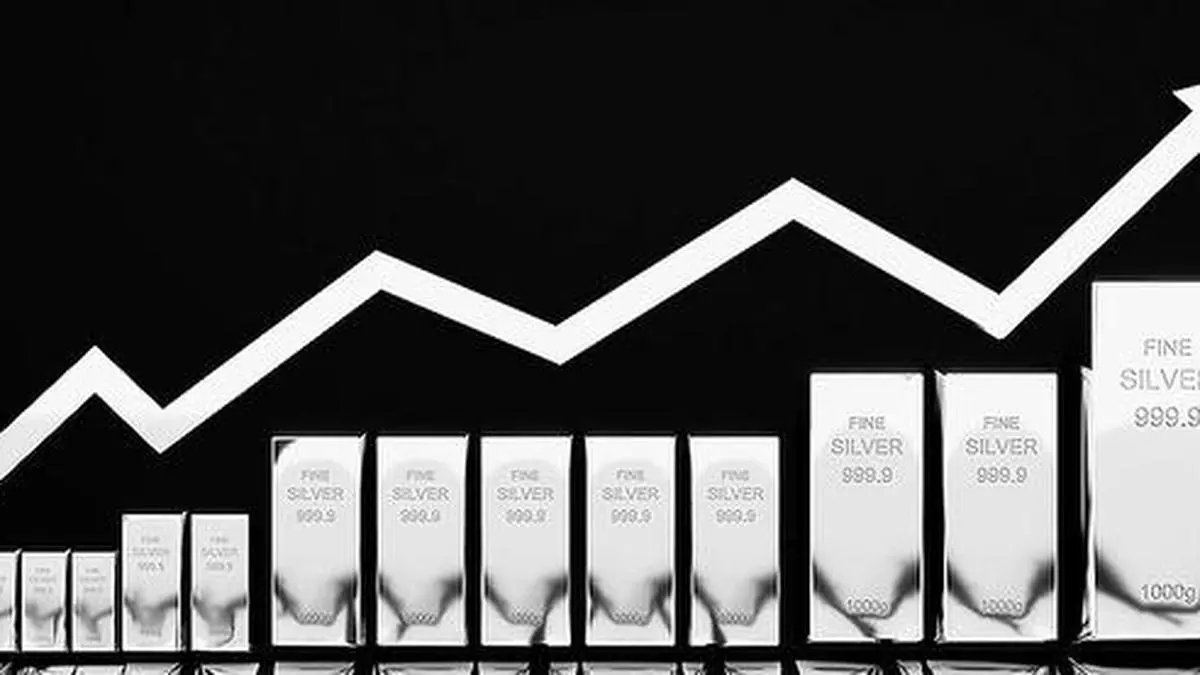
With silver prices topping $79 an ounce and gaining 18 per cent last week, the trade wonders if it would witness another “Silver Thursday” or “Silver Rule 7” will have an impact after the US-based CME Group has come up with new regulations.
On December 26 (Friday), the CME Group, which operates major derivatives exchanges such as CME, COMEX, CBOT and NYMEX, announced it was imposing a $25,000 initial margin for March 2026 silver derivative contracts. Earlier, it was imposing $20,000 margin.
If investors do not have the required amount in their accounts by Monday, their positions will be liquidated. In addition, CME has lowered position limits. Traders said the CME was trying to protect those who had gone short (selling without stocks on hand) in the futures market.
Technical vacuum
“The CME is creating a technical vacuum designed to force you out of your positions,” said a trader. The impact of the CME move was visible on the Shanghai Futures Exchange on Saturday, when silver prices dropped to 19,184 Chinese yuan a kg ($77.38 an ounce) for March contracts after rising to 19,209 yuan ($77.48).
The development comes amid fears of market manipulation, but traders said the CME group has come back with its “Silver Thursday” strategy.
During the weekend, silver ended at $79.11, while March futures slipped lower to $77.19 from $79.7. In India, silver ended the week in the Mumbai market at ₹2,32,100 a kg. On MCX, silver closed at ₹2,40,935.
Silver has gained 174 per cent so far this year, more than gold’s 73 per cent but a tad lower than platinum’s 180 per cent. Traders said silver is reminding the trade of the events that unfolded in the 1970s, when it soared to $50 an ounce.
When Hunts hunted silver
The only change is that its use has expanded to electric vehicles (EVs), solar panels, electronics and the medical sector. In the 1970s, the then US president Richard Nixon cut off the dollar’s link with gold.
Hunt brothers, Nelson and William, decided to take control of the silver market. They began mopping up silver at $2 an ounce. They garnered a huge share of the market and airlifted silver bars to Swiss vaults several times, which pushed up prices to $50 an ounce.
Then, jewellery manufacturers began melting stocks to make money from rising silver, and many sold their family silver. The problem resulted in a jeweller, Tiffany and Co, running a full page advertisement in the New York Times criticising the manipulation in the silver market.
The white precious metal’s price was reined in after Comex (Commodity Exchange) stepped in to impose trade limits. It led to prices nosediving by 50 per cent on a single day. It plunged to $10 from $50 in two months. It is recalled as “Silver Thursday”.
Move to curb at $75?
Similarly, in 2011, when silver hit $49.5 an ounce, the CME raised the margin five times within 10 days. It plunged prices by 30 per cent in a couple of weeks.
A market analyst said on “X” (formerly Twitter) that six global “powerful” financiers, including a CME official, had decided to curb silver’s rise beyond $75 an ounce. However, physical traders stepped in to counter the move.
The analyst said there were 41,000 call options contracts at $75 “strike”, which means the precious metal has to be delivered if prices top the level. The analyst said the fear was that there could be demand for delivery for these option trades.
The volume involved is 200 million ounces, whereas COMEX has an inventory of only 24.8 million ounces. This could only result in silver bursting through to $100 an ounce.
Chinese curbs
According to traders, the Chinese curbs on silver exports from January have begun to play out in the market. In addition, for every ounce of physical silver available in the market, over 300 ounces have been sold.
Silver’s current phenomenal run is being attributed to geopolitical crisis, lack of confidence in the dollar, tariff war and concerns over the global economy. In addition, the market has been facing a physical deficit since 2020, with a lack of new investments in the mining sector.
Published on December 28, 2025