
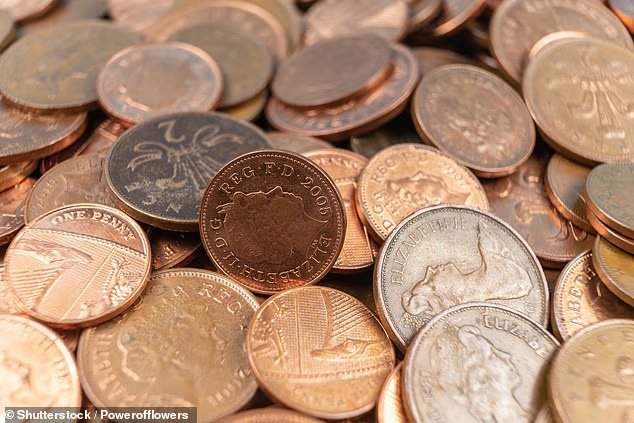
I’ve got a huge jar of 1 and 2p coins. Some are from the 1970s, 80s and 90s – and others are more modern.
I’ve seen the price of copper has gone up hugely in recent times. My question is, is the copper scrap value worth more than face value of the coins?
If so, how much is a 1p or 2p truly worth?
Helen Kirrane of This is Money replies: The 1p coin was one of three new coins introduced into general circulation in February 1971, when the United Kingdom adopted a new decimal currency system. The other two new coins were the 1/2p and 2p coins.
One and two pence coins minted between 1971 and 1991 were made of 97 per cent copper, before rising metal prices meant the Royal Mint started using steel.
One and and two pence coins minted after this were only copper-plated.

Moneymaker? This reader is wondering whether their 1 and 2p coins could be rising in value
The future of 1 and 2p coins was also thrown into doubt when it was revealed that the in July 2024 that the Treasury had not ordered any new coins to be minted from the Royal Mint and did not expect to order any new 1p and 2p coins in the coming years.
The key coins to look at in your collection are those from the 70s, 80s and early 90s as these have the highest copper content. There was also a 1998 two pence struck in copper.
One special coin that could earn you some cash as a collectible is the the 1983 ‘New Pence’ 2p coin. The 2p design used to read ‘New Pence,’ but this was changed to ‘Two Pence’ in 1982.
A small number of 1983 coins were mistakenly made with the old ‘New Pence’ wording, and these can be worth up to £1,000.
For expert advice on your copper coin conundrum, we spoke to Gregory Edwards, a coin expert at auctioneers Spink and Philip Mussell, director of coin news publication Token Publishing.
How much are 1p and 2p copper coins worth?
Helen Kirrane replies: Metal prices have surged over the past year. Gold and silver in particular have repeatedly hit new record highs.
But the copper price has also soared in recent months, rising to an all time high of more than $13,000 a tonne in January 2026.
This is due in part to high demand for the red metal.
Electric vehicles, renewable energy infrastructure such as wind turbines and solar panels, and the huge data centres required for the roll-out of artificial intelligence all require large amounts of copper.
Gregory Edwards replies: Pre-1992 copper coins – the 97 per cent copper blend – are worth more than their face value and they have been for some time.
Roughly speaking, the intrinsic content is about 100 per cent above the face value for a penny and the same for a two pence – so, a 1p could be worth 2p and a 2p worth 4p.
Philip Mussel replies: Today’s copper price is higher than it has been for a while, and whilst there are different types of copper it averages out around £5.50. A 1p weighs 3.56grams and a 2p weighs twice that at 7.12 grams.
This is a throwback to the days when a coin had actual value based on its metal – so a 2p had to weigh twice a 1p. You need 280 1p coins to make a kilo and 140 2p coins.
At the moment, you could make a profit of £2.70 on every kilo of copper coins. A kilo of copper 1p or 2p coins would have a face value of £2.80, but a scrap value of £5.50.
This theoretically gives a pure copper penny a value of 1.958p and a 2p a value of 3.916p.
But our ‘copper coins’ haven’t really been copper since 1860 when they changed to bronze, which is typically an alloy of 88 per cent copper and then 12 per cent tin. This means that straight away our coins are only worth 88 per cent of what they were had they been copper.
In reality, they are worth less than that as they aren’t a ‘pure’ metal (often there are other metals in bronze too) and may require work, therefore the scrap value reduces quickly.
What can you do with the coins?
Gregory Edwards replies: Under Section 10 of the 1971 Coinage Act, it is illegal to melt down or break up any metal coin that is currently circulating in the UK, or has ceased to be current at any time after May 16, 1969, unless a licence has been granted by the Treasury.
So you would be committing a criminal act by melting them down. Equally, scrap metal merchants usually buy and sell on the kilo and tonne of dirty and refined copper.
As these coins are 97 per cent copper, you would need a substantial sum of coins to make the endeavour worthwhile.
So it pays to hoard your pennies, but until the law changes, you cannot act.
Philip Mussel replies: Unfortunately scrapping a kilo here and a kilo there of copper let isn’t something most of the big scrappers want to deal. They are dealing in tons of the metal each day, and whilst you may find someone willing to take a kilo from you it won’t necessarily be an easy task.
After you’ve sorted all your coins to make sure that they are pre-1992, and finally found someone who’ll take a few kilos of bronze from you, you’re likely to be turned away when they find out it’s current coinage you’re trying to scrap.
In my opinion, it’s really not worth the hassle!
SAVE MONEY, MAKE MONEY

4.4% cash Isa
4.4% cash Isa
Trading 212: 0.8% fixed 12-month bonus

£100 cashback
£100 cashback
Transfer or fund at least £10,000 with Prosper
.jpg)
4.47% cash Isa
4.47% cash Isa
Includes 12-month boost for new customers

£3,000 cashback
£3,000 cashback
1% cashback up to £3,000 when transferring

Sipp transfers
Sipp transfers
Get between £100 and £3,000 cashback
Affiliate links: If you take out a product This is Money may earn a commission. These deals are chosen by our editorial team, as we think they are worth highlighting. This does not affect our editorial independence. Terms and conditions apply on all offers.