
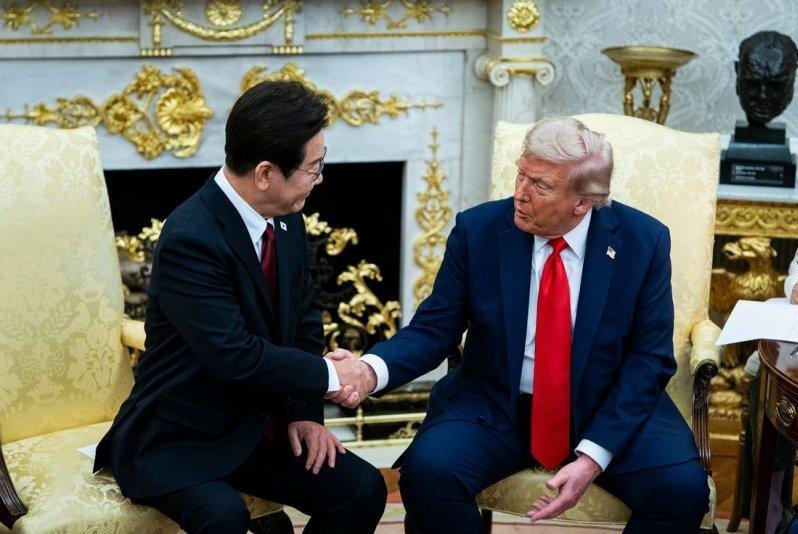
U.S. President Donald Trump and his South Korean counterpart, Lee Jae Myung, shake hands during a meeting in the Oval Office of the White House in Washington on August 25. To coincide with Lee’s visit, South Korean companies pledged to invest $150 billion in the United States. File Photo by Al Drago/UPI
SEOUL, Nov. 7 (UPI) — After the inauguration of the Donald Trump in January, the South Korean government and its corporations were pressed to invest hundreds of billions of dollars in the United States to avoid high tariffs.
Observers expressed concern Friday that such large-scale overseas investments could end up harming Asia’s fourth-largest economy, which heavily depends on the manufacturing industry.
Late last month, Seoul agreed to invest $200 billion in cash and $150 billion in shipbuilding and other industrial projects in the United States over the coming years, with an annual ceiling of $20 billion.
In return, Washington would reduce tariffs on Korean exports to 15% from 25%, honoring the terms agreed upon in late July. Trump also vowed to provide propulsion technology to help the key U.S. ally in East Asia build a nuclear-powered submarine.
The deal coincided with Trump’s visit to Korea to meet his counterpart, President Lee Jae Myung, on the sidelines of the Asia-Pacific Economic Cooperation Summit.
“Beginning next year, our annual investments in the United States are expected to double compared to 2025. When corporate funds move abroad, companies will have less capacity to invest at home,” Sogang University economics Professor Hur Jung told UPI.
“The problem is that it appears to become a long-term trend, which is feared to lead to the hollowing out of Korea’s manufacturing sector. The government is required to put forth great efforts to address this,” he said.
Hur recommended the country to prioritize traditional industries, such as semiconductors and automobiles, rather than concentrate on artificial intelligence-based innovations, which have been the main focus of the incumbent Seoul administration.
Other analysts note that the worries go beyond the $350 billion investment plan, as many Korean corporations have announced major spending initiatives in the United States to avoid high tariffs.
For example, Korea’s state-backed companies and private enterprises promised up to $150 billion in investments in the United States in August, when Lee had his first summit with Trump.
Back then, Hyundai Motor Group unveiled a plan to funnel $26 billion in the United States until 2028, while Hanwha Group committed $5 billion to expand its shipyard in Philadelphia, which the Korean conglomerate acquired late last year.
Korean Air also plans to purchase 103 aircraft from Boeing by the end of the 2030s, which is expected to total $36.2 billion in value.
“Korea Inc. invested $106 billion in domestic facilities last year. And its companies are now ready to spend $150 billion in the United States alone after a single meeting between the two countries’ political leaders in August. Does it make sense?” economic commentator Kim Kyeong-joon, formerly vice chairman at Deloitte Consulting Korea, asked rhetorically in a phone interview.
“Our foreign exchange reserves stand at just over $400 billion, and we are preparing to pour more than that amount into a single foreign market. Such an approach could weaken our ability to invest domestically, weighing heavily on the manufacturing-based economy,” he said.
According to the Organization for Economic Cooperation and Development, manufacturing accounts for 27% of South Korea’s gross domestic product, which is almost double the average among other member countries.
Against this backdrop, the Ministry of Trade, Industry and Resources is set to establish a forum involving related researchers and businesses to deal with the expected crisis. The Bank of Korea also warned of the gravity of the situation in an August report.
“As in past crises, our corporations, the government and households need to share a sense of urgency and work together to overhaul the country’s aging economic structure,” the central bank said at the time.
However, critics take issue with the complacency of top policymakers like Kim Yong-beom, chief presidential secretary for policy in the current administration, who downplayed fears about the hollowing out of the domestic manufacturing sector.
“Such assessments may be premature because many partner firms and key operations, including research and development centers, still remain based in Korea,” Kim told a conference in early September.