

The $200,000 Financing Mistake That Changed How I Approach Investment Property Mortgages Forever
Four years ago, I watched a savvy real estate investor make a financing decision that cost him over $200,000 in potential profits. He was acquiring a gas station, very near to a 12-unit apartment building in an emerging neighborhood – exactly the type of property that creates generational wealth when financed properly. The numbers worked beautifully: $1.2 million purchase price, $18,000 monthly income, and strong appreciation potential based on nearby development projects. More of those Gas Station listings for sale can be found on our website!
The investor had excellent credit, substantial assets, and plenty of experience. But he was eager to close quickly before interest rates rose, so he accepted the first financing offer he received: a conventional investment property loan at 6.25% with 25% down. The loan officer assured him it was “competitive for investment properties,” and mathematically, the deal still generated positive cash flow.
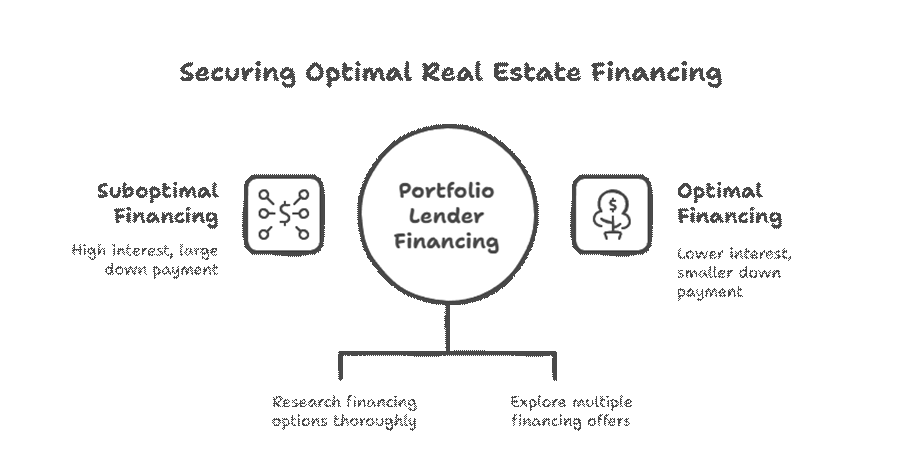
What he didn’t realize was that with a little more preparation and a broader search, he could have secured portfolio lender financing at 5.5% with just 20% down. That 0.75% interest rate difference plus the extra 5% down payment he didn’t need to put down would have saved him $87,000 in upfront costs and approximately $130,000 in interest payments over the loan term.
But the real cost was opportunity cost. The extra $87,000 he tied up in that down payment could have been leveraged into another property that would have generated additional cash flow and appreciation. When I calculated the total impact over his 10-year investment horizon, including the lost opportunity to deploy that capital elsewhere, the “convenient” financing decision cost him well over $200,000.
Why Investment Property Financing Is a Completely Different Game
Most people approach investment property financing like they’re buying another home, and that mindset creates expensive mistakes from day one. Lenders view investment properties as fundamentally riskier than primary residences, and every aspect of the financing reflects this increased risk assessment.
The down payment requirements alone shock many first-time investors. While you might buy a primary residence with 3-10% down, investment properties typically require 20-30% down, and some lenders demand even more for certain property types or borrower profiles. This isn’t just about lender greed – it’s about risk management. If you default on your primary residence, you lose your home. If you default on an investment property, you’re more likely to walk away, especially if the property has lost value.
Credit score requirements are significantly higher for investment properties. While you might qualify for a primary residence mortgage with a 620 credit score, most investment property lenders want to see scores of 720 or higher. They’re also much less forgiving of recent credit issues, bankruptcies, or foreclosures. The logic is simple: if you’re going to be managing multiple properties and mortgages, they want evidence that you’re exceptionally reliable with credit obligations.
The debt-to-income calculations become much more complex with investment properties. Lenders typically count only 75% of projected rental income when calculating your qualifying income, acknowledging that rental properties have vacancy periods and unexpected expenses. Some lenders are even more conservative, counting only 50-65% of rental income, especially for new investors who don’t have a track record of managing rental properties successfully.
Conventional Financing: The Foundation Most Investors Start With
Conventional loans remain the most common financing option for investment properties, but success requires understanding the nuances that separate experienced investors from newcomers who struggle to get approved.
Fixed-rate mortgages provide predictable payments that make cash flow analysis straightforward, but they typically carry higher rates than adjustable-rate options. For buy-and-hold investors planning to keep properties long-term, the payment stability often justifies the rate premium. However, for investors planning to refinance within a few years or sell the property, adjustable-rate mortgages can provide lower initial payments and free up cash for additional investments.
I typically recommend adjustable-rate mortgages for investors who plan to refinance within 3-5 years or who are acquiring properties in rapidly appreciating markets where they expect to sell or refinance before rate adjustments become significant. The initial rate savings can be substantial – I’ve seen 5/1 ARMs priced 0.75% below comparable fixed-rate loans, which translates to hundreds of dollars monthly in cash flow improvement.
Portfolio lenders offer some of the best conventional financing options for serious investors, but most people don’t know they exist. These are banks and credit unions that keep loans on their books rather than selling them to Fannie Mae or Freddie Mac. Because they’re not constrained by government-sponsored enterprise guidelines, they can offer more flexible terms: lower down payments, higher debt-to-income ratios, and sometimes better rates for borrowers with strong banking relationships.
Alternative Financing: When Conventional Doesn’t Work
Sometimes conventional financing isn’t available or optimal, and alternative financing options can unlock opportunities that would otherwise be impossible. But these options require careful analysis because they often involve higher costs or additional risks that can undermine your investment returns if not managed properly.
Hard money loans serve a specific purpose in real estate investing: they provide fast access to capital when timing is critical. I’ve used hard money to help investors acquire distressed properties that needed to close within days, or to fund fix-and-flip projects where the renovation timeline didn’t allow for conventional financing delays. But hard money rates typically run 8-12%, with points and fees that can add another 2-4% to your upfront costs.
The key to successful hard money use is having a clear exit strategy. I worked with a client who used hard money to acquire a property at auction, completed renovations within four months, and then refinanced into conventional financing. The hard money loan cost approximately $15,000 more than conventional financing would have, but it enabled him to acquire a property worth $180,000 for just $95,000 – a net profit that more than justified the financing premium.
Private lenders can offer more flexible terms than institutional lenders, but they require careful vetting and legal documentation. I’ve seen successful private lending arrangements where investors borrowed from individuals at competitive rates with more flexible qualification criteria.
Qualifying for Investment Property Loans: The Strategic Approach
Getting approved for investment property financing requires more than just meeting minimum requirements – you need to position yourself as the type of borrower that lenders compete for rather than reluctantly accept.
Your credit profile needs to be spotless, not just adequate. Lenders scrutinize investment property borrowers much more carefully than primary residence buyers. I always recommend investors get their credit scores above 760 before shopping for investment property loans. The rate improvements between 720 and 760+ credit scores can save thousands of dollars annually in interest payments.
Income documentation becomes more complex with investment properties because you’re asking lenders to count rental income that doesn’t exist yet. For your first investment property, lenders typically won’t count any of the projected rental income in your qualification calculations. For subsequent properties, they’ll usually count 75% of lease income from existing rentals, but they want to see lease agreements, rent rolls, and tax returns that show consistent rental income.
The Cash Flow Optimization Strategy
Successful investment property financing isn’t just about getting approved – it’s about structuring loans to maximize cash flow and minimize risk across your entire portfolio. This requires thinking about financing holistically rather than optimizing each property in isolation.
Loan term selection has an enormous impact on cash flow and total returns. Longer loan terms reduce monthly payments and increase cash flow, but they also increase total interest costs and reduce equity buildup. I typically recommend 30-year terms for buy-and-hold investors focused on cash flow, and shorter terms for investors prioritizing equity building or planning to hold properties only a few years.
The math can be counterintuitive. A client was comparing 20-year versus 30-year financing on a property that generated $2,800 monthly rent. The 20-year loan had monthly payments of $1,950, while the 30-year loan payments were $1,650. The extra $300 monthly cash flow from the 30-year loan allowed him to save for the down payment on his next property 18 months sooner. The income from that second property more than offset the extra interest costs from the longer loan term.
Common Financing Mistakes That Destroy Returns
After helping hundreds of investors structure their financing, I’ve identified patterns in the mistakes that separate successful investors from those who struggle to build wealth through real estate.
Overleveraging kills more real estate investment careers than market downturns or bad tenants. Investors get excited about using leverage to amplify returns and forget that leverage also amplifies losses. I’ve seen investors stretch to buy as many properties as possible, leaving themselves with no cushion for vacancies, repairs, or market changes. When several properties hit problems simultaneously, they lose everything.
The safe leverage approach is ensuring that each property can handle mortgage payments even with extended vacancies. I recommend that properties generate enough rent to cover mortgage payments, insurance, taxes, and maintenance reserves even with 10-15% vacancy factors. This conservative approach might reduce your initial portfolio size, but it ensures long-term survival and profitability.
Ignoring total cost of financing is another expensive mistake. Investors often focus solely on interest rates while overlooking points, fees, closing costs, and ongoing expenses that can significantly impact returns.
Alternative Strategies for Portfolio Growth
Experienced investors often use sophisticated financing strategies that allow faster portfolio growth while managing risk effectively. These strategies require more complex planning but can dramatically accelerate wealth building for qualified investors.
BRRRR (Buy, Rehab, Rent, Refinance, Repeat) allows investors to recycle their capital repeatedly by refinancing properties after renovation to pull out most or all of their invested capital. The strategy works when you can buy properties below market value, add value through improvements, and refinance based on the improved value at higher loan-to-value ratios.
I worked with an investor who perfected this strategy with single-family homes in transitioning neighborhoods. He would acquire distressed properties for $80,000-$100,000, invest $30,000-$40,000 in renovations, and create properties worth $160,000-$180,000. After renting them for six months to establish income history, he would refinance at 75% of the improved value, pulling out $120,000-$135,000 – enough to cover his initial investment plus most of the renovation costs.
Cross-collateralization allows investors to use equity in multiple properties to secure financing for additional acquisitions. Instead of putting down 25-30% cash for each property, you might pledge several existing properties as collateral for loans to acquire new properties with little or no money down. This strategy can accelerate portfolio growth but increases risk because problems with one property can affect your entire portfolio.
Building Lender Relationships for Long-Term Success
The most successful real estate investors don’t just find financing – they build relationships with lenders who become partners in their investment strategy. These relationships provide access to better terms, faster approvals, and creative financing solutions that aren’t available to ordinary borrowers.
Portfolio lenders offer the best opportunities for relationship building because they keep loans on their books and have more flexibility in underwriting and pricing. I always recommend investors identify 2-3 portfolio lenders in their market and begin building relationships even before they need financing. Open business accounts, maintain substantial balances, and get to know the commercial lending team.
One of my most successful investor clients built a relationship with a community bank that led to incredible financing opportunities. He started by moving his business banking to the institution and maintaining six-figure average balances. When he needed financing for his first investment property, they offered portfolio terms better than he could find elsewhere.
The Future of Investment Property Financing
The investment property financing landscape continues to evolve, driven by regulatory changes, technology improvements, and shifting market conditions. Understanding these trends helps investors position themselves for future opportunities and challenges.
Technology is streamlining the application and approval process for investment property loans. Online platforms now allow investors to compare multiple lenders, submit applications digitally, and track approval progress in real-time. However, relationship-based lending remains important for serious investors who need flexible terms and creative financing solutions.
Regulatory changes periodically affect investment property financing availability and terms. The qualified mortgage rules that took effect after the 2008 financial crisis made some types of investor financing more difficult to obtain. Future regulatory changes could further impact lending standards, so smart investors maintain financing options with multiple lender types.
Making Your Financing Strategy Work
The $200,000 mistake I described at the beginning could have been avoided with better preparation and a more strategic approach to financing. That investor eventually became one of my most successful clients, but only after he learned to treat financing as a strategic tool rather than just a means to an end.
Successful investment property financing requires understanding all your options, building relationships with multiple lenders, and structuring loans to optimize your overall portfolio returns rather than just getting the lowest rate on individual properties. It means planning your financing strategy before you start shopping for properties, and it means being prepared to walk away from deals that don’t meet your financing criteria.