Close Menu
Invest Intellect
    Facebook X (Twitter) Instagram
    Invest Intellect
    Facebook X (Twitter) Instagram Pinterest
    • Home
    • Commodities
    • Cryptocurrency
    • Fintech
    • Investments
    • Precious Metal
    • Property
    • Stock Market
    Invest Intellect
    Home»Investments»China’s stock woes: funds shun equities for bonds, ETFs, luxury homes in downbeat market
    Investments

    China’s stock woes: funds shun equities for bonds, ETFs, luxury homes in downbeat market

    August 24, 20248 Mins Read


    Four months after the State Council, China’s cabinet, unveiled a nine-point document aimed at restoring investors’ confidence and attracting long-term funds, the market is back in a downward spiral after a relief rally. There are telltale signs of investors shunning stocks: turnover on the Shanghai and Shenzhen exchanges has plunged to a four-year low, the benchmark CSI 300 Index has lost a tenth of its value from this year’s high and quick sector rotations dominate trading.
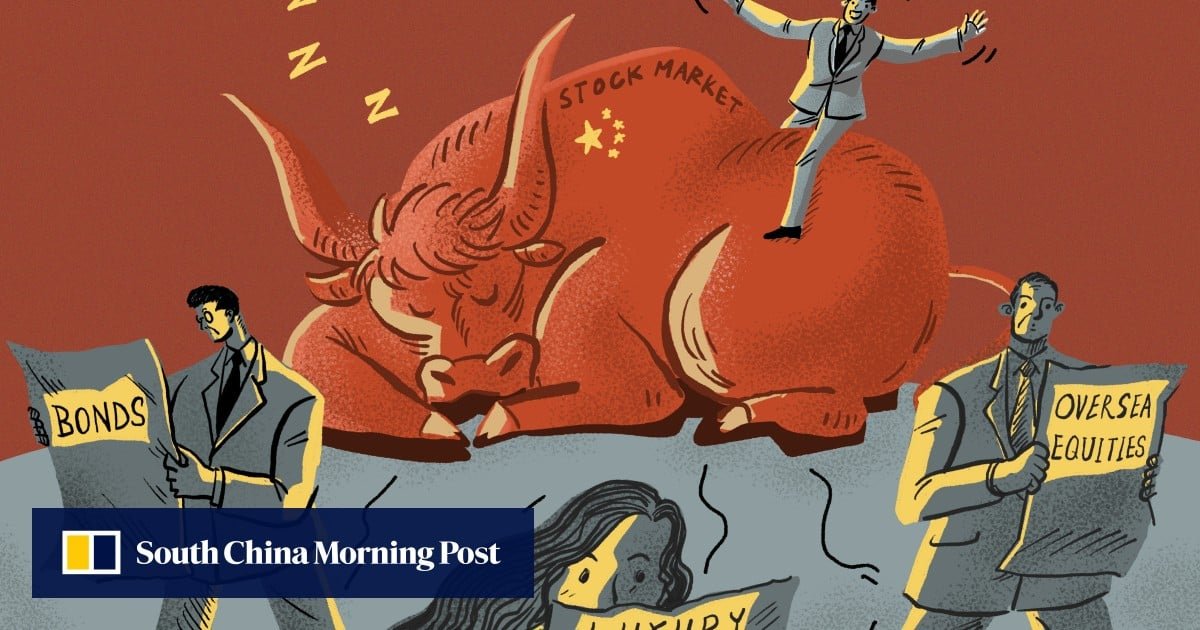
    Instead, investors have been scooping up other assets from bonds to exchange-traded funds (ETFs) tracking overseas equities, and luxury homes in tier-one cities. The frenzy is in sharp contrast to the flagging stock market, with the yield on the benchmark government bond sliding to a record low, ETFs tracking underlying US and Japanese stocks trading at a premium to their net-asset values and new luxury homes selling out.

    This is a setback for Wu Qing, the chairman of China Securities Regulatory Commission (CSRC), who rolled out a flurry of measures since he took over in February, from pledges to boost the quality of listed companies to crackdowns on short selling. After a brief rebound spurred by such state support, investors have been fleeing amid worries about the prospects of economic growth and corporate earnings.

    “The Chinese markets remain very frustrating for investors,” said Gary Dugan, CEO of The Global CIO Office in Dubai, which provides services to family offices, wealth managers and ultra-high-net-worth individuals. “Investors are looking for tangible and sizeable measures from the government. The market is in need of policies that [can] deliver a boost to near term growth. If an effective stimulus is delivered to the economy, the upside in the market could be sizeable.”

    Investors are disappointed by the absence of strong follow-up measures, particularly to defuse and tackle the protracted woes in the property market, after the Communist Party’s third plenary session and the ensuing Politburo meeting. At these two gatherings, top leaders pledged to achieve the annual gross domestic product target of about 5 per cent, spurring optimism about increased policy support for short-term growth.

    Instead, China’s central bank made cuts to the policy interest rate and the longer-term loan prime rate following the two meetings, underwhelming stock traders and triggering a flight to haven trades.

    “While the Politburo’s communique acknowledged economic lethargy and promised measures to address the weakness, there were no new specific policies,” said Ronald Temple, chief market strategist at Lazard Asset Management. “The Politburo highlighted the need to resolve housing issues, but it offered no new meaningful measures to absorb the excess supply of housing units or to stimulate consumption in the broader economy.”

    Temple said he was withdrawing the call he made earlier this year about China’s growth bottoming, adding that “China will likely be a drag on global growth again in 2024 and 2025”.

    China’s patchy economic recovery continued into July. New bank lending grew at the slowest pace in 14 years and industrial output fell short of expectations, while retail sales slightly beat estimates.

    The CSI 300 Index is now about 10 per cent off the high for the year set on May 20, and the combined daily trading values on the Shanghai and Shenzhen exchanges fell to 472.9 billion yuan (US$66.1 billion) last week. It was the lowest since May 2020 and considerably smaller than the daily average of 589 billion yuan this month and 790 billion yuan this year.

    Even some of the most extreme measures taken by the CSRC have failed to revive confidence. A month ago, the watchdog suspended the securities relending business by state-backed margin-trading firm China Securities Finance, which loans stocks to short sellers. That has virtually decimated short selling, plunging outstanding value to a more than four-year low as short-sellers rushed to unwind trades to skirt the clampdown.

    China’s opaque reshuffling of high-ranking finance officials and the ongoing clean-up of the securities industry have also put investors on edge, leaving them guessing about the policy intentions.

    Last month, the CSRC abruptly replaced vice-chairman Fang Xinghai, a reform-minded and outspoken official who helped to facilitate communication between the Chinese regulator and overseas investors. Though Fang had just crossed the official retirement age of 60, his departure stoked concerns about further opening-up of the capital market particularly amid an exodus of foreign investors.
    A week later, Zhao Xuejun, chairman of Harvest Fund Management, was placed under official investigation without any specific reason. Beijing-based Harvest is the nation’s fourth-largest mutual-fund firm overseeing 1.57 trillion yuan in assets. Before that, the government had initiated investigations into several senior officials at the Shanghai Stock Exchange and the head of the CSRC’s branch in eastern Jiangsu province.
    All these developments, together with a dire outlook for the economy, have deterred China’s 220 million retail investors, the largest such group in the world, from making fresh investments. Of the 532.4 billion yuan in new mutual funds launched in the first half, only 600 million yuan was stock focused, with the rest targeting fixed-income products, according to industry data.

    To be sure, some optimists argue that the downside risk is limited and stocks are attractive relative to bonds, which are fetching record-low yields.

    “In terms of valuation, Hong Kong-China equities are currently trading at the lower end of their historical range, which could represent attractive entry points for longer term investors,” said William Fong, head of Hong Kong China equities at Baring Asset Management in Hong Kong. “As the economy gradually normalises, we are finding attractively priced, strong structural growth opportunities from a bottom-up perspective.”

    Stocks linked to infrastructure, healthcare and technology may outperform as they benefit from the nation’s strategies to pursue sustainable growth, tech innovation and environmental awareness, he said.

    UBS Group strategist Meng Lei said China’s insurance companies, which sit on total assets of more than 30 trillion yuan, would gradually switch to stocks, as the industry’s investment returns are set to be squeezed by rapidly falling bond yields. The yield on China’s benchmark 10-year government bond fell to an all-time low of 2.124 per cent on August 2.

    “The inflows from insurance companies [to stocks] won’t take place overnight,” said Meng. “They will add positions gradually depending on the changes in fundamentals and earnings recovery.”

    The CSI 300 Index is currently valued at 11.6 times estimated earnings for this year, compared with a multiple of 23.2 for the S&P 500 Index and 21.2 for the Nikkei 225, according to Bloomberg data.

    Despite the edge, investors remain vigilant against falling into the so-called valuation trap – cheaper valuations offset by lower corporate earnings.

    UBS’ rare rating downgrade last month of Kweichow Moutai, the maker of premium baijiu liquor, alarmed stock traders. The Swiss bank predicted that the compound annual profit growth for the liquor behemoth would slow to 8 per cent from 2023 to 2025, just over half the rate between 2020 and 2023, because of shrinking demand amid weak consumer spending.

    For now, investors are fixated on asset classes other than stocks. Some are betting on the extension of a record-breaking rally in the bond market, even as the central bank repeatedly warns of the potential risk of low yields that could lead to huge investment losses should growth pick up. They argue that the deflationary trend in producer prices will prompt further interest-rate cuts to bolster demand for debt products. China’s factory-gate prices dropped for a 22nd month in July, while consumer inflation remained below 1 per cent for the 17th month in a row.

    Overseas diversification is another popular strategy employed by Chinese investors. Buying of domestically domiciled ETFs tracking stocks in the US and Japan, where both benchmarks hit record highs this year, has been so frenzied that asset-management firms have had to issue repeated statements reminding investors of the risks.

    An ETF linked to the Nikkei 225 run by China Asset Management at one point traded at a record 21 per cent premium to its net-asset value this year, while the premium in the firm’s ETF tracking the S&P 500 Index touched an all-time high of 18 per cent, according to Bloomberg data, underscoring robust demand in the secondary market.

    Besides these options, China’s wealthy investors have set their eyes on a niche segment in the country’s beleaguered property market, parking money in luxury homes in tier-one cities on expectations that limited supply will protect their wealth.

    In Shanghai, China’s biggest city, about 1,600 units priced at 30 million yuan or more found buyers in the first half, an increase of almost 40 per cent from a year ago, according to China Real Estate Information Corp. Most of these flats were located in the downtown areas, where land supply for residential flats is scarce.

    “If you really want to find a safe harbour for capital now, luxury homes in big cities such as Shanghai should be the best choice,” said Yan Yuejin, vice-president of E-house China Real Estate Research and Development Institute in Shanghai. “No matter how home prices swing, these premium properties are rare and can meet the demand for preserving and boosting wealth.”

    For now, overseas investors have taken a back seat as signs of a stock rally remain elusive.

    “No one has China and Hong Kong [stocks] on their radar now,” said Brook McConnell, president at South Ocean Management.

    “There’s slow improvement, just not enough to get anyone excited yet. The patient is still lying still on the bed. The markets need more from Beijing.”


    Source link

    Share. Facebook Twitter Pinterest LinkedIn Tumblr Email

    Related Posts

    See How Retirement Savings Vary Among Americans by Age

    Investments

    55-64 Year Olds Retirement Savings Analysis Reveals Surprises About Their Financial Readiness

    Investments

    Millennials and Retirement—What the Numbers Show About Becoming a Millionaire

    Investments

    changes that could reshape your retirement

    Investments

    Which Country Has the World’s Oldest Retirement Age?

    Investments

    I’m Betting Big On These 8-10% Yields For Early Retirement

    Investments
    Leave A Reply Cancel Reply

    Top Picks
    Commodities

    TC Energy Corporation lance la perception des péages sur le gazoduc Southeast Gateway

    Cryptocurrency

    Next Cryptocurrency to Explode, 26 February — AI Rig Complex, Filecoin, Immutable, Sui

    Investments

    Après le PSG et Braga, QSI pourrait acquérir Malaga

    Editors Picks

    Augmentum Fintech investit dans la plateforme d’investissement pour particuliers RetailBook

    May 12, 2025

    China, Indonesia launch new local currency settlement framework

    September 11, 2025

    Tesla’s Bitcoin Pile Intact Despite Recent Wallet Moves — Elon Musk-Led Company HODLes King Crypto For 5th Straight Quarter – Tesla (NASDAQ:TSLA)

    October 24, 2024

    Gold and silver prices today on 13-10-2024: Check latest rates in your city

    October 13, 2024
    What's Hot

    King Street et Lumyna annoncent le lancement du fonds Lumyna

    March 31, 2025

    Sustainable bonds planned amid tight global markets – Newspaper

    August 18, 2025

    All you need to know about the EU agriculture sector

    February 13, 2024
    Our Picks

    New Mastercard-Fintech Alliance Enhances Digital Payments

    August 20, 2024

    “Câbles et systèmes arrachés”, écoulement de fioul… enquête après des dégradations dans un dépôt pétrolier Bolloré Energy, site classé Seveso

    February 26, 2025

    LLMs are now commodities: Nilekani – Technology News

    February 21, 2025
    Weekly Top

    Gold, silver rates today: Metal prices continue to rise. Should you buy them before the Union Budget 2026?

    January 25, 2026

    Cyprus extends deadline for €67.5m agricultural investment schemes

    January 24, 2026

    The new treasure hunters: How metal-detecting became a way for women in the UK to bond | Culture

    January 24, 2026
    Editor's Pick

    Australian Fintech Ziksu partners with Elanistech to tap Indian student market

    August 16, 2024

    HMRC data – Mortgage Strategy

    July 31, 2025

    Hackers Use Fake Web3 Job Interviews To Steal Cryptocurrency From Job Seekers

    February 28, 2025
    © 2026 Invest Intellect
    • Contact us
    • Privacy Policy
    • Terms and Conditions

    Type above and press Enter to search. Press Esc to cancel.