
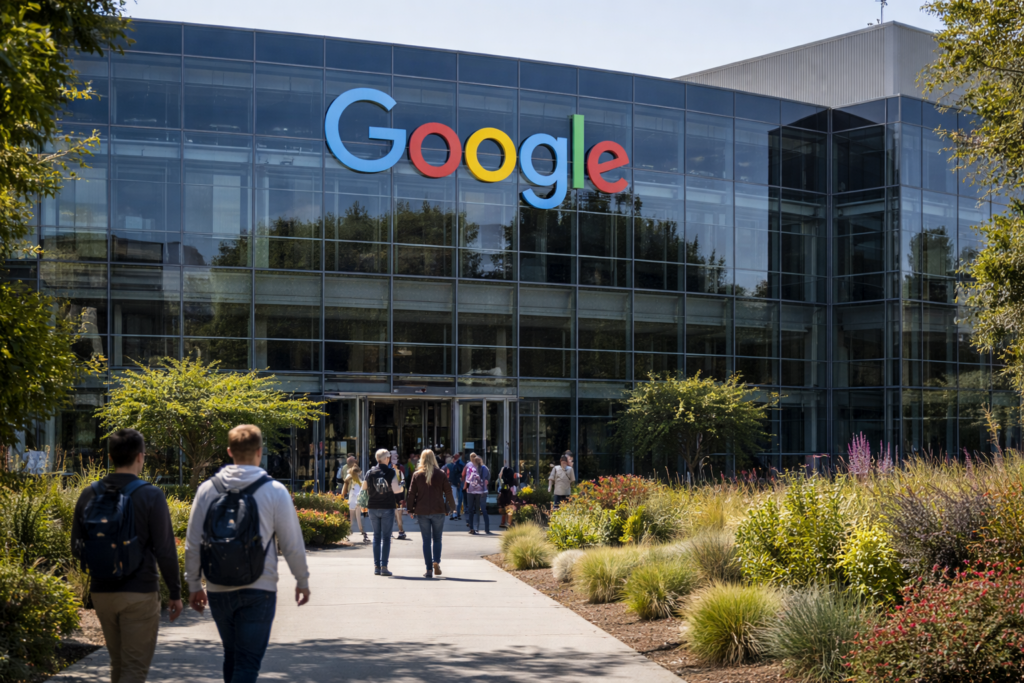
If the scale of Big Tech’s AI spending plans for 2026 was not striking enough, Alphabet’s reported move to issue a rare 100-year bond has added a new dimension to the debate over how far tech giants are willing to go to finance the AI boom.
Alphabet Inc. is preparing to sell a rare 100-year bond as part of a massive debt issuance, marking the first sale of such ultra-long-dated debt by a technology company since the late 1990s, according to Bloomberg.
Alphabet plans to raise around $20 billion in the current bond offering- this was later confirmed by Reuters which said Alphabet, in a company filing on Tuesday, had announced filing for a bond offering to raise around $20 billion.
The proposed century bond will be denominated in sterling and is expected to form part of a broader multi-tranche issuance that includes four other pound-denominated notes.
The fundraising is part of a wider push to support roughly $185 billion in investment this year, much of it tied to artificial intelligence infrastructure, data centres and next-generation technologies.
Alphabet’s rare century bond offering signals both the scale of the AI investment boom and the extraordinary confidence investors are placing in the staying power of today’s tech giants.
Century bonds: rare instruments for exceptional issuers
Century bonds are among the most unusual instruments in corporate finance, issued only by companies perceived to have exceptional longevity and financial resilience.
They are typically associated with blue-chip industrial giants rather than fast-moving technology firms.
“So-called century bonds tend to be museum pieces because they’re so rare,” Michael Collins, senior investment officer at Prudential Fixed Income, said in a 2010 Wall Street Journal report.
If Alphabet proceeds with the issuance, it will join a small club of corporate issuers that have sold 100-year debt, including Ford Motor Co., which raised $2.5 billion through a green bond in 2021, and Motorola, the last high-grade company to issue a century bond in 1997.
Other iconic American companies such as Walt Disney, Coca-Cola and IBM issued similar bonds in the early 1990s, when long-term interest rates were relatively low and investor appetite for ultra-long maturities was strong.
Yet the prospect of a century bond from a technology firm is seen as unconventional.
Even Oracle and Meta Platforms drew attention in recent years when they issued 40-year bonds, a maturity that tech companies once avoided due to uncertainty about long-term industry dynamics.
Why investors buy debt that lasts a century
The appeal of century bonds lies less in their novelty than in their ability to match long-term liabilities.
Life insurance companies and pension funds are natural buyers because they seek assets with maturities that align with decades-long obligations.
Since these investors often hold the bonds to maturity, century bonds tend to trade infrequently in secondary markets.
Insurers such as Prudential, Aviva and Genworth were among buyers of Coca-Cola’s 100-year bonds issued in 1993.
Ultra-long debt can also attract investors engaged in long-term estate planning, who view such bonds as a stable vehicle for transferring wealth across generations.
Strengths and pitfalls of 100-year bonds
At times, strong demand for century bonds has reflected broader pessimism about near-term returns in traditional fixed-income markets.
In mid-2019, for instance, interest rates on long-term government bonds plunged to record lows, with several sovereign nations even issuing debt at negative yields.
However, historical experience serves as a warning that corporate longevity is never guaranteed.
Coca-Cola’s market value stagnated for years following its 1990s issuance, while IBM’s dominance eroded as a new generation of technology leaders emerged.
The decline of Motorola was even more precipitous; despite being a top 25 US corporation by market cap and revenue when it issued its century bond in 1997, it has since plummeted.
As investor Michael Burry recently noted on social media: ‘Today, Motorola is the 232nd largest market cap with only $11 billion in sales.’
Why analysts expect good demand for the 100-year bond
The company is pouring capital into artificial intelligence, autonomous vehicles, robotics and quantum computing through its next-generation Willow processors, signalling ambitions that extend far beyond search and advertising.
Yet even Alphabet chief executive Sundar Pichai has stopped short of projecting the company’s trajectory far into the future, underscoring the inherent uncertainty of technology over a century-long horizon.
However, reports suggest that Alphabet’s current bond sale has attracted more than $100 billion in demand across currencies and maturities, signalling sustained appetite for high-grade corporate debt even amid market volatility.
Nancy Tengler, chief executive and chief investment officer of Laffer Tengler Investments, argues that today’s technology leaders are fundamentally different from their predecessors.
“You have to view this very differently than in the 90s because these companies now have enormous cash reserves,” she said in a Barron’s report.
“We’re not just betting on AI — we also believe in robotics, space, quantum and nuclear as key areas to round out our strategy.”
Bruno Schneller, managing partner at Erlen Capital Management in Zurich, agreed in a MarketWatch report, saying given Alphabet’s profile, its strong balance sheet, cash generation, and market access, “it is one of the few corporates that can credibly issue at that tenor.”
The willingness of investors to lock capital into a technology company for a century also reflects a broader shift in how the sector is perceived.
Once seen as cyclical and vulnerable to disruption, hyperscale tech firms are increasingly viewed as critical infrastructure providers.
“The ability of a tech company to issue a 100-year bond shows how investors are increasingly treating hyperscalers as long-term infrastructure rather than cyclical tech,” eToro global market analyst Lale Akoner said.
Analysts also say issuing a 100-year bond in sterling is strategically sound because the UK market has a deep pool of investors accustomed to ultra-long maturities.
“They’ve chosen sterling bonds not only to expand the investor pool but also because they may believe the real value of what they must repay will fall over time,” Pepperstone analyst Michael Brown said in a Dow Jones report.
“You’d expect demand for the sale to be pretty healthy.”
Alphabet’s broader funding strategy
Alphabet’s century bond plan is unfolding alongside a multi-tranche offering in the US dollar market and a potential debut issuance in Swiss francs.
The company has been marketing a seven-part dollar transaction expected to be priced shortly, reflecting a diversified approach to funding.
Alphabet last tapped the US bond market in November, raising $17.5 billion in a deal that attracted roughly $90 billion of orders.
That issuance included a 50-year bond, the longest corporate tech bond sold in US dollars last year, which has since tightened in secondary markets.
The company also raised €6.5 billion in Europe at the time.