
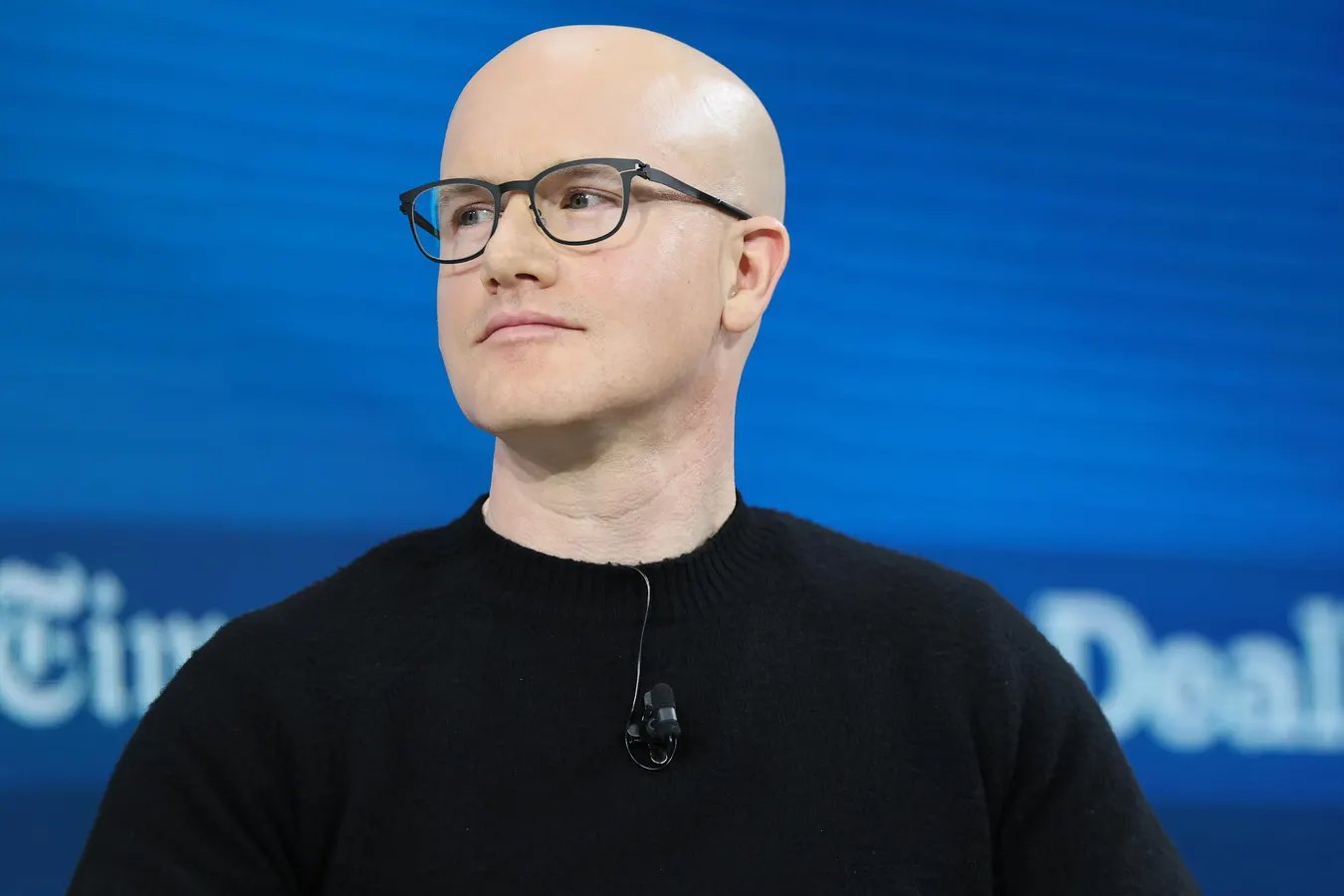

NEW YORK, NEW YORK – DECEMBER 03: Coinbase CEO Brian Armstrong sits silently onstage during the 2025 New York Times Dealbook Summit at Jazz at Lincoln Center on December 03, 2025 in New York City. NYT columnist Sorkin hosted the annual Dealbook summit which brings together business and government leaders to discuss the most important stories across business, politics and culture. (Photo by Michael M. Santiago/Getty Images)
Getty Images
In December 2025, Coinbase CEO Brian Armstrong took the stage in San Francisco to announce what he called “The Everything Exchange.” The company that built its business on Bitcoin was now offering stocks, prediction markets, derivatives, AI-powered financial advice, and loans of up to $5 million against crypto holdings — all in one app.
“Coinbase is no longer a place to just trade crypto,” Armstrong declared. “It’s a place where you can trade everything.”
Across town, Robinhood was telling a similar story. The company reported that prediction markets ( contracts letting users bet on election outcomes, sports, and economic data ) had become its fastest-growing product ever, reaching $100 million in annualized revenue in under a year. CEO Vlad Tenev called prediction markets potentially “one of the largest asset classes” in finance.
And in Paris, a team of former FXCM executives was building Ouinex, a platform designed to let crypto traders access forex, commodities, and stock indices without leaving the crypto ecosystem. “The user experience is super fragmented,” founder Ilies Larbi told me. “You can’t trade gold or stocks if you’re a crypto bro. On the other hand, the CFD world is completely separate.”
Every fintech under the sun seems to be heading in the same direction: the everything app.
The Great Convergence
The lines between what used to be distinct financial products are dissolving. What started as specialized platforms : Robinhood for commission-free stock trading, Coinbase for cryptocurrency, PayPal for payments, Revolut for international banking — are all converging into sprawling super-apps that handle everything from stock trades to stablecoin savings to sports betting.
Coinbase’s December announcement crystallized the trend. The platform now holds over $500 billion in crypto assets, a figure that grew fivefold in three years. But the company is no longer content with crypto alone. Users can buy stocks using USDC stablecoins, trade prediction market contracts through a partnership with Kalshi, borrow against their Bitcoin and Ethereum holdings, and soon consult an AI-powered financial advisor.
Robinhood is moving just as aggressively from the other direction. The stock trading app that added crypto in 2018 reported Q3 2025 revenue of $1.3 billion — double the prior year. Beyond prediction markets, the company launched Robinhood Ventures to give retail investors access to private companies, and plans to generate more than half its revenue outside the United States within the decade. Assets under custody now exceed $333 billion.
The pattern repeats across the industry. Revolut, which started as a currency exchange app for travelers, now offers stock trading, crypto, savings accounts, and insurance across Europe and increasingly the US. PayPal launched its own stablecoin, PYUSD. Cash App combines peer-to-peer payments with Bitcoin trading, stock investing, and tax filing. Public partnered with Zero Hash to offer crypto alongside equities. Each started somewhere different. All are converging on the same product.
The Tokenization of Everything
What makes this convergence possible? The answer lies in what OpenSea CEO Devin Finzer calls “the tokenization of everything”: a trend as old as Bitcoin itself.
“When you’re talking about the tokenization of everything, it really is everything,” Finzer told me. “You can have prediction markets, onchain stocks, cultural things, games, tickets.”
Tokenization. representing ownership of any asset as a digital token on a blockchain, removes constraints that previously kept asset classes siloed. Traditional markets operate within defined hours, geographic restrictions, and accreditation requirements. Tokenized assets can trade 24/7, settle in minutes, and cross borders without friction.
This expansion of what can be traded expands the total market. Coinbase now envisions tokenizing real estate and private company shares. Robinhood offers over 400 tokenized stocks to European users, with plans to eventually move these assets onto blockchain-based systems where users control their own custody. The infrastructure that powers crypto is becoming the infrastructure that powers everything.
But the convergence runs both directions. While crypto-native companies add traditional assets, traditional finance players are pulling crypto into their existing ecosystems. Robinhood didn’t rebuild its platform on blockchain — it added crypto as another asset class alongside stocks and options. Larbi’s Ouinex uses traditional forex execution infrastructure to serve crypto traders. The financialization of everything doesn’t require crypto infrastructure. It just requires the willingness to offer everything in one place.
The Economics of Attention
The business logic behind this convergence is straightforward. Customer acquisition costs in fintech have risen relentlessly. A platform that offers only one product must spend heavily to attract users, then watch them leave for competitors offering broader functionality.
Super-apps solve this problem. As I wrote in 2024 analyzing European retail brokers: platforms like Revolut and Robinhood “can amortize customer acquisition costs across multiple product lines while leveraging existing user relationships for cross-selling.” A customer who uses an app for both banking and trading is far stickier than one who only checks stock prices.
The math is simple. If it costs $50 to acquire a customer who generates $100 in lifetime revenue from stock trading, the economics are marginal. But if that same customer also keeps a savings balance earning the platform net interest income, trades crypto on weekends, and occasionally bets on elections, the calculus changes entirely.
This creates a flywheel. More products attract more users. More users justify investment in additional products. The everything app becomes self-reinforcing.
Everyone Looks the Same
But if every platform offers the same products, how does anyone differentiate?
Finzer argues that as the market expands, different platforms will serve different user types. “For us, we really think of ourselves as providing a consumer crypto experience for people who aren’t necessarily looking for a new bank,” he said. OpenSea focuses on cultural and community experiences (NFTs, creator coins, digital art) rather than competing directly with Coinbase or Robinhood on trading infrastructure.
Coinbase positions itself as the trusted, regulated option. Robinhood emphasizes simplicity and its roots in democratizing access. Revolut leans into its European DNA and international functionality. Each claims a distinct identity.
Yet the products themselves increasingly overlap. If Coinbase, Robinhood, and Revolut all offer stocks, crypto, and prediction markets with similar interfaces, the differentiation may come down to something less tangible: brand, culture, community.
Financial apps may end up like football teams: functionally similar, but culturally coded. Users choose based on identity and affiliation as much as features. A crypto-native user who grew up with Coinbase may never switch to Robinhood, regardless of product parity. A retail trader who started with Robinhood’s stock app may feel uneasy trusting a “crypto company” with their portfolio.
Everyone’s Heading For Everything
For consumers, the implications are concrete. Prediction markets and memecoins are coming to your traditional brokerage. The app you use to check your 401(k) may soon let you bet on the Super Bowl. The line between investing and gambling, already blurred, will blur further.
For the platforms, the race is on. Tenev was explicit about the timeline: Robinhood aims to generate over half its revenue outside the United States within the decade, and a similar share from institutional rather than retail clients. Coinbase is building AI advisors and tokenization infrastructure for institutions. The winners will be those who achieve scale before the market consolidates.
Both sides (crypto adding TradFi, TradFi adding crypto) are betting on the same destination. Larbi captured the competitive pressure: “Do everything with urgency. Time is against us.”
The question isn’t whether convergence will happen. It’s whether anyone can build something distinctive enough to matter once it does.