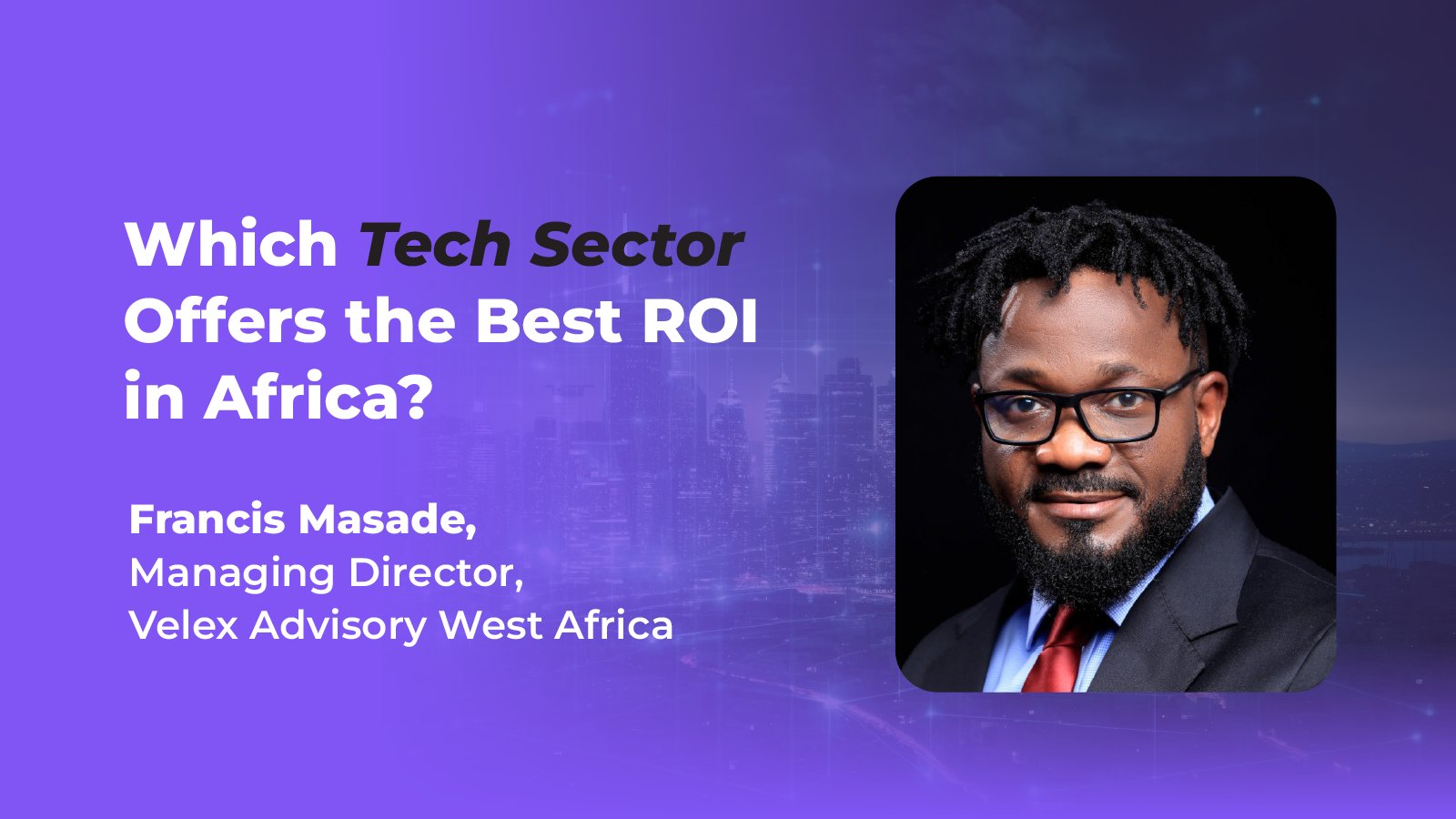
- Fintech, e-commerce, and healthtech are driving Africa’s tech boom, with over $3 billion in startup funding in 2024, each sector offering unique opportunities and regulatory challenges.
- Success depends not just on sector choice but on aligning with local market dynamics, regulatory environments, and operational capabilities across diverse African markets.
- Velex Advisory emphasizes rigorous due diligence, local insight, and strategic alignment to help investors and founders navigate Africa’s complex but high-potential tech landscape.
Across Africa, technology is reshaping economies at a remarkable pace.
In 2024 alone, African startups attracted over $3 billion in venture funding, with fintech, e-commerce, and healthtech accounting for the majority of that investment.
From payment systems reaching the unbanked to digital health platforms bridging care gaps, innovation is solving structural challenges while creating entirely new markets.
At Velex Advisory, we’ve observed this evolution up close across our work across Africa.
The opportunities are vast, but so are the differences between markets. For investors, founders, and scaling enterprises, the real challenge isn’t finding potential; it’s identifying where capital, capability, and timing align to deliver sustainable returns.
Choosing between Fintech, E-commerce, or Healthtech in Africa means understanding which sector’s fundamentals align with your risk appetite and operational strengths, and where regulation, infrastructure, and market behaviour will support, not hinder, your growth.
Here’s an overview drawn from our advisory work and insights from teams operating on the ground.
Fintech
Fintech remains one of the most mature and globally visible tech segments on the continent, with markets like Kenya, Nigeria, and South Africa producing companies that have scaled beyond Africa’s borders.
The potential is immense! About 50% of the African population is unbanked, yet mobile penetration is high. This gap has made digital wallets, payments, and micro-lending platforms essential infrastructure rather than optional services.
However, the sector is increasingly regulated. For instance, the Central Bank of Nigeria’s tightening of fintech rules has raised both barriers to entry and the cost of compliance.
While this can deter less-prepared entrants, it also creates space for well-capitalized, compliance-ready operators to build defensible positions. The question for market entrants isn’t whether demand exists; it’s whether you can operate with the required licenses, banking partnerships, and trust frameworks from day one.
E-commerce
Africa’s e-commerce market is on a steep growth trajectory, projected to generate US$42.45 billion in revenue by 2025. The acceleration is being driven by three major forces: a fast-growing young population, rapid smartphone adoption, and rising digital payments infrastructure.
In markets such as Kenya, Nigeria, and South Africa, online retail is becoming an increasingly mainstream part of consumer life. That said, growth in the sector looks very different depending on where you are. In South Africa, for example, relatively mature logistics and high card penetration have allowed established players like Takealot to capture a broad, loyal customer base.
In contrast, Nigeria has faced persistent challenges around last-mile delivery and consumer trust. Jumia, the continent’s best-known e-commerce brand, has had to reorient its model around smaller-ticket items and mobile-first engagement to adapt to consumer behaviour.
Other African countries are finding their own paths. Kenya’s M-Pesa integration has made mobile payments the backbone of e-commerce, reducing transaction friction and enabling even micro-merchants to sell online. In Egypt, rising middle-class consumption and government investment in digital infrastructure have spurred an increase in online marketplaces, making it one of the fastest-growing ecosystems in North Africa.
Despite these advances, challenges remain. Cash-on-delivery still accounts for more than 51% of transactions in countries like Kenya, creating operational risks for merchants. High delivery costs, which can sometimes add 20–30% to the order value, erode margins and limit repeat purchases. In rural areas, low logistics coverage means that the bulk of growth remains urban-driven, narrowing the addressable market unless companies can innovate around distribution.
For investors and operators, this means that while the addressable market is expanding rapidly, success hinges on execution. Business models that blend digital platforms with robust physical distribution networks and build trust through transparent customer service tend to outperform.
In our work, we’ve seen that ventures which adapt to country-specific realities, whether that’s Egypt’s urban density, Kenya’s mobile money dominance, or South Africa’s developed retail networks, achieve faster adoption and more sustainable growth.
Healthtech
Healthtech is fast emerging as a priority area, driven by demographic pressure, under-resourced public systems, and a growing middle class willing to pay for better care.
In Rwanda, government-backed telemedicine initiatives have established a framework for startups to integrate with the national health system. In Nigeria and South Africa, private-sector platforms are building hybrid care models that blend in-person clinics with app-based consultations.
The upside is significant, but so are the risks. Healthtech ventures face some of the strictest data protection and licensing requirements, particularly around patient privacy. Expansion often hinges on demonstrating both clinical efficacy and compliance, which can extend time-to-market but also strengthen long-term defensibility.
Sector Choice is Only Half the Equation
Selecting a sector is just the first step. Execution in Africa’s high-growth markets depends on aligning your entry strategy with regulatory realities, local market behaviour, and operational capacity.
Vadim Mildov, Executive Chairman at Velex Group, often reminds investors that “Africa doesn’t lack opportunity, it tests preparation. The winners are rarely those who find gaps in the market first, but those who structure their entry to survive the realities on the ground.”
We’ve seen promising ventures like Okra stumble not because their core offering lacked demand, but because they underestimated licensing timelines in Fintech, misjudged logistics readiness in E-commerce, or overlooked multi-jurisdictional compliance in Healthtech.
At Velex Advisory, our approach blends rigorous market assessment with financial, legal, and operational due diligence. This means identifying both the enablers and the friction points, whether that’s central bank policy shifts, consumer adoption curves, or evolving healthcare licensing rules.
We supplement this with reputation mapping to assess potential partners and risk–opportunity reporting, which enables investors and founders to make informed, confident decisions before committing capital.
If you’re weighing Fintech’s scalability, E-commerce’s consumer reach, or Healthtech’s resilience, the right choice will come down to matching sector dynamics with your investment horizon, operational strengths, and tolerance for regulatory complexity.
Partner with Velex Advisory. Let’s assess, prepare, and position your venture for lasting impact in Africa’s tech economy.
Contributing Author:
Francis Masade
Managing Director, Velex Advisory West Africa
Francis Masade leads market entry and expansion strategies for fintech, e-commerce, and healthtech ventures across West Africa. With extensive experience in regulatory compliance, investment advisory, and operational structuring, he helps investors and startups navigate Africa’s complex business environments to build scalable and resilient ventures. Connect with him on LinkedIn.