
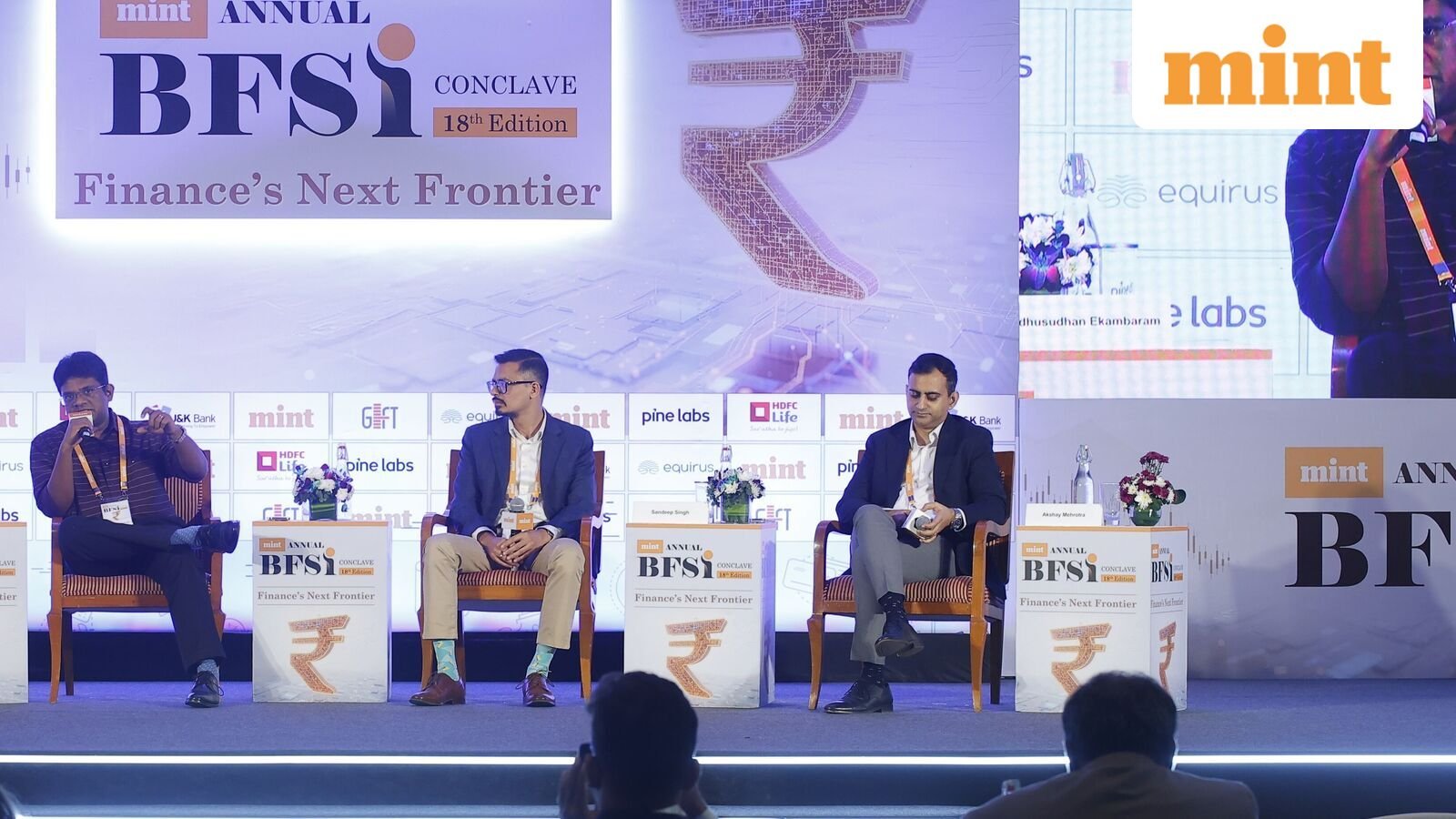
India’s fintech lending sector is entering its second act—and it looks markedly different from the first, top industry executives told Mint.
Speaking at a panel discussion on digital lending’s next chapter at Mint’s annual BFSI Summit on Friday, fintech founders said the sector is moving away from blitz-scale expansion toward stronger liability management, unit economics and deeper monetization of existing customers.
“I don’t think fintech 2.0 is about scale anymore,” said Sandeep Singh, chief executive of Trillionloans, a subsidiary of BharatPe. “It’s more about liability management and depth of customer monetisation.”
That shift follows a turbulent first decade for digital lending.
“The entire fintech lending is a decade-long story,” said Madhusudhan Ekambaram, chief executive and co-founder of KreditBee. “When we started, it was an unregulated world. In March 2020, more than 2,400 companies were lending.” Regulatory scrutiny quickly changed that. “Six months later, that number came down to 85 after the first set of regulations came in,” he added.
The regulator’s expectations were clear, he said. “What the regulator wanted was licensing, KYC (know-your-customer), fairness, and not being too smart to find workarounds of the regulator’s norms.”
Regulation reshapes lending economics
Much of the regulatory impact became evident after the pandemic, as tighter rules around digital lending, data usage and risk-sharing took effect.
“The majority of the regulation impact was visible post-covid,” said Akshay Mehrotra, managing director and group chief executive of Fibe. “That gave players like Fibe and KreditBee, who understood the regulator’s norms better, a large opportunity to scale.”
But today, scale looks different from the early years of fintech lending. Customer acquisition has also evolved. “Earlier, innovation was about improving UI and UX,” Singh said. “Now it’s about how well you actually know the customer.”
Penetration without large balance sheets
Despite a decade of activity, large balance-sheet scale remains rare among fintech lenders.
Industry estimates suggest only a handful of digital-first lenders have crossed the ₹10,000 crore assets under management (AUM) mark, highlighting how difficult it has been to build large, durable loan books. Capital constraints, regulatory limits and asset-quality considerations have kept most fintech lenders well below that threshold.
As a result, fintechs punch above their weight in loan disbursement volumes rather than in absolute AUM.
“Look at the volume of loans fintechs do—they have a 60% or higher market share,” Ekambaram said. “It looks more like a penetration impact than an AUM impact.”
That penetration is pushing lenders to specialize. “The single largest thing fintechs can do—what large banks often can’t—is solve very specific customer demands,” Mehrotra said. “Each of us is trying to solve for a niche. For us, that has meant moving into impact categories like healthcare loans.”
Differentiation has also become central to fundraising. “In financial services, until you differentiate, you cannot raise enough funds,” Mehrotra added.
Capital, listings and the next phase
Even as venture capital has grown more selective, founders argue that capital remains available.
“Funds are available at any point for the right price,” Ekambaram said.
The overall funding for these lenders fell to $752 million across 53 deals in 2025 year to date (YTD), down from $1.53 billion across 69 deals in 2024, Venture Intelligence data showed. Funding for unsecured lenders slowed sharply, pushing several players, including KreditBee, Fibe and MoneyView, to explore public markets for capital.
“Lending companies always need more capital, and from a regulatory perspective, lending companies should ideally be publicly-listed,” Ekambaram said.
Several digital lenders are lining up for listings. “It’s only about one company getting through, and others will start rushing in. Next year, we expect many publicly trading lending players,” he added.
A credit-hungry market
Despite tighter rules, founders remain optimistic on demand.
“India is a credit-starved country,” Mehrotra said. “Consumerism is just coming in and has become part of daily life. That tells us the industry still has significant room to grow.”
Navigating that growth will require closer engagement with regulators. “RBI (Reserve Bank of India) writes in simple language,” Ekambaram said. “Don’t overthink it. Being in constant conversation with the regulator always works better.”