

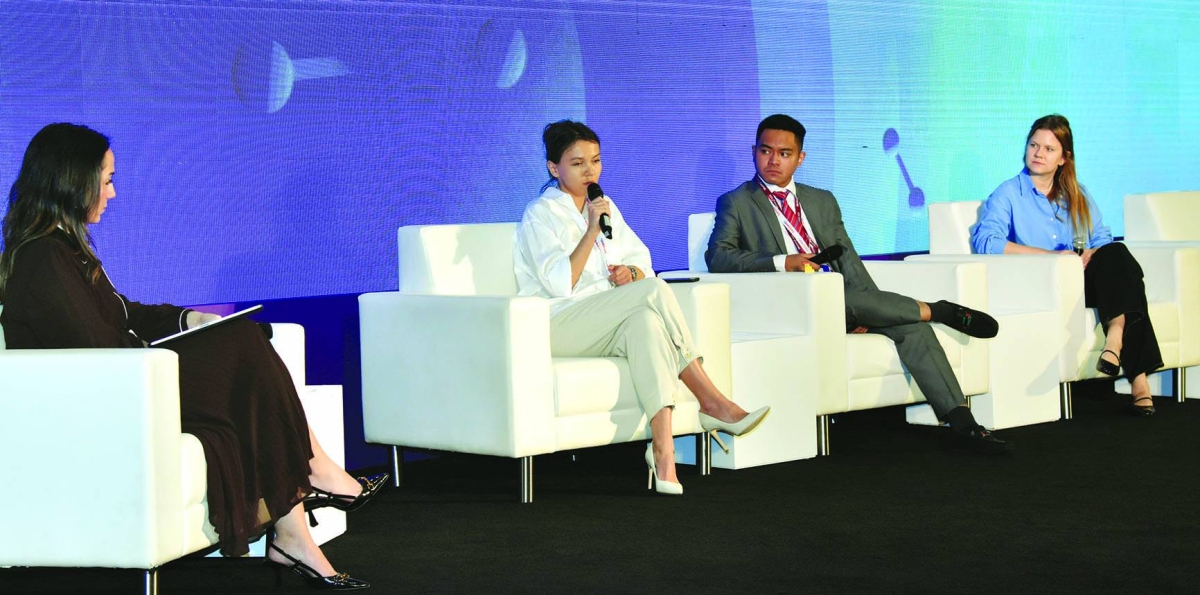
Anastasiya Zubritskaya, COO of Remozo (2nd from left), shares insight on the panel discussion ‘Fintech Solutions for SMEs — Unlocking Growth Potential’ while looking on are (from left) moderator Vanessa Rameix, regional director — The Business Year Qatar; Daniel Sansano, CEO of Daniel Sansano Capitals Inc; and Mal Filipowska, head of portfolio and platforms at Seedstars. PICTURE: Thajudheen
Industry leaders have highlighted the key challenges facing small and medium-sized enterprises (SMEs), as well as the digital solutions that can help them access international markets.
Speaking at a panel discussion held on the sidelines of the recently concluded Mena Fintech Festival 2025, Anastasiya Zubritskaya, COO of Remozo; Mal Filipowska, head of portfolio and platforms at Seedstars; and Daniel Sansano, CEO of Daniel Sansano Capitals Inc, agreed that SMEs remain the backbone of economies across emerging markets, yet continue to struggle with financing, compliance, and scaling.
Filipowska, whose company invests across 41 countries, pointed to access to working capital as the most pressing obstacle. “This is still one of the biggest issues that SMEs face globally, regardless of whether it’s in Mexico, in Uganda, or the Middle East; still, there is not enough working capital provided to those young start-ups and SMEs that don’t have a long history,” she said, noting that Seedstars is preparing a fund dedicated to SME support.
Similarly, Sansano argued that reliance on traditional bank loans with high interest rates leaves many enterprises unable to grow. “No matter how great your idea is, if it lacks funds, then that’s the problem,” he pointed out.
He explained that his firm has introduced a simplified funding model that requires only a pitch and identification to eliminate tedious paperwork that often discourages many entrepreneurs.
Zubritskaya, meanwhile, pointed to operational infrastructure as one of the main challenges. She said SMEs seeking to hire global talent or manage cross-border payments often lack the resources to build compliant systems.
She urged companies to adopt employer-of-record and contractor-of-record services to reduce regulatory risk: “Automated compliance and ready-made infrastructure make it easier and cheaper to meet frameworks across borders.”
The panel also examined how fintech tools can support global expansion. Filipowska highlighted embedded finance in B2B marketplaces as a transformative solution, particularly in fragmented industries, such as construction in African countries, citing Kenya.
By integrating lending and factoring directly into marketplaces, Filipowska emphasised that SMEs can access capital more efficiently, adding that artificial intelligence (AI) is increasingly used to optimise credit scoring and underwriting.
Sansano emphasised AI’s role in customer service and forecasting tools that help SMEs identify profitable markets and products abroad: “Adaptability is the key to survival in this ecosystem. SMEs should embrace innovation rather than cling to traditional practices.”
Zubritskaya cautioned that global operations are no longer straightforward, as regulators demand localisation and stricter documentation. She pointed to Uzbekistan, where local payment cards dominate, as an example of how SMEs must tailor their strategies to each market.
Citing Qatar’s efforts to address challenges in its SME ecosystem, Filipowska lauded the infrastructure provided by Qatar Development Bank (QDB) and incubators but called for more frequent hackathons and mediation platforms to connect startups with regulators and banks.
On the other hand, Sansano underscored the value of education and mentorship, noting that incubation programmes must be regularly paired with updated training in finance, compliance, and operations.