

Introduction: The New Financial Terrain of Terrorism
In 2024, Islamic State – Khorasan Province (ISKP) recalibrated its financial architecture, leveraging cryptocurrency to circumvent institutional oversight, fund operations, and recruit across borders. The shift is mapped, active, and already interfacing with European security protocols. While Western institutions focus on large-scale financial flows, ISKP operates below the threshold, leveraging anonymity, decentralization, and technical opacity to sustain its networks.
This article segments the crypto-terrorism interface into ten operational modules: documented flows, tactical advantages, institutional blind spots, platform vulnerabilities, recruitment pipelines, strategic implications, monetization of risk, forensic disruption, operational forecasting, and immersive ecosystems. The article segments the crypto-terrorism interface into ten operational modules calibrated for integration into existing counterterrorism workflows.
Documented Flows: ISKP’s Crypto Footprint in 2024
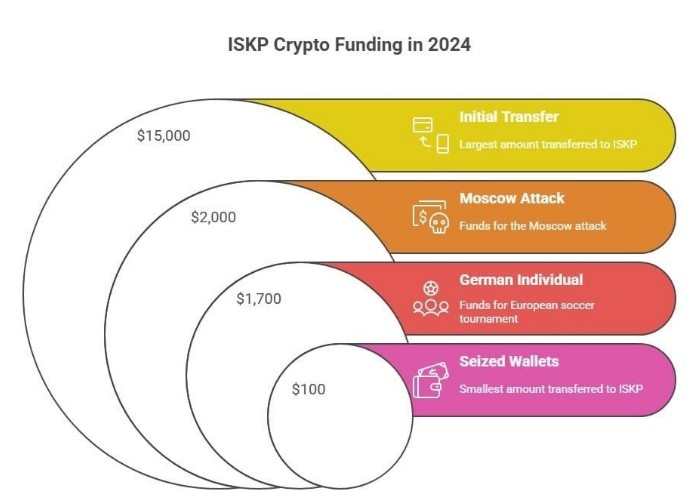
ISKP’s crypto operations are traceable, segmented, and increasingly transnational. In March 2024, ISKP carried out a deadly attack in Moscow that was partially financed with cryptocurrency. The attackers received approximately $2,000 in virtual assets shortly before executing the massacre at Crocus City Hall, which left 140 people dead. This transaction was routed through a high-risk exchange and flagged only after forensic reconstruction.
In June 2024, a German individual sent $1,700 in crypto to ISKP and applied to work as a security guard at a major European soccer tournament. The event had been repeatedly identified as a target in jihadist propaganda. The transaction passed through a regulated exchange, but its intent was only revealed after the arrest.
In December 2024, a UK-based individual was sentenced to prison for sending more than £16,000 in cryptocurrency to ISKP. The funds were split across multiple wallets and routed through decentralized platforms, complicating attribution and delaying intervention.
In Turkey, authorities seized crypto wallets linked to ISIS financiers operating within the country. These wallets were connected to donation campaigns masked as humanitarian aid, with funds redirected to ISKP cells in Afghanistan and Pakistan. TRM Labs identified hundreds of transactions linked to ISKP, ranging between $100 and $15,000. These transfers flowed through regulated exchanges, high-risk platforms, and individual traders.
A parallel case emerged in Gaza, where the U.S. Treasury sanctioned the crypto exchange Buy Cash for facilitating transfers to Hamas’s Al-Qassam Brigades. The platform operated with minimal KYC enforcement and accepted multiple cryptocurrencies, including Tether and Bitcoin. Intelligence confirmed that Buy Cash routed donations from sympathizers in Europe and Southeast Asia directly to Hamas-linked wallets.
Tactical Advantages: Crypto as a Modular Asset
ISKP’s use of cryptocurrency is not incidental. It is modular. Each tactical function is mapped to a distinct operational need. Anonymity sustains recruitment. Decentralization enables logistics. Micro-transactions bypass financial thresholds. Privacy coins neutralize attribution. Together, these components form a coherent and adaptive financial architecture.
The group does not anchor itself to any single coin or platform. It recalibrates. When Bitcoin becomes traceable, it pivots to Monero. When mixers are sanctioned, it shifts to peer-to-peer swaps. When exchanges enforce KYC, it migrates to decentralized protocols. This elasticity reflects a strategic grasp of blockchain mechanics.
ISKP’s rotating wallets often spike in activity following new issues of Voice of Khurasan, indicating a direct correlation between media cycles and funding surges. Blockchain forensics firms now segment terrorist wallet behavior into operational typologies: static wallets for propaganda-linked donations, rotating wallets for short-term campaigns, bridge wallets for asset conversion, and dormant wallets activated only during operations.
Institutional Blind Spots: Why Detection Alone Fails
Detection is insufficient. ISKP’s crypto operations exploit institutional latency. Agencies operate on quarterly budgets, legacy infrastructure, and procedural inertia. ISKP operates on real-time adaptation, decentralized execution, and asymmetric timelines.
Most counterterrorism frameworks misclassify crypto as a compliance anomaly. They delegate it to regulatory teams, not intelligence units. They monitor exchanges, not protocols. They flag transaction volume, not behavioral cadence. This misalignment allows ISKP to operate in plain sight.
Legal fragmentation amplifies the vulnerability. Privacy coins such as Monero remain legal across multiple jurisdictions. Mixers are prohibited in the U.S. but remain globally accessible. DeFi platforms function without centralized oversight, rendering enforcement structurally ineffective. Terrorist networks exploit regulatory arbitrage, operating from permissive environments while targeting adversarial ones.
Platform Vulnerabilities: The Decentralized Dilemma
Decentralized finance platforms present a structural challenge to counterterrorism workflows. Unlike centralized exchanges, which require user verification and maintain transactional records, DeFi protocols operate without intermediaries. Users can swap assets, pool liquidity, and execute smart contracts without disclosing identity or location.
Protocols such as Uniswap, PancakeSwap, and SushiSwap enable asset conversion without KYC enforcement. Mixers like Tornado Cash and Wasabi Wallet further obscure transactional lineage. In 2024, Alexey Pertsev—architect of Tornado Cash—was sentenced to five years in the Netherlands for enabling laundering linked to terrorism and ransomware.
ISKP-linked wallets routinely interface with DeFi protocols to convert Bitcoin into Monero, then route funds through mixers prior to disbursement. These operations unfold within minutes, across jurisdictions, and evade conventional alert systems. The architecture is engineered for invisibility.
Recruitment Pipelines: Crypto as Entry Point
ISKP’s recruitment architecture is digital by design. Cryptocurrency functions as the initial access layer. Donation campaigns are framed as acts of solidarity rather than declarations of allegiance. Instructional content is positioned as empowerment, not indoctrination.
Channels on Telegram, Element, and Briar circulate multilingual guides on wallet creation, mixer navigation, and fiat-to-crypto conversion. QR codes and wallet addresses are embedded directly into propaganda assets. Full tutorials are hosted on dark web forums. The crypto layer is not peripheral. It is structurally embedded.
This configuration lowers the threshold for participation. Recruits no longer need to travel, train, or formally affiliate. They can contribute financially, anonymously, and incrementally. This creates a new operational category: the digital financier.
Strategic Implications: Crypto as Threat Multiplier
Cryptocurrency does not originate terrorism. It amplifies it. It extends reach, accelerates coordination, and fragments attribution. ISKP’s crypto infrastructure transforms isolated actors into interoperable nodes. It converts localized threats into transnational systems. It replaces physical logistics with digital architecture.
This transformation demands a strategic response. Agencies must move beyond episodic disruption and adopt systemic recalibration. This includes redefining risk models, embedding blockchain intelligence into threat matrices, and aligning legal frameworks with adversarial innovation cycles.
Investor ecosystems must also recalibrate. Crypto assets linked to terrorism are not limited to compliance exposure. They carry reputational volatility. In 2024, multiple hedge funds divested from protocols associated with Hamas-linked wallets following publicized seizures. ESG-focused investors now monitor wallet exposure as a reputational risk vector.
Flagged crypto flows are increasingly modeled as financial signals. The shift from threat detection to asset valuation enables agencies to convert operational intelligence into reputational leverage—and investors to price exposure as risk. A wallet flagged for ISKP interaction becomes not just a security concern but a financial indicator. A DeFi protocol exploited by jihadist networks becomes not just a vulnerability but a reputational liability.
Forensic Disruption: AI and Blockchain Intelligence
Advanced blockchain forensics enhanced by AI now detect suspicious transaction patterns with precision exceeding 90 percent. Supervised learning models—ranging from decision trees to neural networks—correlate wallet behavior, mixer interaction, and transaction cadence to flag operational flows.
Yet structural challenges persist. Jurisdictional data standards remain fragmented. Algorithmic bias risks misclassifying benign behavior. Adversarial adaptation outpaces regulatory cycles. To counter this, agencies must invest in dynamic modeling, real-time analytics, and interoperable intelligence frameworks.
The Kelley School of Business reports that embedding AI into counterterrorism finance workflows has reduced false positives and improved interdiction rates. However, without legal harmonization and interagency coordination, these capabilities remain underleveraged.
Blockchain analytics firms now segment terrorist wallet behavior into operational typologies. Static wallets support propaganda-linked donations. Rotating wallets sustain short-term campaigns. Bridge wallets facilitate coin conversion and mixer routing. Dormant wallets activate only during operational windows. These typologies enable agencies to model risk, anticipate activation, and correlate wallet behavior with propaganda cycles.
Operational Forecast: Crypto-Terrorism 2026
Based on current trajectories, the next phase of crypto-terrorism may include:
- AI-generated wallet obfuscation using synthetic transaction patterns
- NFT-based propaganda with embedded donation links
- Stablecoin laundering via cross-chain bridges
- Decentralized autonomous cells funded exclusively through crypto
- Smart contract automation for disbursement and recruitment
- Encrypted donation platforms hosted on decentralized storage networks
Agencies must prepare for these evolutions by investing in anticipatory intelligence, modular disruption frameworks, and cross-sector coordination. The threat is not static. It is iterative. The architecture is not experimental. It is engineered.
Tenth Module: Metaverse and Crypto-Terrorism – The Immersive Frontier
Operational Expansion: Immersive Propaganda and Ideological Conditioning
In 2025, ISKP initiated trials within immersive environments to deploy propaganda and conduct ideological conditioning. Leveraging decentralized metaverse platforms such as Decentraland and The Sandbox, the group reconstructed virtual spaces simulating training camps, digital mosques, and combat scenarios. These environments are not passive visualizations; they are interactive systems.
Recruits access these spaces through anonymous avatars, participate in simulated briefings, and receive operational instructions in real time. Entry is gated via cryptocurrency transactions, often facilitated through NFTs functioning as untraceable digital credentials.
NFTs as Access Tokens and Financial Instruments
Non-fungible tokens serve multiple operational roles. ISKP employs them as access credentials for restricted environments, affiliation markers for new recruits, and financial instruments masked as digital artwork.
Certain NFTs embed metadata linking to donation wallets. Others function as cryptographic keys to encrypted VR domains. The decentralized architecture of NFT platforms, especially when hosted on peer-to-peer networks or IPFS-based storage, complicates seizure and attribution.
Emerging Risk: Gamified Training Modules
Gamification of recruitment introduces a new threat vector. ISKP has tested first-person training modules where users acquire combat tactics, encryption protocols, and logistical workflows. These modules are distributed via peer-to-peer networks, with access controlled by smart contracts and wallet verification.
The convergence of immersion, anonymity, and crypto-financing produces a closed, resilient, and scalable ecosystem. Agencies must treat the metaverse not as a peripheral social space but as an operational infrastructure.
Strategic Response
NFT Surveillance: Construct registries of flagged NFTs with metadata linked to terrorist wallets and operational infrastructure.
Immersive Platform Partnerships: Establish direct channels with VR and metaverse platforms to identify and neutralize radicalizing content.
Counterterrorism Simulations: Develop metaverse-based training environments for law enforcement and intelligence units to simulate threat scenarios and test disruption protocols.
Conclusion: Discipline Over Detection
The crypto-terrorism interface demands discipline. Detection is reactive. Discipline is structural. ISKP’s operations are modular, resilient, and engineered for invisibility. The response must mirror this architecture: modular, resilient, and designed for disruption.
Agencies must build interoperable registries of flagged wallets, mixer interactions, and DeFi protocol usage. They must train analysts in blockchain forensics and privacy coin surveillance. They must establish partnerships with crypto compliance firms to deploy real-time alert systems. They must reframe crypto-financing as a strategic threat, not a technical anomaly.
ISKP is not improvising. It is executing. Its crypto architecture is not experimental. It is engineered. The objective is not to eliminate cryptocurrency; it is to eliminate its operational utility for terrorism. That requires precision, coordination, and mapped discipline.