
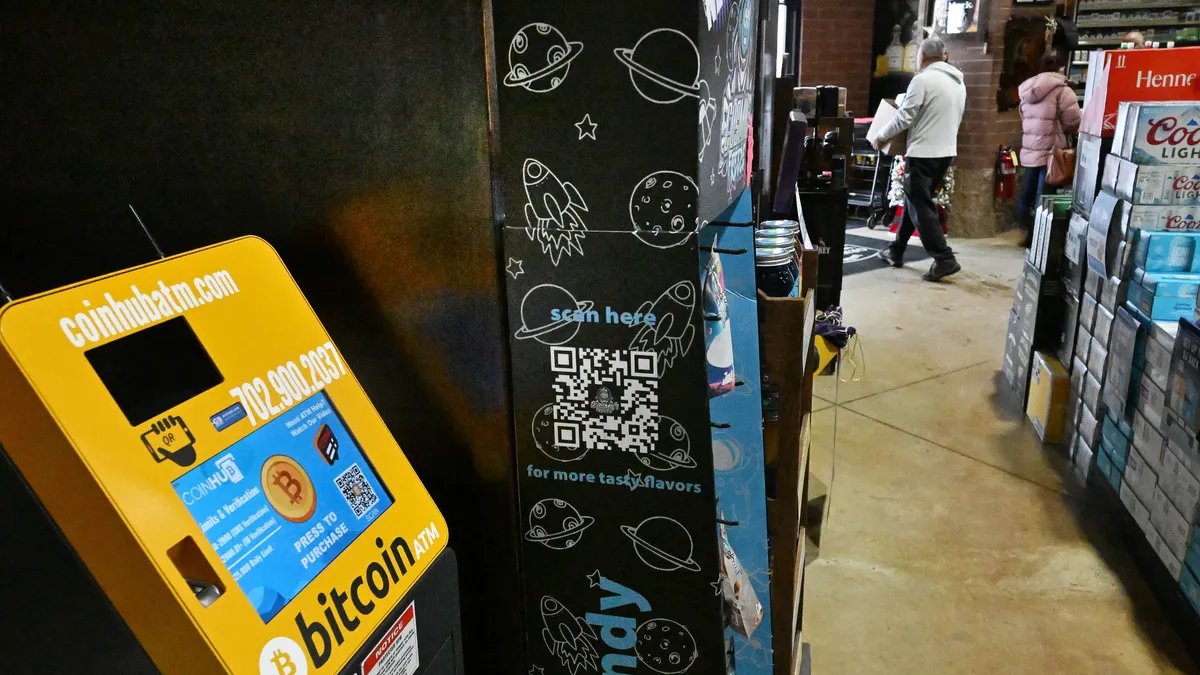
Sterling Heights city leaders passed an ordinance Tuesday evening regulating cryptocurrency machines in the city in an effort to protect seniors and other residents from fraud that they claim is tied to the machines.
The ordinance establishes new licensing and operating regulations for virtual currency machines, including cryptocurrency kiosks and Bitcoin ATMs. Sterling Heights Police Capt. Colleen Hopper said residents lost $559,400 in scams related to these machines in 2025.
In mid-December, Sterling Heights City Council members revised the proposed ordinance, adding daily and monthly transaction limits of $2,000 and $10,000, respectively. They voted unanimously to pass the legislation on Tuesday. Sterling Heights City Attorney Marc Kaszubski said the ordinance will be rolled out gradually.
Sterling Heights Mayor Michael Taylor said the ordinance passed Tuesday night because there is “strong support” on the council “for helping vulnerable people.”
“And we know that there have been hundreds of thousands of dollars stolen from residents or visitors to Sterling Heights recently from these machines, and I don’t think that they serve any legitimate purpose,” Taylor told The Detroit News. “If you want to buy cryptocurrency, there’s plenty of ways to do it. ….By restricting how much money people can put into these machines, both with a daily limit and a monthly limit, it’s going to help our residents.”
Sterling Heights is the among the first municipalities in the state to pass cryptocurrency ATM regulations. Grosse Pointe Farms and Harper Woods have already done so.
Cryptocurrencies are digital currencies that can be used for internet-based electronic payments or as a store of value, and they function independently of governments and central banks.
Hopper said last month that the city investigated 25 cases of fraud related to crypto kiosks in 2025. She said the average age of the victim is around 64 years old.
Sterling Heights Chief of Police Andrew Satterfield said that under the new ordinance, the owner of the business and the owner of the machine will have to get a license. The ordinance allows the city to conduct annual inspections of the machine and to ensure the license is displayed on it.
The user of the machine has to have access to a customer service hotline, and the individual needs to have a photo ID.
The ordinance also includes other regulations, including preventing new users of crypto machines from conducting daily transactions of over $1,000 for the first 14 days. But the monthly limit means transactions can’t exceed $10,000.
Cassie Thierfelder, manager of advocacy at AARP Michigan, thanked the council for the revisions it made to the ordinance.
“It’s going to provide so much more protection to the residents of Sterling Heights,” she said. “By adding those daily and monthly transaction limits, you’re helping to prevent someone from losing their entire life’s savings in one act of fraud.”
Jon Turke, director of government affairs for CoinFlip, said previously in a letter to city officials that the proposed ordinance relies on “a policy recommendation that creates a false sense of consumer protection.”
CoinFlip is an operator of virtual currency kiosks and has three locations in Sterling Heights. The proposed $1,000 daily transaction limit for new users doesn’t adequately account for federal reporting requirements, Turke said.
He also said federal law requires it and other money service businesses to collect photo identification for transactions over $1,000.
CoinFlip, however, believes a money transmitter license should be required for all virtual currency kiosk operators, Turke said. It also supports requiring clear disclosures regarding all fees and terms of service and requiring live customer service.
Amy Patti, a CoinFlip spokesperson, told The News on Tuesday that the company won’t be commenting beyond Turke’s letter.
Grosse Pointe Farms Councilman Lev Wood told the Sterling Heights City Council that his suburban Detroit city voted on its cryptocurrency machine ordinance in July, making it the first city in the state to enact such regulations. He encouraged Sterling Heights and Grosse Pointe Farms to “put pressure” on their neighboring cities and townships to pass cryptocurrency ordinances.
“What we need is a buffer of cities in the southeast Michigan region that will keep our residents hopefully protected, right?” he said.
Wood also voiced support for the Legislature taking action to regulate cryptocurrency machines.
Sterling Heights Councilman Michael Radtke said the fraud is “a statewide problem.”
“I think that some of the fears we have here are that people will be sent outside of our community to other communities that don’t have regulations to have fraud committed against them,” he said, “but we can only do our part, and this is a great part of it.”
asnabes@detroitnews.com