
The Senate on Tuesday passed legislation to establish a regulatory framework for stablecoins, putting the cryptocurrency industry, which had long been viewed with suspicion by lawmakers in Washington, on the brink of a major policy breakthrough.
Bipartisan approval of the bill, known as the GENIUS Act, followed an aggressive lobbying campaign aimed at transforming the cryptocurrency industry’s image from scandal-plagued experiment to legitimate financial sector.
Senate passage came over the fierce objections of many Democrats, who warned that the measure lacked strict-enough regulations or oversight to prevent abuses, including anti-corruption rules that would bar President Trump and his family from continuing to profit from cryptocurrency.
The bill still must be passed by the House and signed by the president. But the 68-30 vote in the Senate marked the first time the chamber has approved major cryptocurrency legislation. It represented a significant step toward giving the industry what it has long sought from Washington: the credibility that comes with federal oversight.
Stablecoins, a type of digital currency tied to the value of the U.S. dollar, are often seen as comparatively reliable types of cryptocurrency. These cryptocurrencies are designed to avoid the wild fluctuations in value of some popular coins like Bitcoin, making them something of a bridge to the world of traditional currency.
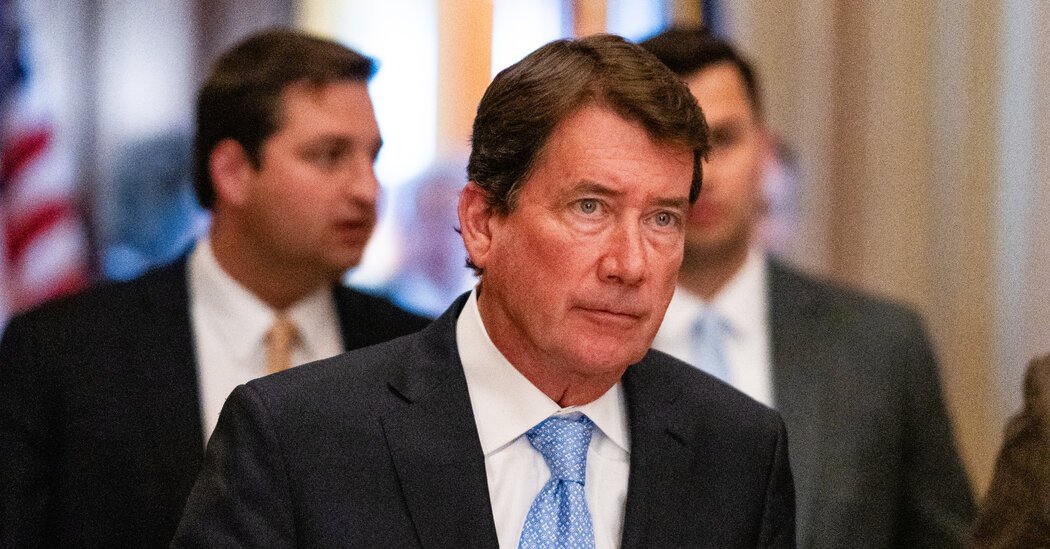
Senator Bill Hagerty, Republican of Tennessee and the bill’s lead sponsor, said the legislation would be a significant step toward breaking down the barriers between traditional financial markets and decentralized markets. He said it would help bring the country’s financial system into the modern era.
“To modernize our payment system and to restore our nation’s competitive edge, we must act now,” he said ahead of the vote on the Senate floor.
The legislation’s success reflects the dramatic shift that has taken place in Washington as Republicans have consolidated a governing trifecta.
While the Biden administration cracked down on digital assets, Mr. Trump has pulled back sharply on such regulations, signaling a more permissive stance that aligns with the cryptocurrency industry’s goals.
That has coincided with Mr. Trump’s family’s rapid expansion into the industry, which has made the president into a crypto dealer who stands to make huge sums of money from it.
In a policy statement released before the final vote, White House officials wrote that the bill “removes regulatory uncertainty that has hindered innovation and competitiveness in the digital assets sector.” They also argued that the legislation would enhance the dominance of the U.S. dollar in the cryptocurrency space over other forms of currency.
The biggest hurdle for the industry has always been legislative: securing regulations that confer legitimacy without adding onerous requirements. And for that, executives and lobbyists had to turn their full attention to Capitol Hill.
Ahead of the 2024 election cycle, a network of Silicon Valley crypto executives and political strategists set their sights on Washington. They formed a number of crypto-focused super PACs which spent a total of more than $130 million to influence tight congressional races across the country.
Candidates backed by the super PACs, which supported both Democrats and Republicans, had a staggering success rate, winning 53 of 58 races.
Now that work has begun to pay off. Eighteen Democrats joined Republicans in backing the measure, while two Republicans opposed it.
The stablecoin bill would give a government imprimatur to an important branch of the industry and help encourage more companies in the traditional finance world to experiment with digital currencies. Circle, the world’s second-largest stablecoin company, went public this month, with its shares surging nearly 170 percent on the first day of trading.
Executives at virtually all the major U.S. crypto companies have voiced support for the legislation.
“This is a foundation for legitimizing stablecoins, embedding them into the global network of money movement,” John Wu, president of the crypto firm Ava Labs, said in an email, adding that the so-called GENIUS Act “lives up to its name.”
Mr. Hagerty said the bill would improve payment efficiency, boost demand for U.S. Treasury securities and help maintain the dollar’s global dominance. Without action, he warned, the United States risked losing its competitive edge for an asset that many Americans are already using, an argument echoed by a number of his colleagues.
“Many constituents of mine and of others already have money in stablecoin, and there are no rules,” said Senator Ben Ray Luján, Democrat of New Mexico. “There should be rules surrounding this.”
A coalition of Democrats, led by Senator Kirsten Gillibrand of New York, have supported the legislation despite misgivings from some senior members of the party.
Senator Elizabeth Warren, Democrat of Massachusetts, was unforgiving in her criticism, arguing that the legislation’s “thin regulation” mirrored the deregulatory approach that helped create the 2008 financial crisis.
“It’s the same move a second time,” Ms. Warren said in an interview. “Why is the industry here asking for regulation? They want the gold star of U.S. government oversight without really having significant oversight.”
Ms. Warren is not alone. Senator Chuck Schumer of New York, the Democratic leader, has also opposed the bill consistently. He said that it improved through negotiations, but criticized the absence of anti-corruption protections, specifically those aimed at preventing Mr. Trump and his family from continuing to profit from cryptocurrency, an issue that became a wedge among Democrats as the bill made its way through the Senate.
Initially, Democrats believed they would have a chance at addressing those concerns. Senator John Thune, Republican of South Dakota and the majority leader, promised that their changes would be considered, and Democrats contributed to the more than 100 proposed modifications.
Among them was one from Senator Jeff Merkley, Democrat of Oregon, who sought to bar the president and his family from issuing stablecoins.
“We need guardrails that ensure that government officials aren’t openly asking people to buy their coins in order to increase their personal profit or their family’s profit,” Mr. Merkley said on the Senate floor.
But Republicans refused to consider any measure that touched on Mr. Trump’s involvement in the industry, and ultimately shut down the amendment process, leaving a small bipartisan group of senators to negotiate only a few changes to the bill.
Several crypto-friendly Democrats helped ensure that the measure made it through the Senate. Senator Ruben Gallego, Democrat of Arizona, noted that the final version included key consumer protections and would ensure FDIC oversight for certain stablecoin activities. But he conceded that a major Democratic priority — a ban on public officials and their families profiting from stablecoin ventures — was left out.
Despite the bipartisan support, a pair of Republicans remained opposed.
Senator Josh Hawley, Republican of Missouri, objected to what he called a watered-down effort to keep big technology companies out of the stablecoin space. He had pushed for an outright ban on publicly traded tech firms like Amazon and Alphabet issuing stablecoins. Instead, the bill would delegate that authority to a newly created regulatory board.
“There’s a board that can approve them anyway; that’s ridiculous,” Mr. Hawley said. He also sought to revoke liability protections for tech companies that issue stablecoins, arguing that financial firms should not enjoy the same shield as content platforms.
Senator Rand Paul, Republican of Kentucky, argued that the bill was too restrictive, saying its regulations, including a requirement that a board unanimously approve issuers, were “going to make it very difficult for stablecoin to succeed.”
David Yaffe-Bellany contributed reporting.