
Key Takeaways
- Charlie Lee created Litecoin, one of the earliest and most successful altcoins.
- Litecoin was designed as a complement to Bitcoin, offering faster transactions and lower fees.
- Lee worked at Google before focusing on cryptocurrency and joining Coinbase as an engineering manager.
- He left Coinbase to lead the Litecoin Foundation and further develop Litecoin.
- A key goal for Lee is creating sound money through cryptocurrency.
Charlie Lee is renowned as the software engineer who created Litecoin, a leading Bitcoin derivative.
Litecoin (LTC) stands out for its faster blocks and higher maximum supply.
Under Lee’s guidance, Litecoin remains a top cryptocurrency amid a volatile market.
Lee’s background in top tech firms and innovations in crypto demonstrate his technical prowess.
Alison Czinkota / Investopedia
Charlie Lee’s Background: Ivory Coast to MIT
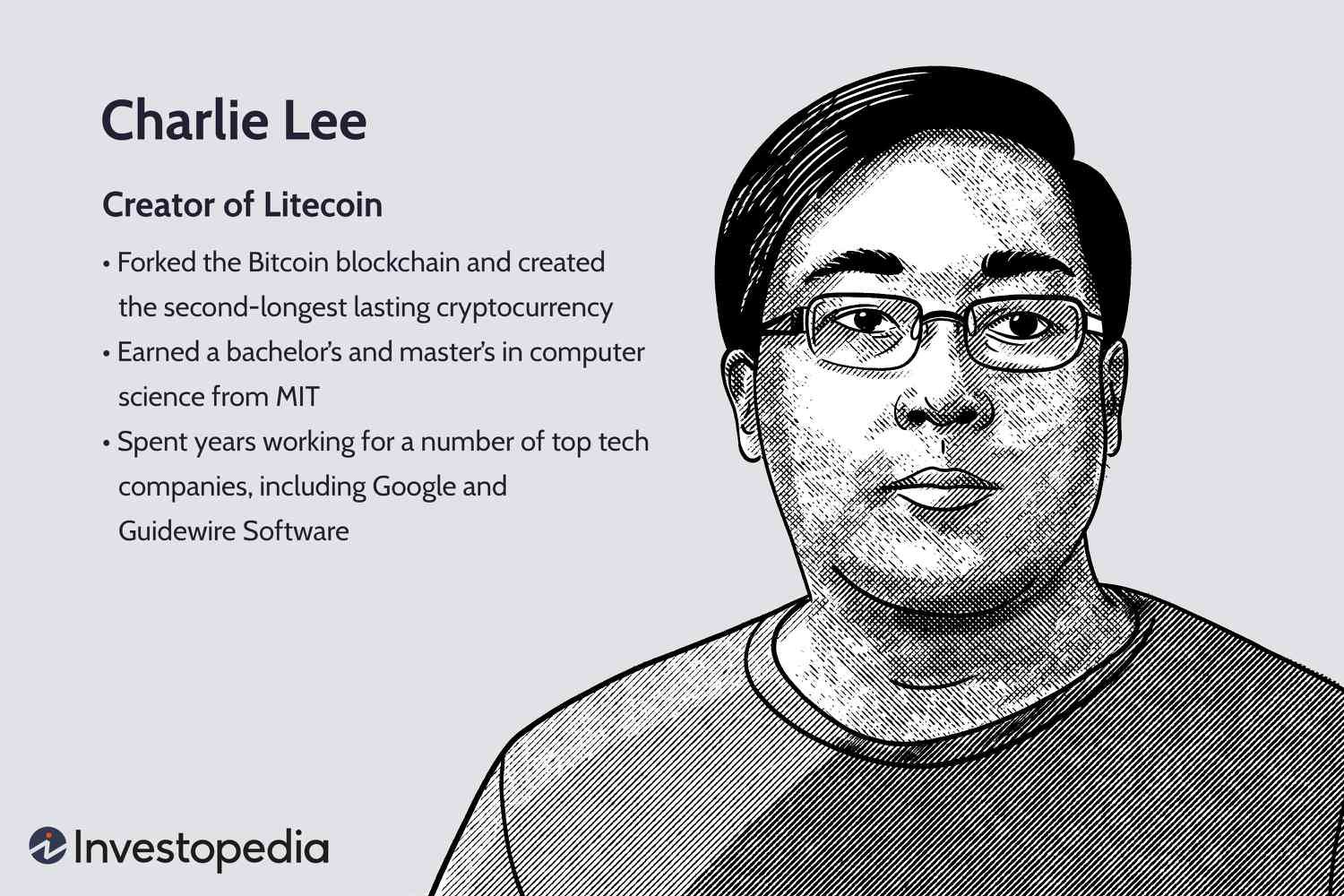
Charlie Lee was born in 1977 to Chinese parents in the West African nation of Ivory Coast, where his parents had lived since the 1960s. When he was 13, the family moved to the United States. After graduating from Lawrenceville School, a prep school in New Jersey, in 1995, Lee earned both a Bachelor of Science (1999) and a Master of Engineering (2000) in Computer Science from the Massachusetts Institute of Technology (MIT). Lee’s father was also an MIT graduate, and his brother Bobby Lee, another crypto entrepreneur, later became the founder and CEO of BTCC, Bitcoin’s cryptocurrency exchange in China.
Before joining Google in 2007, Lee spent seven years as a software engineer at leading tech companies in California: KANA Communications (2000–2003) and Guidewire Software (2003–2007).
From Google Engineer to Litecoin Innovator
Lee’s six-year tenure (2007–2013) at Google as a software engineer was marked with work on iconic products (YouTube Mobile, Chrome OS, Play Games). During his time there, the world’s first cryptocurrency, Bitcoin (BTC), was invented by an anonymous programmer (or programmers) under the pseudonym Satoshi Nakamoto.
Lee has said that he was first introduced to cryptocurrency in 2011 when he read an article about Silk Road, an online marketplace that accepted only Bitcoin as payment. His personal economic philosophy had already made him skeptical of the Federal Reserve System, and in these pre-Litecoin years, he was exploring various investment strategies that would be less reliant on central banks, including the trading of gold. Given his expertise in computer technology and his keen interest in alternative investments, this article became the lens that focused all his attention on cryptocurrency and supporting blockchain technology as the ideal avenue to attain his goals.
Lessons from Fairbix: Creating a Successful Cryptocurrency
Like many other developers eager to copy Bitcoin, Lee failed at his first cryptocurrency attempt. Unlike most of those other developers, he succeeded in his second attempt.
Fairbix, a blockchain payment system he developed by cloning the source code from Tenebix (another early cryptocurrency), crashed within a few weeks of its release, primarily due to a bug regarding transaction scams that Lee decided not to fix because he was working on Litecoin.
Litecoin and Bitcoin: A Comparative Analysis
Charlie Lee has always described Litecoin as a complement—not a competitor—to Bitcoin: as “silver to Bitcoin’s gold.” Ever since the 2011 release, he has positioned Litecoin as the ideal cryptocurrency for lightweight transactions, such as online shopping, and Bitcoin as the cryptocurrency for heavyweight transactions, such as international payments. Toward that end, Lee built LTC with several similarities to Bitcoin as well as several modifications designed to help it scale more effectively.
Both Litecoin and Bitcoin are decentralized, peer-to-peer (P2P) cryptocurrencies that enable minimal-cost payments anywhere in the world without a third party. Litecoin is a Bitcoin fork: a currency that took the Bitcoin source code with a few minor changes that diverged into a separate path with a distinct coin.
However, Lee also built into Litecoin a few important differences that would not only differentiate his currency from Bitcoin in the crypto-asset market but also correct certain flaws he had identified with Bitcoin: accessibility, speed, volume, and cost.
Litecoin’s Unique Mining Approach and Algorithm
By choosing a different mining algorithm (Scrypt vs. SHA-256), Charlie Lee sought to make mining accessible to anyone with a basic computer’s central processing unit (CPU)—unlike Bitcoin, which required the greater processing power of a graphics processing unit (GPU). Initially, Lee’s choice of Scrypt did allow Litecoin to be mined on CPUs, but that advantage proved to be short-lived.
When mining software and application-specific integrated circuits (ASICs) for the Scrypt algorithm were developed, Litecoin miners moved to GPUs as well, and it was no longer competitive to mine Litecoin without a more powerful mining rig.
Litecoin’s Key Advantages Over Bitcoin: Speed, Supply, and Cost
Frequently cited advantages Litecoin has over Bitcoin were designed by Lee specifically to make LTC more “spendable” than BTC: faster block creation, higher maximum circulating supply, and lower transaction fees. Not only did Lee design Litecoin to produce blocks four times faster (average interval of 2.5 minutes to Bitcoin’s 10 minutes), but he also built Litecoin to have four times the maximum circulating supply (Litecoin a maximum of 84 million LTC; Bitcoin a maximum of 21 million BTC) and much lower average transaction fees than Bitcoin.
Charlie Lee’s Impact at Coinbase
In 2013, two years after the Litecoin release, Lee left Google to accept a role that allowed him more time to work on his digital currency: engineering manager at Coinbase, a recently created digital currency exchange. Within two years, he was promoted to director of engineering.
Steering the Litecoin Foundation: Lee’s Leadership
By 2017, Lee was ready to work full-time on Litecoin. He left Coinbase to focus exclusively on his role as managing director of the Litecoin Foundation, a nonprofit founded “to advance Litecoin for the good of society, by developing and promoting state-of-the-art blockchain technologies.”
The Visionary Path for Litecoin’s Future
At a conference in 2019, Lee stated that his primary goal is to “create sound money.” Ever since he first heard of Bitcoin, he has believed that cryptocurrency is “a better form of money than … human civilization has ever seen.”
When asked if he foresaw central banks eventually issuing cryptocurrency, he saw no advantage in that scenario. A major benefit of digital money is decentralization, so government control would make cryptocurrency “effectively no different than a digital version of a U.S. dollar.”
He believes that eventually, only a few cryptocurrencies (likely Bitcoin, Litecoin, and a few others) will be left in the market. At that point, those surviving currencies could “actually represent real value” and even become interchangeable: Someone could send Litecoin, and the recipient could receive Bitcoin, which would be converted automatically.
He anticipates that, as merchant adoption builds and user experience improves, consumers will trust cryptocurrency, mass adoption will follow, and it will be used like traditional money everywhere. “Things will get simpler, and that is when things will take off.”
Where Is Charlie Lee Now?
Charlie Lee is managing director of the Litecoin Foundation.
Who Is the Owner of Litecoin?
Litecoin is an open-source blockchain and cryptocurrency project maintained by the nonprofit Litecoin Foundation. It is not explicitly owned by anyone.
Who Created LTC?
Litecoin (LTC) was created by Charlie Lee, a software engineer and cryptocurrency enthusiast.
The Bottom Line
Unlike many other cryptocurrencies eager to copy Bitcoin, Charlie Lee’s Litecoin has demonstrated impressive staying power in a highly competitive space. His strong track record as a developer and community leader is due to his technical expertise and his status as a key social media influencer with one million followers in the crypto and blockchain community. As managing director of the Litecoin Foundation, Lee’s primary focus is promoting awareness and adoption of Litecoin.
The comments, opinions, and analyses expressed on Investopedia are for informational purposes only. Read our warranty and liability disclaimer for more info. As of the date this article was written, the author owns BTC and XRP.