
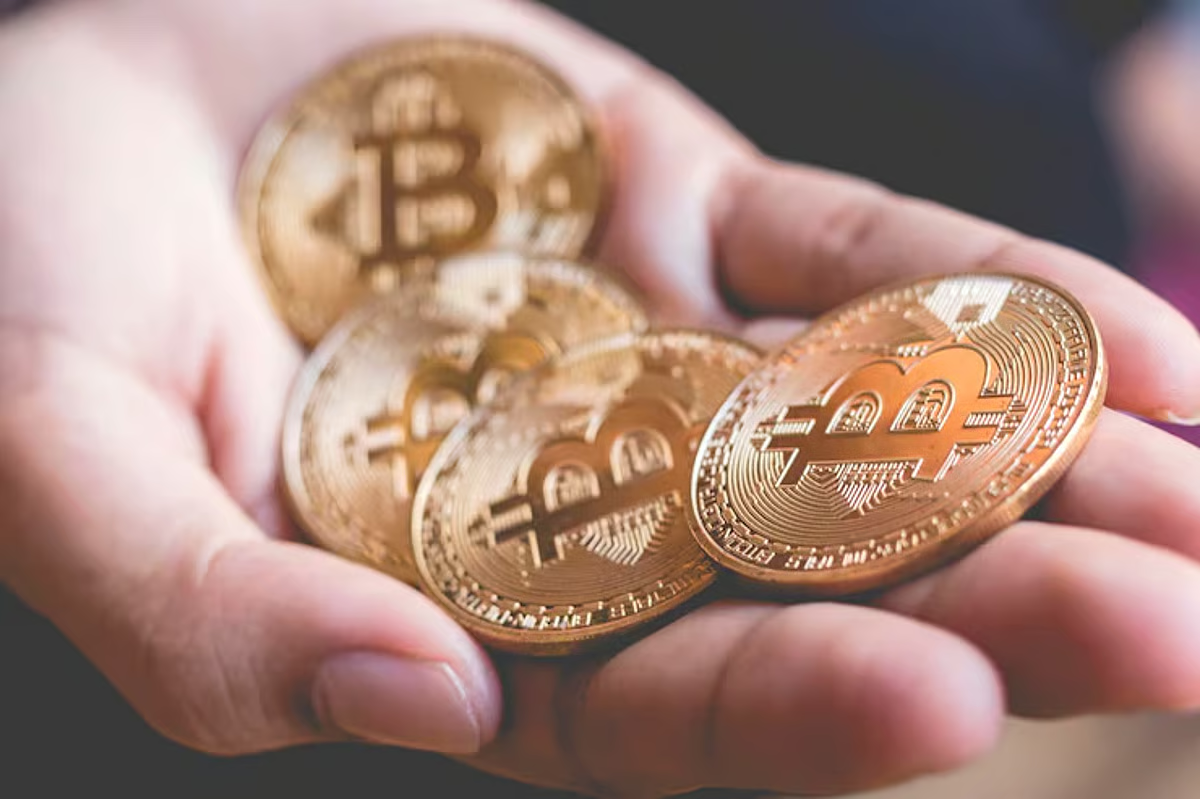
Bitcoin is also commonly termed “Digital Gold.” This is because of its significance. It was the first cryptocurrency to realize the concept of decentralized money. It was developed in 2009 by a person or group of people, known as “Satoshi Nakamoto.” Bitcoin disrupted the conventional financial system because it eliminated the middleman, or in this case, the banks. It enabled the direct transfer of money between two individuals.
In the past few years, Bitcoin has evolved from a small-scale experiment to a full-fledged financial asset. Today, the governments and individuals around the world talk about Bitcoin as a value storage asset, investment opportunity, and even as a hedge-inflation asset. Though there are thousands of cryptos in the market today, Bitcoin still holds a special place in the digital world.
What Makes Bitcoin Different?
Bitcoin relies on the use of blockchain technology, which is a kind of public ledger where all the transactions are recorded. Data within the blockchain cannot be altered, meaning that it is very secure.
The salient features of the bitcoin are:
-
Decentralization-No single entity governs Bitcoin
-
Limited Supply – There will only be 21 million Bitcoins
-
Transparency – Transactions are openly visible on the public ledger
-
Security – Cryptography secures the network against fraud.
These fundamental differences set Bitcoin completely apart from conventional fiat currencies, which can be printed or controlled by a central bank.
The Rise of Bitcoin ETFs and Why They Matter
Bitcoin ETFs (Exchange-Traded Funds) have emerged as a major milestone in the evolution of the cryptocurrency market. They allow investors to gain exposure to Bitcoin through traditional stock exchanges without directly buying, storing, or managing the digital asset itself. This makes Bitcoin more accessible to institutional investors, retail participants, and those who prefer regulated financial products.
The introduction of Bitcoin ETFs has helped bridge the gap between traditional finance and the crypto ecosystem. Key benefits include:
-
Easier access to Bitcoin through familiar investment platforms
-
Reduced technical and security concerns related to wallets and private keys
-
Increased institutional participation in the crypto market
-
Greater market legitimacy and regulatory oversight
As Bitcoin ETFs gain traction, they are expected to improve liquidity, reduce entry barriers, and play a crucial role in shaping mainstream adoption of cryptocurrencies. For many investors, Bitcoin ETFs represent a safer and more structured way to participate in the Bitcoin market while staying within existing financial frameworks.
Bitcoin Halving: Why Supply Shocks Matter
Bitcoin halving is a built-in event that occurs roughly every four years. During a halving, the reward that miners receive for validating transactions is cut in half, reducing the rate at which new Bitcoin enters circulation.
Why Bitcoin halving is significant:
-
It limits the supply of new Bitcoin
-
It reinforces Bitcoin’s scarcity model
-
It often influences long-term market sentiment
-
It aligns with Bitcoin’s fixed maximum supply of 21 million coins
Historically, Bitcoin halving events have played a key role in shaping market cycles by tightening supply while demand continues to evolve. Although halving does not guarantee price increases, it remains one of the most closely watched events in the crypto ecosystem.
How Bitcoin Works in Simple Terms
Bitcoin Transactions: Transactions in bitcoin are verified by a network of computers known as nodes spread all over the world. The nodes follow certain rules that validate whether the transaction is valid or not. If the transaction is found to be valid, then it is collected together in a block and incorporated in the blockchain.
Bitcoin uses a procedure known as mining, whereby powerful computers solve mathematical equations. Bitcoin mining involves:
In contrast to conventional banking, Bitcoin is an open system that runs 24-7, having neither holidays nor geographical constraints
Bitcoin and the Broader Crypto Ecosystem
The evolving cryptocurrency market led to the emergence of various digital currencies with different intentions and functions. For example, while Bitcoin is strictly focused on decentralization and wealth preservation, other cryptocurrencies are-intended to optimize speed, scalability, or global payments.
One of these is the XRP Crypto, referred to frequently along with Bitcoin. Bitcoin focuses on decentralization and the scarcity of funds, whereas the purpose of XRP Crypto is to provide fast and efficient transactions, especially for financial organizations.
These distinctions are what will enable the investor to select the appropriate cryptocurrency according to their requirements.
Bitcoin vs Other Cryptocurrencies
As if to show that even though Bitcoin is dominating the market, it is not the only player. Comparing Bitcoin to assets like XRP Crypto really shows how diversified the crypto space has become.
The strong qualities of Bitcoin include:
Meanwhile, XRP Crypto is known for:
In particular, it focuses on cross-border payments. Rather than competing directly, Bitcoin and XRP Crypto often fulfill different functions within the digital financial ecosystem.
Why People Invest in Bitcoin
Bitcoin offers several advantages to investors, including but not limited to, the preservation of value.
Typical reasons include:
-
Store of value like Gold
-
Protection from Inflation
-
Portfolio diversification
-
Interaction with blockchain innovation
As more and more institutional interest emerges, Bitcoin is finding acceptance as a legitimate financial instrument and not a temporary trend.
Challenges and Risks of Bitcoin
Despite its advantages, Bitcoin is not without challenges. Understanding these risks is important before adopting or investing in it.
Some key concerns include:
-
Price volatility – Bitcoin prices can fluctuate sharply
-
Regulatory uncertainty – Laws differ across countries
-
Scalability issues – Transaction speed can slow during high demand
-
Energy consumption – Mining requires significant power
These challenges have also opened the door for alternatives like XRP Crypto, which aim to solve some of Bitcoin’s limitations while operating within the broader crypto market.
The Future of Bitcoin
Bitcoin’s future continues to be widely debated. Some see it becoming a global reserve asset, while others believe it will coexist with traditional finance and other digital currencies.
Potential developments include:
-
Increased institutional adoption
-
Better integration with financial systems
-
Improvements through secondary layers like payment networks
-
Clearer regulatory frameworks
At the same time, cryptocurrencies such as XRP Crypto may play a complementary role by handling faster transactions, while Bitcoin remains a long-term value anchor.
Frequently Asked Questions (FAQs)
1. What is Bitcoin used for?
Bitcoin is used for peer-to-peer payments, long-term investment, and as a store of value. Many people also view it as digital gold.
2. Is Bitcoin the same as other cryptocurrencies?
No. Bitcoin focuses on decentralization and scarcity, while others like XRP Crypto are designed for speed, efficiency, and financial infrastructure use cases.
3. Can Bitcoin replace traditional money?
Bitcoin is unlikely to completely replace fiat currencies but may function alongside them as an alternative financial asset.
4. Why is Bitcoin considered secure?
Bitcoin uses cryptography, decentralization, and a large global network of miners to secure transactions and prevent manipulation.
5. How is XRP Crypto related to Bitcoin?
Both are cryptocurrencies, but they serve different purposes. Bitcoin is often used as a store of value, while XRP Crypto focuses on fast and low-cost transfers.
Final Thoughts
Bitcoin remains the foundation of the cryptocurrency world. Its ability to operate without central control, combined with its limited supply, makes it a powerful financial innovation. While newer digital assets like XRP Crypto bring efficiency and speed to specific use cases, Bitcoin continues to lead as the most recognized and trusted cryptocurrency globally.
As the digital economy grows, Bitcoin’s role is likely to evolve rather than disappear, shaping the future of money alongside other blockchain-based solutions.