
Hello from New York, where I’m still working through Thanksgiving leftovers.
Bond traders are sounding the alarm over central bank independence, warning that Kevin Hassett could aggressively cut interest rates to please US President Donald Trump if he is appointed Federal Reserve chair. Hassett has recently emerged as the frontrunner to replace Jay Powell, whom Trump has clashed with.
Meanwhile the EU is (finally) cracking down on Russian gas. From autumn 2027 the bloc will impose a full import ban for four years. European commission president Ursula von der Leyen said today was a “good day”. Hungary says it’ll sue. Watch this space.
In today’s Energy Source, we explain why power traders are casting doubt on surging AI demand forecasts. — Martha
Why are energy traders sceptical of the data centre build-out?
There’s something weird going on in forward energy markets.
The conventional narrative is that the rise of artificial intelligence, as well as the electrification of cars and heating and air conditioning systems, is causing a huge boom in power demand in the US — which if not met could hobble the data centre rollout and drive up utility bills.
According to data from energy consultancy Grid Strategies, after decades of flat demand, electricity usage will rise by an average of 5.7 per cent every year until 2030, with peak demand forecast to increase 3.7 per cent annually.
At the same time, power generation and transmission infrastructure is limited and hard to build, and the wait time to connect to the grid is long — according to BloombergNEF, data development takes seven years on average.
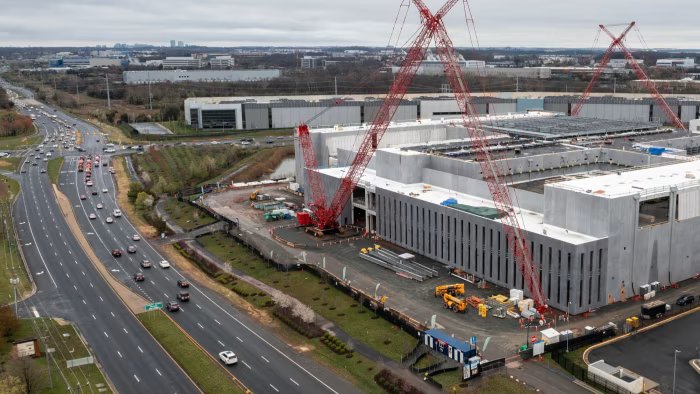
Tech companies are sounding the alarm about energy shortages. Politicians are losing elections because of rising electricity costs and fears over data centres. Look out of your window and you might even see a data centre being built. But some are questioning if electricity demands are being overstated.
That’s the conclusion activity in the forward energy markets seems to be pointing to.
First, a primer. Forward markets are where traders meet to buy and sell commodities, from oil to orange juice, that will be delivered in the future.
Their purpose is to minimise price risk, since buyers are protected if prices rise and sellers guarded if prices fall. This certainty helps support long-term investments and signals expectations about future supply, demand and macro forces shaping commodities.
Forward energy markets are where future power is bought and sold. Since power is an infrastructure-heavy sector, price certainty is important for building the power plants and pipelines that will be essential for fuelling the AI boom and keeping ratepayer costs down.
Buyers include utilities, data centres and other large industrials, while sellers can be power generators and gas producers. The middlemen are specialists such as Vitol and Tenaska as well as the trading arms of well-known companies including NextEra, Shell and Goldman Sachs.
If electricity demand shoots up, unmet by supply, a market watcher could expect futures prices to rise dramatically. But this isn’t happening.

Travis Kavulla, vice-president of regulatory affairs at NRG Energy, a generation and utility company, called attention to this in a recent X thread and letter to the US Department of Energy, calling it a “vexing phenomenon”.
In grid operator PJM’s market, which includes Virginia’s “data centre alley”, forward prices for 2030 are only slightly elevated compared to 2026.
In Ercot, which serves Texas, the forward market has been “backwardated”, meaning that distant years are cheaper than nearer ones. Data centres in that region are forecast to require 77 gigawatts by 2030, a 163 per cent increase from 2024 projections.
While there has been a modest upswing in recent months, market watchers say forward prices aren’t where they’d expect them to be. This could suggest that traders think data centre electricity demand is inflated due to building restrictions and equipment shortages.
“There are so many hurdles to building anything, be it a strip mall, power plant or data centres,” said Gabe Phillips, a former energy trader and chief executive at Catalyst Power Holdings. “You’ve got permits, local zoning issues, supply chain delays, inhospitable landlords.”
“There are a thousand reasons why what’s announced publicly never materialises in reality,” he said.
Traders may think that politicians will step in to keep the price of electricity down, as state governors across the PJM region have.
Data centres might also become more efficient, meaning their chips require less energy. But as demand for AI operations increases, this effect could be tempered.
“There’s no question we’re getting more efficient every time we run a computation,” said Rob Gramlich, president of Grid Strategies, the energy consultancy. “But on the other hand, the number of computations are going up exponentially. Maybe market participants think efficiencies are going to win the race over the amount of compute.”
Data centre developers are being encouraged by their own timelines, politicians, grid operators and some utilities to “bring their own generation” using generators and technologies such as fuel cells. This power procurement may not show up in the market.
“The most important piece is that many data centres aren’t going to connect to the power system,” said Phillips. “They’re going to be power islands.” (Martha Muir)
Power Points
-
Glencore has slashed 1,000 jobs as it cuts costs and streamlines operations.
-
India’s oil consumption will grow more quickly than China’s for the first time next year, says Trafigura.
-
A fusion energy company backed by Google and Chevron is establishing a joint venture with the UK government’s atomic laboratory.
Energy Source is written and edited by Jamie Smyth, Martha Muir, Alexandra White, Rachel Millard, Malcolm Moore and Ryohtaroh Satoh, with support from the FT’s global team of reporters. Reach us at energy.source@ft.com and follow us on X at @FTEnergy. Catch up on past editions of the newsletter here.
Recommended newsletters for you
Moral Money — Our unmissable newsletter on socially responsible business, sustainable finance and more. Sign up here
The Climate Graphic: Explained — Understanding the most important climate data of the week. Sign up here