

After a frenetic presidential campaign, voters are faced with a stark choice on climate and energy. The outgoing Joe Biden administration prioritized actions on this front, passing a landmark bipartisan infrastructure law and the $300 billion investment of the Inflation Reduction Act (IRA), and matching this legislation with an expansive slate of regulations and incentive-based programs favoring a clean manufacturing agenda.
The future of this agenda depends on the outcome of the election. Former President Donald Trump has promised to reverse course and reassert the fossil fuel-centric “energy dominance” posture of his prior administration, along with a resurgence of protectionist trade policies. Vice President Kamala Harris, who cast the tie-breaking vote to pass the IRA, has promised to build upon her predecessor’s clean energy industrial policy legacy. But both candidates face constraints that will shape their approach to energy and climate, with great geopolitical and national security implications.
STAY CONNECTED
Sign up for PowerPlay, the Atlantic Council’s bimonthly newsletter keeping you up to date on all facets of the energy transition.
Full steam ahead, or double back?
While there’s no shortage of pressing energy and climate considerations awaiting the next administration, four are most immediate.
1. Permitting reform
Despite President Biden’s legislative successes, comprehensive permitting reform remains elusive. Recent analyses have warned that if permitting and environmental review bottlenecks remain unaddressed, as much as 100 gigawatts of new clean energy projects could be delayed, and $100 billion of potential investment lost over the next decade. With an estimated 40 percent of new manufacturing projects experiencing delays already, and surging new projections for electricity demand growth, the permitting reform question may soon go from challenge to crisis.
All sides agree that something must be done on permitting, but diverge on what that should entail. The previous Trump administration attempted to limit environmental reviews to expedite permits. A Harris administration is expected to favor review timelines that balance stakeholder input and environmental justice considerations, akin to the Biden administration’s executive-level efforts and stated reform principles.
Permitting reform has the potential to benefit a wide range of project types—from pipelines to offshore wind and nuclear—but that diversity makes for tricky politics among advocates for some categories of projects over others.
A starting point for reform exists in the bipartisan Energy Permitting Reform Act introduced by Senators Joe Manchin (D-WV) and John Barrasso (R-WY). Its prospects in the lame-duck session are uncertain, and the next Congress may decide its fate.
In that circumstance, whoever occupies the White House will have outsized influence on the negotiations. So, too, will the makeup of Congress—but even if either party secures a trifecta, they will almost certainly need to compromise to attract votes from across the aisle to pass reform via regular order. With high-profile energy moderates like Manchin now departing, these bipartisan negotiations could be fraught regardless of White House intervention.
2. IRA implementation
The IRA is unlikely to be fully repealed even under a Republican trifecta, despite Trump’s promise to try. But with Republican control of Congress, some controversial provisions—such as the $7,500 credits for electric vehicle (EV) purchases—could be eliminated. But even without Congress, the IRA’s original design could be undermined by more subtle executive action.
The White House, through federal agencies, can avoid issuing important guidance or regulations, drastically change how tax incentives are structured, stifle disbursement for specific programs, and delay leases, reviews, and studies needed to implement the IRA. For example, Trump plans to rescind any and all “unspent” IRA monies. Similarly, the law’s hydrogen tax credit guidance, 45V, has yet to be finalized amid fierce debate. A Trump administration uninterested in hydrogen’s decarbonization potential could further delay this guidance or alter it in ways that exacerbate risk and uncertainty in this emerging sector.
A Harris administration would face a monumental implementation task. Of the IRA’s initial $145 billion in direct spending, tens of billions remain undisbursed and thus vulnerable to repeal under a new Congress.
Spending money quickly may seem an enviable problem, but managing the debates around IRA guidance is not. In addition to the drama surrounding 45V, the Biden administration has received sharp criticism over its interpretation of the IRA’s EV provisions, from perceived giveaways to foreign auto industries to controversial electric vehicle minerals agreements with other governments. Navigating these issues while maintaining the original intent of the IRA will be a difficult tightrope for a Harris administration to walk.
3. Trade policy
Trade policy has seen strong continuity between the Trump and Biden administrations. President Biden has largely retained his predecessor’s energy-related tariffs, including those targeting Chinese EVs and solar technologies.
The former president is prepared to revive his “America First” system of trade barriers, intended to decouple the US economy from China as much as possible. He has promised to establish a baseline global tariff on most foreign products, followed by incremental increases based on alleged currency devaluation. With the United States-Mexico-Canada Agreement (USMCA) up for review in 2026, a new Trump administration is expected to make fresh demands on Mexico, which has growing economic ties with China. By the same token, incoming European Union (EU) regulations on imported methane emissions and a carbon border adjustment mechanism (CBAM) might provoke a Trump administration into retaliatory measures that could ensnare energy exports.
Harris’ trade agenda also views China as a geostrategic adversary and promises to “fight for a level playing field with China and other global competitors.” Though her campaign disavows the “disastrous trade war” of the Trump era, it reaffirms support for reshoring manufacturing under President Biden’s clean industrial policy. Her approach, however, prioritizes multilateralism and maintaining partnerships wherever possible, especially in North America, East Asia, and Europe. For example, a Harris administration would likely negotiate with the EU to secure exemptions for US fuels and other exports that might be affected by EU climate policies.
The CBAM presents an area of potential convergence between the EU and both potential administrations. Multiple bills to enact a US version exist, including the GOP-endorsed Foreign Pollution Fee and the Democrat-sponsored Clean Competition Act. To be sure, Trump and Harris have disparate views of what a CBAM should accomplish, how its funds should be spent, and how it would impact domestic producers of high-emission products. But the concept appeals to both sides, albeit for different reasons, especially as industrial policy is likely to remain the driving theme for any presidency.
4. Natural gas
The role of natural gas and new gas infrastructure in the US energy system is at the crux of energy policy discussions. US electricity is increasingly powered by natural gas. US liquefied natural gas (LNG) is an important commodity for allies in Europe. The prospects for a sharp increase in US power demand driven by artificial intelligence highlight the importance of affordable, domestically produced gas in meeting these requirements.
The Trump campaign has derided the Biden-era focus on clean energy technologies and reasserted its vision for prioritizing American fossil fuels, especially natural gas. The Harris campaign has taken a nuanced approach that acknowledges the imperative to reduce fossil fuel emissions while also touting LNG exports to Europe and record US fossil fuel production under the Biden administration, and disavowing a federal fracking ban which she supported during her 2020 campaign.
The candidates diverge on the ongoing LNG export authorization pause, which froze new permits to sell to countries without a US free trade agreement. This pause, ostensibly to allow for a thorough review of the approval process for new applicants, has been lambasted by Republicans. The Biden administration has pledged that the review will conclude by the end of 2024 and the pause will be lifted in early 2025, but Trump has vowed to terminate it immediately upon taking office. Harris faces a delicate balancing act; while she has indicated support for LNG exports as an economic and national security matter, she has not criticized the pause either.
Additionally, the next administration may need to consider the impact of new export permits on domestic gas prices. While the Natural Gas Act has always required such analysis before granting permits, the impact of exports on domestic prices has historically been modest. As exports grow to larger shares of total demand for US natural gas, the price impacts for domestic consumers could be significant, potentially creating new domestic opposition to exports based on economic, rather than climate, concerns.
Guardrails
Neither candidate, however, will enter office with a clean slate or unlimited options. Three critical guardrails will constrain their respective energy and climate agendas.
1. The death of deference
Earlier this year, a seismic Supreme Court ruling overturned the “Chevron doctrine,” which allowed agencies wide regulatory latitude in areas where their statutory authorizations were ambiguous. As a result, agencies’ proposed regulations must now be firmly grounded in the letter of statues, even those written decades ago.
Federal agencies must now tread carefully. A future Harris administration would be particularly impacted, tasked with defending a slate of her predecessor’s climate-focused regulations now winding their way through the federal judiciary. If controversial rules, like the Securities and Exchange Commission’s new climate disclosure regulation, are overturned on the basis of agency overreach, Harris-appointed agency leadership may be forced to expend time and resources on new regulations subject to similar constraints.
However, the end of deference cuts both ways. A Trump administration could face a ruling binding it to certain IRA provisions it may oppose, such as the methane fee.
2. Congress
While Congress’ post-election composition is still unknown, the likeliest scenario appears to be divided control of the chambers. But even if either party were to gain full control, the next Congress faces a circuitous series of fiscal negotiations. Many provisions from the 2017 Tax Cuts and Jobs Act are set to expire at the end of 2025, setting up contentious debates over various rates, deductions, credits, and subsidies. This situation raises troublesome questions over finding new revenues and adjusting corporate tax rates, areas where either future administration will have strong opinions.
These imminent debates herald a more constrained fiscal environment than existed during the prior Trump or Biden administrations. Appetites for more energy and climate spending will be extremely low, even among Democrats who have plenty of other priorities. Conversely, there will be a hunt for new revenues. The latter could be an opening for protectionist tariff or border adjustment policies depending on who holds executive office. Undisbursed funds, such as those in the Biden-era climate and infrastructure laws, would also be tempting targets to help pay for new tax plans.
3. Federalism
The US federal system represents the most important limitation on any president’s agenda. In an increasingly polarized national political environment with few states that are not largely controlled by one party, either future presidency’s agenda will be met with state-level pushback, usually in the form of lawsuits.
How those suits proceed with a conservative-dominated Supreme Court is an open question. What is certain is that states will govern as they please, pursuing their own policy mandates, funneling tax dollars toward preferred projects, and making critical infrastructure and permitting decisions which have ripple effects elsewhere. For example, in the late 2010s, former President Trump’s withdrawal from the Paris Agreement did not stifle ongoing clean energy expansion in northeastern and Sun Belt states.
In a post-IRA environment, this situation may present a greater challenge to a Trump administration than a Harris one. Billions of dollars of federal investment in clean energy and manufacturing during the Biden administration has gone to traditional Republican strongholds such as Georgia, Tennessee, Texas, and South Carolina. Any attempts to rescind this funding or cut tax incentives which have enabled major investments in these states will be controversial. As ever, all politics is local.
What’s next?
As the 2024 campaign enters its final hours, the respective energy and climate agendas of each ticket are a study in contrasts. Even so, the future under either administration is murky, with significant limitations and complex negotiations ahead for whoever occupies the White House in 2025. This is to say nothing of the unforeseen events which can propel a government into one direction or another, such as global pandemics, land wars in Europe, or disruptions in global shipping hubs.
The competing visions of the campaign cycle will soon be a memory. What comes next will have enormous implications for the world.
David L. Goldwyn is chairman of the Atlantic Council’s energy advisory group and a nonresident senior fellow at the Atlantic Council Global Energy Center and the Adrienne Arsht Latin America Center.
Andrea Clabough is a nonresident fellow at the Atlantic Council Global Energy Center and a senior associate at Goldwyn Global Strategies, LLC.
MEET THE AUTHORS


RELATED CONTENT
OUR WORK

The Global Energy Center develops and promotes pragmatic and nonpartisan policy solutions designed to advance global energy security, enhance economic opportunity, and accelerate pathways to net-zero emissions.
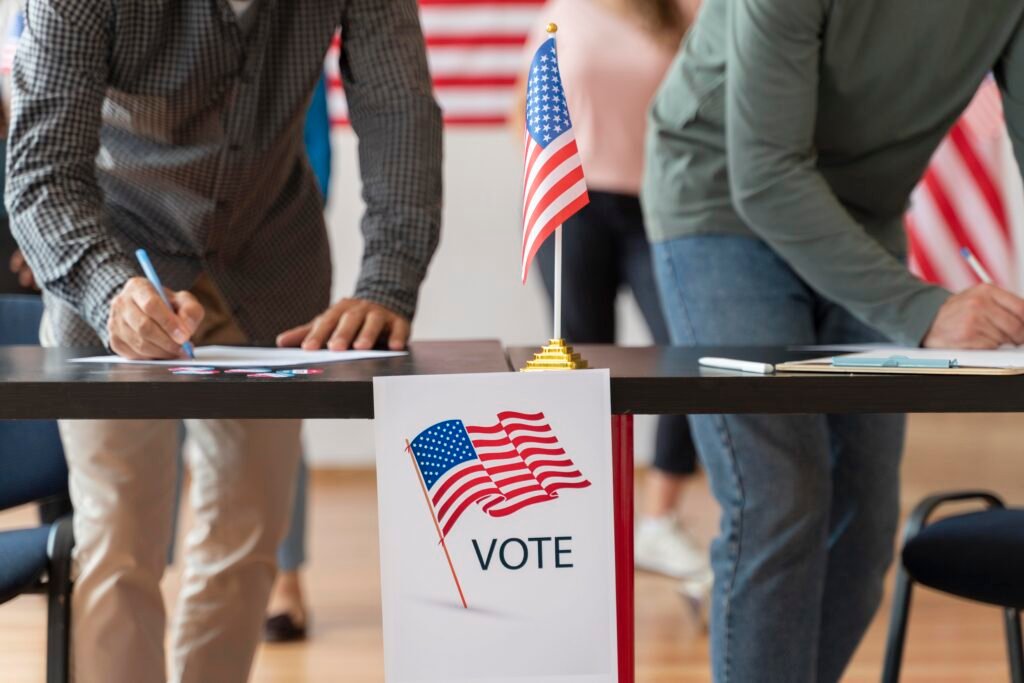
Image: People registering to vote in US. (FreePik) https://www.freepik.com/free-photo/people-registering-vote-united-states_18301086.htm#fromView=search&page=1&position=17&uuid=48b21de7-e735-413b-8acd-d6cafa8aae45