
When you buy through links on our articles, Future and its syndication partners may earn a commission.

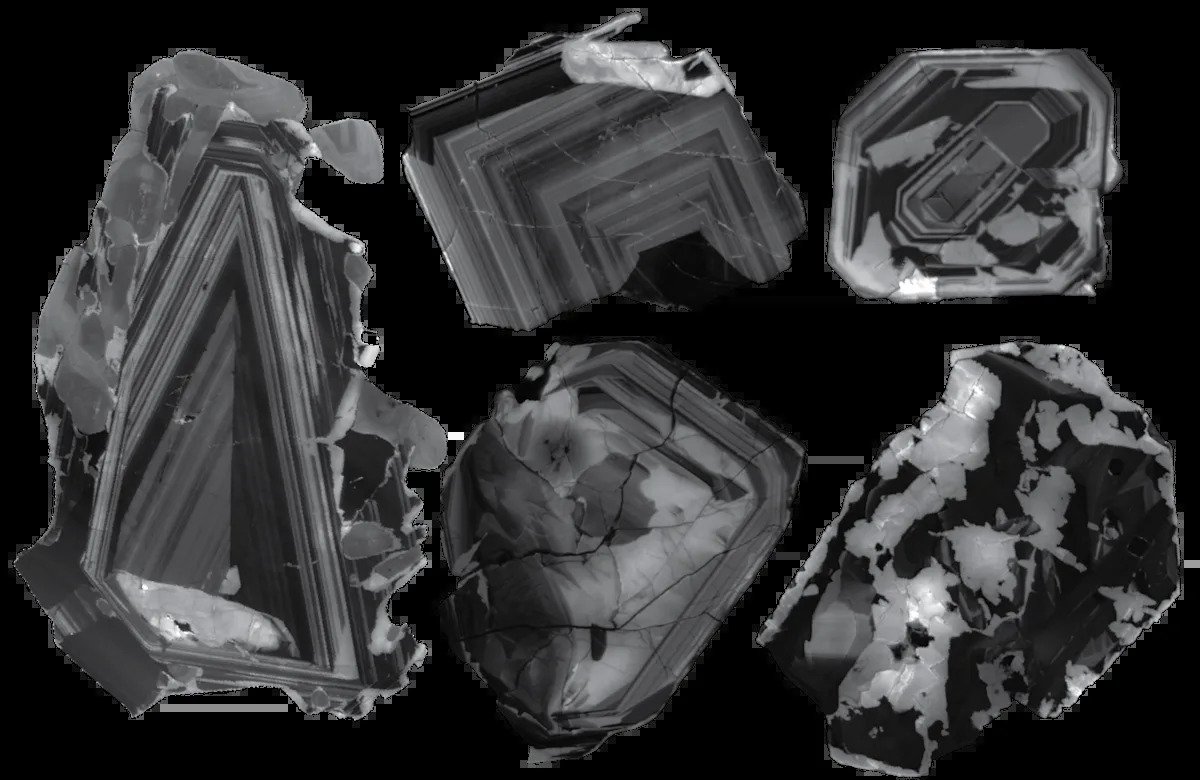
Zircon crystals ranging from 0.1 to 1 mm that were analyzed in this study. Their isotopic signatures allowed the scientists to determine the age of carbonatite formation with high precision. | Credit: Figure reproduced from: Droellner et al., (2025) Geological Magazine, Volume 162 , e33. https://doi.org/10.1017/S0016756825100204. © The Author(s), 2025. Published by Cambridge University Press. Licensed under CC BY
A recently discovered enormous source of niobium — a metal that’s essential for much of today’s technology — appears to have formed when the supercontinent Rodinia ripped apart around 830 million years ago, according to a new study.
The niobium-rich carbonatites, which could be one of the world’s largest sources of the metal, have come from deep within the Earth’s mantle, scientists reported in a study published Sept. 2 in the journal Geological Magazine.
Niobium is a silvery, corrosion-resistant metal with superconducting properties, making it key for strengthening steel and for use in devices such as MRI scanners and particle accelerators.
Currently, 90% of the global supply of niobium is extracted from a single mine in Brazil, with the other 10% coming from a Canadian mine. Understanding how, where and when these massive Australian sources formed can help to find new deposits, study co-author Maximilian Dröllner, a sedimentology researcher at the University of Göttingen in Germany, told Live Science.
Although small amounts of niobium can be found encased in various types of rock, the quantities required for economic and industrial extraction are primarily sourced from carbonatites — crystalline rocks that consist mainly of magmatic carbonate.
Carbonatites are “a bit like a treasure box,” Dröllner said, because they harbor important metal resources and rare earth elements encased within minerals, Their exact compositions vary depending on where the magma originated inside Earth.
Related: What is the rarest mineral on Earth?
Carbonatites are generally only found beneath Earth’s surface. But because the surface doesn’t reveal what’s buried deep below, exploratory drilling and core extraction are the only ways to know for sure.
The two new niobium-rich deposits in Australia’s Aileron Province — called Luni and Crean — were unearthed during such campaigns by the mining companies WA1 Resources Ltd. in 2022 and Encounter Resources in 2023. The Luni deposit has an estimated 200 million metric tons of niobium, and the smaller Crean deposit has around 3.5 million metric tons.
The companies used diamond core drills to extract long, cylindrical sections of material from each site. Dröllner and his team then took eight samples from three Luni drill cores and two samples from a single Crean drill core.
They took a thin slice of each sample from the areas that appeared to have the most diverse mixes of minerals and textures, which allowed the researchers to tap into the geological story of the rock.
Then, they used a Selfrag machine to fire a series of lightning bolts at the remaining chunks. This caused the rocks to shatter along the boundaries of each mineral grain. Next, they placed these grains under a microscope and a mass spectrometer to get an age for rocks.

By looking at the ratio of different isotopes with their decay products, the research, which was partially funded by the mining companies involved, found that the carbonatites, including the niobium mineralization, formed around 830 million to 820 million years ago.
The analysis also revealed a “clear mantle fingerprint,” Dröllner said, which indicates that the carbonatite magma came from Earth’s mantle rather than from the crust. Both deposits seem to have come from the same source, with a fork in the pipe of the internal plumbing system channeling the magma to each spot.
RELATED STORIES
—Enormous deposit of rare earth elements discovered in heart of ancient Norwegian volcano
—China discovers never-before-seen ore containing a highly valuable rare earth element
—Volcano in Tanzania with weirdest, runniest magma on Earth is sinking into the ground
The team linked the rupture of the supercontinent Rodinia to these deposits. When the supercontinent was pulled apart by the movement of the tectonic plates, Earth’s crust thinned at the newly formed junctures, granting the planet’s innards easier access to the surface. An analysis of helium isotopes showed that the Luni deposit was within touching distance of the surface around 250 million years ago.
Anthony E. Williams-Jones, a professor of geology and geochemistry at McGill University in Montreal who was not involved in the study, said this is very high-quality research. However, he noted that because the researchers only examined drill cores, there is no information on the extent of the deposits and what they look like over the whole area.
Dröllner said more research is needed to construct a three-dimensional map of the deposits, which will eventually allow this niobium to be extracted. Nonetheless, this new understanding of how the Luni and Crean niobium deposit formed will help to create a checklist for identifying likely other spots rich in the metal, he added.