

Heavy metal contamination in Delhi’s groundwater is among the most severe in the country, with Central Ground Water Board’s annual report stating that the Capital is home to some of India’s highest levels of uranium, lead, nitrate, fluoride and salinity-related indicators, posing long-term health risks for people who depend on borewell and hand pump water.
Released this month, the report said “significant concerns have emerged” after analysis of samples taken from the city, while noting that several of these contaminants exceed national drinking water standards.

The health implications are substantial.
Lead, one of the most dangerous toxins detected in Delhi’s aquifers, is a neurotoxin that impairs cognitive development in children, increases blood pressure, affects kidney function and is classified as a probable human carcinogen, making even low concentrations unsafe. According to the report, Delhi has the highest proportion of lead-contaminated groundwater samples in India during the pre-monsoon season — 9.3% of the samples exceeded Bureau of Indian Standards (BIS) limits, far higher than Assam (3.23%) and Rajasthan (2.04%).
As per the report, Delhi has the third highest proportion of contaminated samples of uranium in the country after Punjab and Haryana. Uranium has well-documented links to kidney damage and carcinogenic risks.
Uranium levels in Delhi exceeded permissible limits in 13-15% of the samples. The report identified the northwestern belt, including Punjab, Haryana, Delhi, parts of Rajasthan and Uttar Pradesh as the main uranium hotspot.
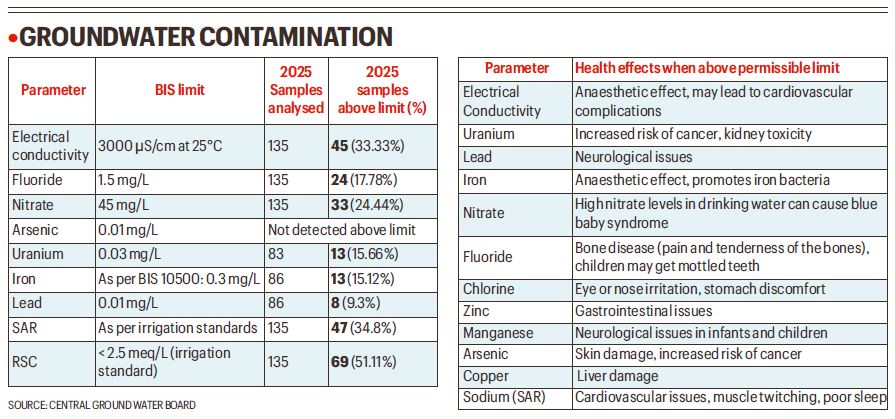
Other contaminants like elevated nitrate levels found in Delhi’s groundwater also pose health risks.
The report noted that nitrate exceedances were largely driven by “anthropogenic sources, notably agricultural practices and improper waste disposal”, while high fluoride concentrations were “predominantly geogenic (naturally occurring), associated with water-rock interaction in crystalline and hard rock aquifers, such as granite and gneissic formations”.
Story continues below this ad
According to the report, electrical conductivity (EC), an indicator of total dissolved solids and salinity, remains one of Delhi’s major groundwater stress points.
It pointed out that salinity concerns are “particularly acute in arid and semi-arid regions of Northwest India, with states like Rajasthan, Delhi, Haryana and Gujarat showing a higher proportion of non-compliant samples”.
Delhi’s groundwater also reflected significant alkali and salinity hazards when assessed through the Sodium Adsorption Ratio (SAR) and Residual Sodium Carbonate (RSC), both of which determine irrigation suitability.
Nationwide, 98.9% of samples recorded SAR less than or equal to 26. But Delhi’s recorded one of the worst figures – it reported up to 179.8 SAR at some locations, with 34.8% of samples exceeding the permissible limit. In case of RSC, Delhi topped the country, with 51.11% samples above the limit of 2.5 meq/L.
Story continues below this ad
The CPCB further observed that monsoon recharge of groundwater does not always improve water quality. Even after monsoon, “a comparable number of locations exhibited deterioration (in parameters)”, it said, adding that this was governed primarily by site-specific factors such as aquifer type and local contamination load.
Delhi also reported substantial saline facies in groundwater, with NaCl-type water making up nearly half (47.4%) of its samples, similar to patterns in arid states like Gujarat and Rajasthan. CaCl₂-type permanent hardness was also noted, with Delhi recording 6.3% – one of the highest after Haryana and Himachal Pradesh.
The Central Ground Water Board’s 2024 data showed 23.3% of Delhi samples exceeded EC limit, 16.5% exceeded fluoride limits, 20.4% exceeded nitrate, and 10.7% exceeded uranium limits.
In 2025, this contamination intensified as EC exceedances rose to 33.33%, nitrate to 33 samples, and fluoride to 17.78%. Uranium exceedance also rose, with 13 of 83 samples above permissible levels. Further, Delhi reported the highest contamination in lead (percentage of samples with lead above permissible limit at 9.3%) among all states during the pre-monsoon period.
Story continues below this ad
Environmental activists said the findings highlight a growing crisis linked to aquifer stress and unchecked borewell activity.
Pankaj Kumar, a Delhi-based environmental activist, said the contamination stems from “over extraction of groundwater and boring activities”. He added that the most concerning indicators are the high uranium levels, electrical conductivity and SAR, noting that “if SAR is too high, the water is not even good for industrial use, let alone other uses”.
These concerns prompted Delhi-based civil society group Earth Warrior to write to the L-G V K Saxena and Chief Minister Rekha Gupta on Friday, demanding immediate public disclosure of groundwater quality data for all 5,500 tubewells and ranney wells operated by the utility.
In the letter, the group said that uranium above permissible limits in 13-16% of samples, along with high nitrate, fluoride and salinity levels, poses serious health risks, including fluorosis, methemoglobinemia, kidney damage and potential carcinogenicity.
Story continues below this ad
It also pointed out that Delhi Jal Board (DJB) supplies over 450 million litres per day of untreated or minimally treated groundwater directly into local networks. The group urged DJB to publish water quality test reports for every operational tubewell, disclose treatment methods (if any) used before supply, list locations where contaminated groundwater is being supplied with only chlorination, and release a time-bound action plan to achieve full compliance with BIS drinking-water standards.
Meanwhile, the CPCB has recommended in its report a combination of source protection, improved fertilizer management, targeted treatment technologies, strict regulation of industrial effluents and hotspot monitoring to contain the spread of contaminants to improve groundwater. It also highlighted the need for hydrogeochemical mapping, especially in cities like Delhi, where multiple contaminants such as salinity, uranium, nitrate and lead overlap spatially.