
Türkiye will witness major energy breakthroughs in 2026, from the launch of its first nuclear power plant and faster growth in renewables to a sharp expansion in domestically produced natural gas, a senior official said on Friday.
These are part of Ankara’s push to reduce external dependency of the country, which has long relied on imports to meet almost all of its energy needs, and to strengthen energy security.
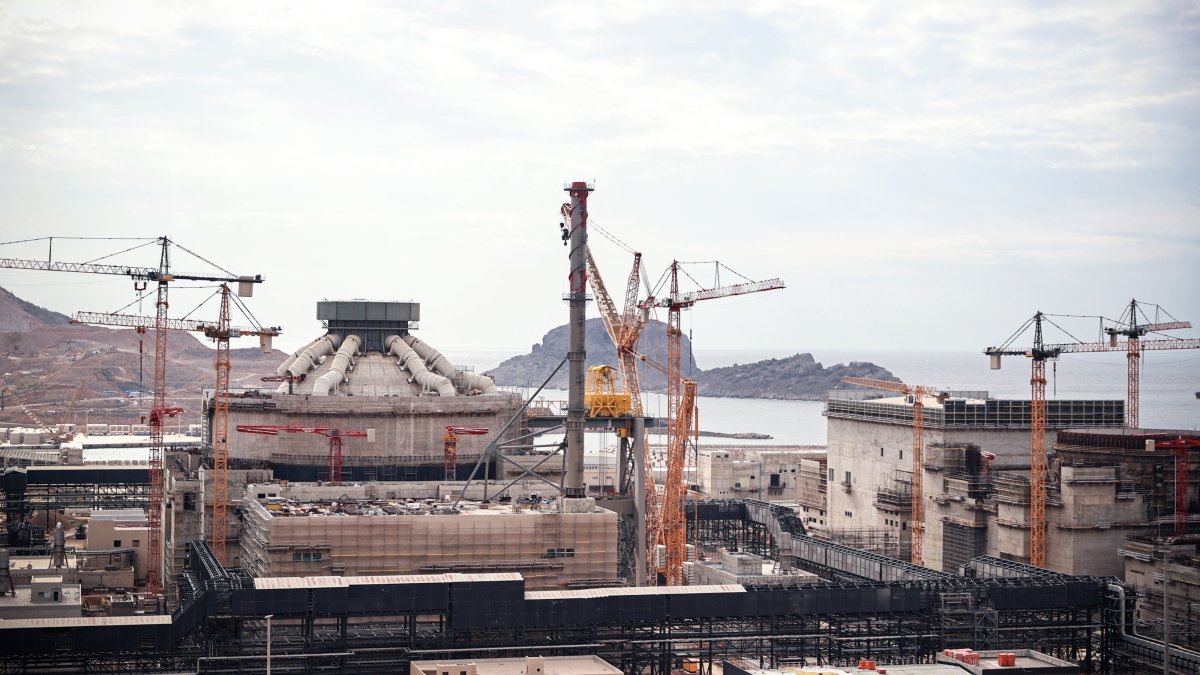
Türkiye aims to generate its first electricity from the Akkuyu nuclear power plant in 2026, Energy and Natural Resources Minister Alparslan Bayraktar said on Friday.
Bayraktar was speaking during a briefing in Istanbul, according to a readout from his ministry.
The $20 billion (TL 858.51 billion), 4.8-gigawatt, four-reactor plant is being built by Russian conglomerate Rosatom in the Mediterranean province of Mersin. Once fully operational, it is expected to generate around 10% of Türkiye’s electricity.
The project has faced several delays, including pandemic-related disruptions, delivery problems after Germany’s Siemens failed to supply key components, and financial hurdles caused by Russian funds frozen abroad.
Bayraktar announced on Friday that Russia had provided new financing worth $9 billion for the Akkuyu.
“This (financing) will most likely be used in 2026-2027. There will be at least $4 billion-$5 billion from there for 2026 in terms of foreign financing,” he said.
Türkiye is also in talks with South Korea, China, Russia and the United States on nuclear projects in the Sinop province and Thrace region, according to Bayraktar, who said Ankara wants to receive “the most competitive offer.”
Türkiye aims to reach 7.2 GW of nuclear capacity by 2035 and 20 GW by 2050. It plans to build three conventional nuclear power plants and complement them with small modular reactors (SMRs).
Bayraktar said Türkiye wanted to generate nuclear power at home and aimed to provide clear figures on targets.
He added that the government is working on a legal framework to regulate and incentivize SMRs.
Renewables, storage, Gulf investment
On renewable energy, Bayraktar said Türkiye was in talks with Saudi Arabia’s ACWA Power company on a 5,000-megawatt solar package.
“We will have completed the agreement for this in the first quarter of 2026, for 2,000 megawatts in the first phase. We are talking about a 2,000-megawatt solar energy project; 1,000 megawatts in Sivas, a thousand in Taşeli,” he said.
“We are discussing a project on solar and storage with yet another firm from the Gulf again. The approximate investment cost of that is between $1.5 billion-$2 billion,” Bayraktar added, without giving details.
On energy storage, Bayraktar said investors currently hold licences totalling 33,500 MW, although only a small portion has been realized so far.
“In 2026, around 2,000 megawatts of storage investment will come online,” he said.
The government may also introduce a Storage Resource Zone (DEKA) model in 2026, similar to its Renewable Energy Resource Zone (YEKA) auction scheme, which has been used to attract private investment and reduce Türkiye’s energy import bill.
This year, Türkiye completed solar and wind tenders allocating 3,800 megawatts of capacity, with expected total investment of around $4 billion.
Bayraktar also highlighted potential in floating solar power plants, saying the government aims to deploy around 3,000 megawatts as soon as possible. Offshore wind projects are also being planned for 2026, potentially under a YEKA-style model, he said.
Rare earths
On rare earth elements, Bayraktar said Türkiye plans to lay the foundation for an industrial-scale processing facility in Beylikova, in the central province of Eskişehir, in 2026, where purity levels have reached 92%-93%.
“We are at a very important project design stage for this facility,” he said.
He stressed that Türkiye has made no binding commitments to any country regarding rare earth supplies.
“We have given no promises or undertakings to any country. We will act in line with Türkiye’s interests. These are not agreements that will be hidden,” Bayraktar said.
The minister said the government wants to reposition state-run Eti Maden as a more active national mining company. “Why shouldn’t Eti Maden be a company that produces copper or owns gold mines?” he said.
TPAO expansion, Black Sea gas, shale oil
Bayraktar said Türkiye aims to further expand the state-owned Turkish Petroleum Corporation (TPAO) and will soon use around 1 billion euros ($1.18 billion) in export credit agency financing from Italy’s SACE for Black Sea projects.
“Türkiye is now moving more strongly toward a period in which it will be a player abroad in energy and mining,” he said.
Speaking at a separate event on Friday, Bayraktar said the government aims to turn TPAO into a company that produces 1 million barrels of oil and gas per year through projects abroad, mergers and acquisitions.
He added that new capacity in natural gas and coal-fired power plants is also being considered for 2026.
On gas, Bayraktar said production at the vast field in the Black Sea is expected to double in 2026.
The Sakarya gas field is estimated to contain 710 billion cubic meters (bcm) of gas. The reserve was gradually discovered between 2020 and 2022. It will meet approximately 30% of the nation’s annual gas needs once the production reaches total capacity.
In mid-May, Türkiye announced a separate 75 bcm gas discovery in the Black Sea.
“We are moving toward a period where we meet the natural gas needs of 8 million households with our own gas,” Bayraktar told reporters. “This corresponds to around 7.5 billion cubic metres, preventing about $3.2 billion in imports at current prices,” he said.
Bayraktar also recalled unconventional oil search in southeastern Diyarbakır province, where shale oil is being explored across four blocks using new techniques.
“The field in Diyarbakır that we think contains shale oil is actually about 10-12 times larger than these four blocks. We are conducting this work in only 600 square kilometers of an area approximately 7,200 square kilometers in size,” he said.
“2026 will be the year we conduct horizontal drilling and hydraulic fracturing. If successful, this could truly have a game-changing effect for Türkiye’s petroleum,” he said.
“That’s why 2026 is important for us.”