
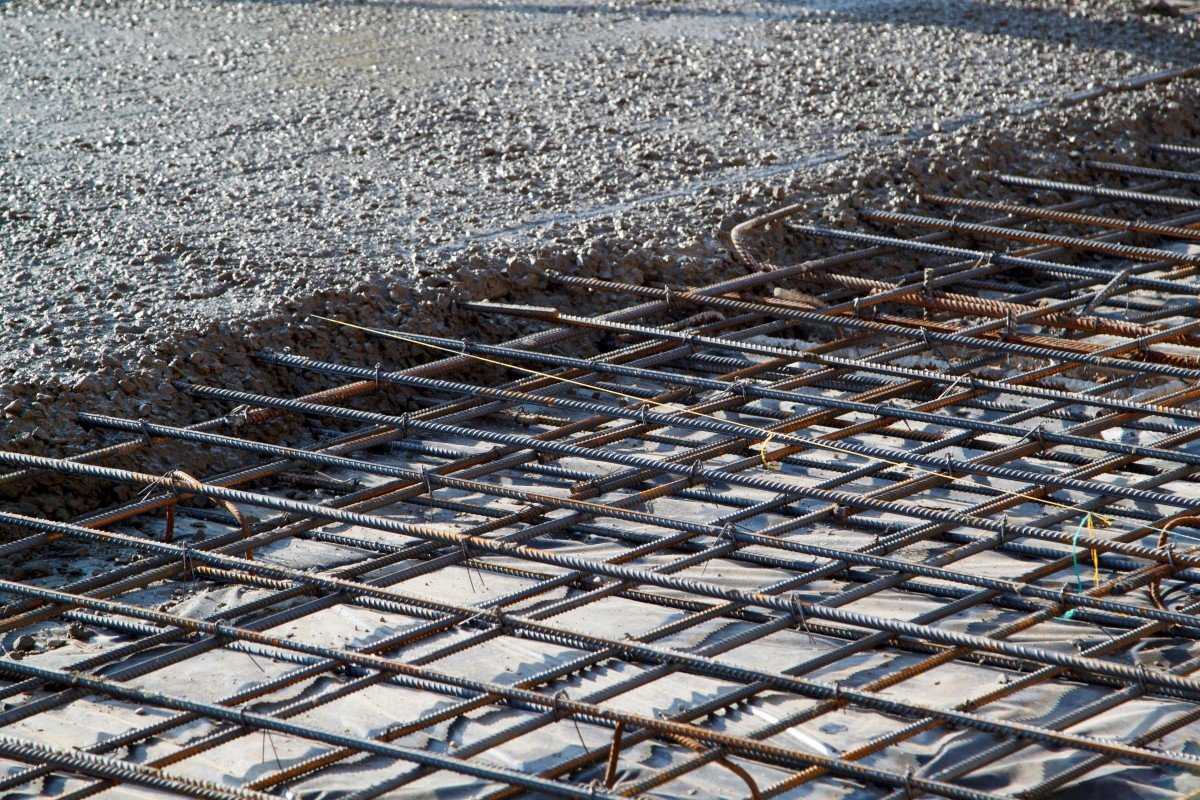
The material consists of various metallic alloys bound by nanoscale precipitates, mirroring the structure of reinforced concrete. 3D-printed titanium alloy struts mimic the steel rebar in reinforced concrete, while a technique known as ‘micro-casting’ was used to build a matrix of other elements including aluminium, silicon and magnesium, acting like the cement.
Additional strength comes from micrometre-sized particles of alumina and silicon nanoprecipitates, which mimic the role of gravel or aggregate found in concrete. The research is described in Nature Communications.
“In our material, the ‘rebar’ is a mesh made of titanium alloy struts,” said lead author Chenwei Shao, a research fellow at Toronto’s Faculty of Applied Science and Engineering.

Postdoctoral fellow Huicong Chen, Research associate Chenwei Shao and Professor Yu Zou at the University of Toronto, demonstrate samples of their new metal matrix composite. – Tyler Irving / University of Toronto Engineering
“Because we use a form of additive manufacturing in which we fire lasers at metal powders to heat them into solid metal, we can make this mesh any size we want. The struts can be as small as 0.2 millimetres in diameter.”
A series of tests was performed on the material to gauge its capabilities. The unique structure was found to deliver exceptional strength in relation to its mass, particularly at high temperatures where other materials are often compromised. Computer models showed this was a result of the composite deforming via a different mechanism than most metals.
“At room temperature, the highest yield strength we got was around 700 megapascals; a typical aluminium matrix would be more like 100 to 150 megapascals,” said Shao.
“But where it really shines is at high temperature. At 500 Celsius, it has a yield strength of 300 to 400 megapascals, compared to about five megapascals for a traditional aluminium matrix. In fact, this new metal composite performs about as well as medium-range steels, but at only about one-third the weight.”
While the material is some way off industrial use, the Toronto team believes its exceptional properties could make it attractive for high-end applications in aerospace, defence and automotive.
“It still costs a lot to create materials like this at scale, but there are some applications where the high performance will be worth it,” said senior author Professor Yu Zou, who leads the lab where the research took place.
“And as more companies invest in advanced manufacturing technologies, we will eventually see the cost come down.”