
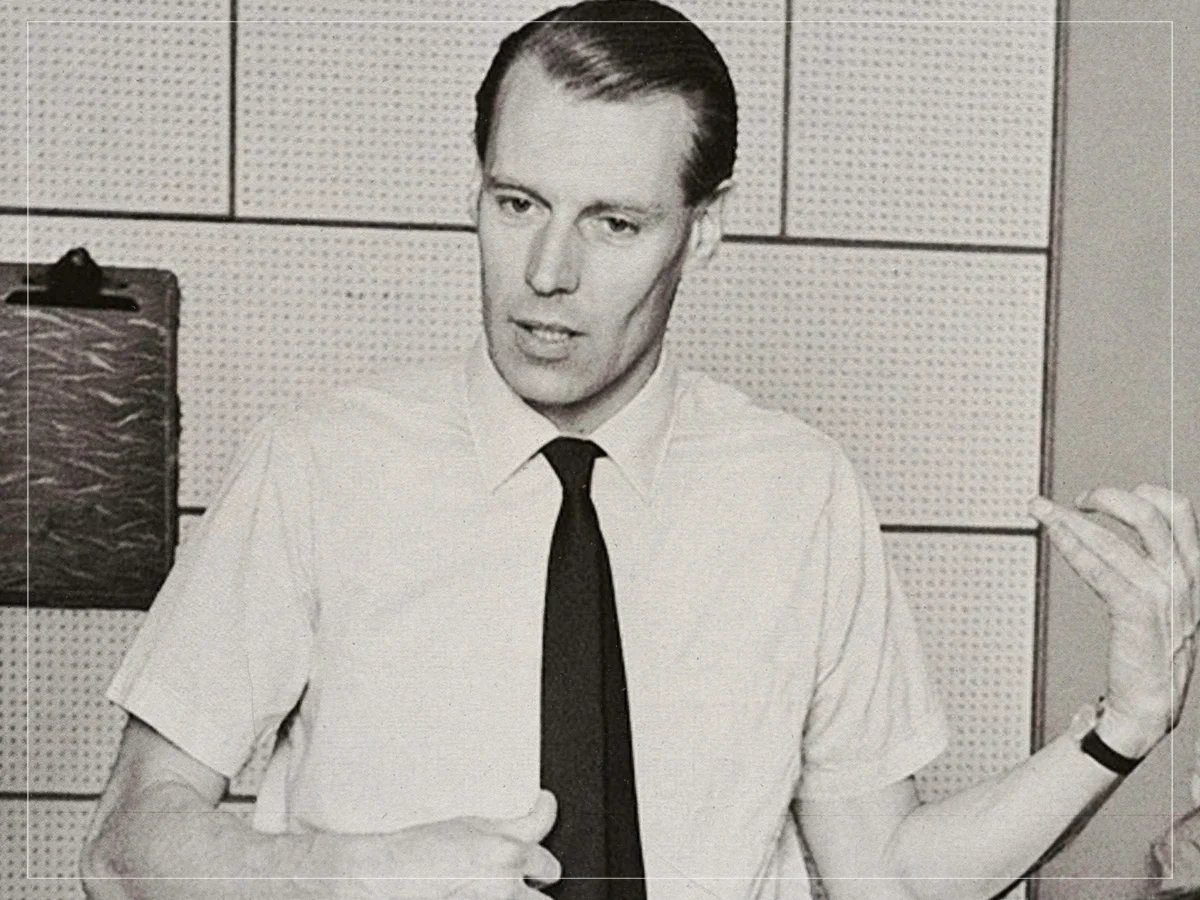

(Credits: Far Out / TIDAL / George Martin)
As a music producer, it’s hard to evade the stereotypes.
Take Rick Rubin, for example. As he wanders barefoot through his Californian studios, the idea of a music producer being a somewhat ethereal and imaginative person is strengthened. Or what about Quincy Jones? A purveyor of style and sophistication, he was almost the walking embodiment of the music he created. Ultimately, there’s space for a producer to embrace eccentricity given how creative their vocation is.
So, with that in mind, you would think the person responsible for producing The Beatles would have been drenched in kaleidoscopic colour and a mop top haircut, to keep up with the band’s experimentalism. But it was quite the contrary. George Martin was the clean-cut and well-spoken counterpoint for the band, guiding them through their musical journey with a quiet and humble sense of calm.
Of course, underneath the effortlessly calm demeanour existed one of the most open and experimental minds in music. After all, this was the man tasked with bringing the esoterica of tracks like ‘Tomorrow Never Knows’ and ‘Strawberry Fields Forever’ to life.
So when the 1960s came to a bitter end for The Beatles, and George Martin’s time was no longer spent in the studio, recording back-to-back albums with the band, his services were inevitably sought after. Bands and artists from all over the musical spectrum wanted to work with the famed producer, for they knew that his diversity could bring out the best of them, whatever the genre. Well, perhaps not every genre. Because in 1980, a decade after he wrapped things up with The Beatles, Martin had an experience that deterred him from one specific genre.
UFO flew out to Martin’s AIR studio in Montserrat to lay down their album No Place To Run, a process with Martin admitting to halting any curiosity he had about working in the heavy metal space thereafter.
He explained, “I once had a flirtation with heavy metal, and I regretted it very much,” Martin later told an interviewer. “It [the genre] didn’t seem to have any sense.”
While he never specifically claimed the band in question were UFO, Pete Way later conceded that he suspected Martin was talking about them. Not necessarily because Martin and the band didn’t get along, or that the album was wholly reflective of a bad working relationship, but just that it was clear Martin was struggling to engage with their style of music.
It was specifically centred around the band’s lead singer, Phil Mogg, and his general reluctance to write lyrics. Having spent a decade with two of the best songwriters of all time, who used lyrics and melody to coax out ideas, this more disinterested style almost confused Martin.
As Way recalled: “Sometimes he would ask: ‘Is Phil coming in today?’ because he was used to John Lennon and Paul McCartney having their lyrics ready. George became anxious about the [lack of] words, and we’d have to placate him: ‘Oh, don’t worry, they’re done,’ when we all knew very well that Phil was down at the beach waterskiing.”
“George would sometimes read out my lyrics,” Mogg later told Classic Rock, mimicking Martin’s accent as he did it: “‘Joey rides the subway, fast from east to west, on the streets he’s number one, some say that he’s the best’. And he’d ask: ‘Who is this Joey? And what was he doing on the subway?’ There was a bit of a culture clash.”
That was the first and last heavy metal Martin produced in his career, and maybe proved that after all his success, there was, in fact, something he couldn’t do.
Related Topics
The Far Out Beatles Newsletter
All the latest stories about The Beatles from the independent voice of culture.
Straight to your inbox.