
The UK’s largest household energy supplier says Britain should embrace Chinese technology in its energy market, adding its weight to a fierce debate about China’s role in a critical industry as the prime minister travels to the country.
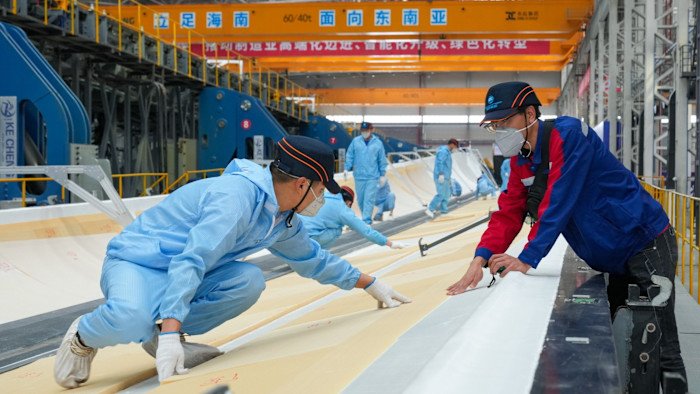
Zoisa North-Bond, chief executive of Octopus Energy’s power generation arm, said greater competition could cut wind farm development costs by almost a third, helping the UK government meet its goal of keeping energy bills down. The company said in September it wants to deploy wind turbines from one of China’s largest manufacturers on its own projects in Britain.
“We look to China and we see the sheer innovation and speed at which they have deployed wind models and how much they have invested in innovation — and you cannot ignore that,” she said.
“And the cost at which they are deploying — when you speak to a Chinese hardware manufacturer, actually it could save 30 per cent on developing wind here in the UK if we could access Chinese wind turbines.”

The intervention comes as Sir Keir Starmer is due to arrive in Beijing on Wednesday with 60 British businesses, including Octopus Energy represented by its chief executive Greg Jackson. The trip is part of efforts to restore UK-China relations after veering in recent years “from the Golden Age to the Ice Age”.
China dominates global supply chains for clean energy hardware and many raw materials, but critics fear its success makes other countries too reliant on the communist state and raises questions over cyber security, state subsidies and rights.
The UK government is also weighing whether to approve proposals for a £1.5bn wind turbine factory in Scotland by Shanghai-listed manufacturer Ming Yang, giving the company an important foothold in a market still dominated by European rivals.
Octopus wants to deploy potentially around six gigawatts of Ming Yang’s turbines in Britain, saying it would explore implementing software to “create the highest levels of data protection and cyber security”.

North-Bond added: “[Security concerns] shouldn’t be a blocker — it’s about how you design software that’s fit for the market. We know we can design software combined with Chinese hardware that could allay some of those concerns.”
Octopus’s retail arm supplies almost 8mn UK households. It has become an influential voice in British business: Jackson is also a government adviser, and the UK has agreed to invest £25mn in Octopus’s technology arm, Kraken.
Starmer’s visit takes place after Donald Trump’s wrecking-ball diplomacy last week and was presented by China as a chance to work with the UK to promote “world peace”.
In an apparent reference to Trump, China’s foreign affairs ministry said: “The international landscape is witnessing turbulence and transformation.” Starmer in turn promised “a strategic and consistent relationship” with Beijing.
Starmer knows his visit could rile Trump, who threatened new tariffs on Canada after its prime minister Mark Carney announced a “strategic partnership” with Beijing and agreed to reduce tariffs on Chinese electric cars.

But the prime minister noted before the trip that a succession of western leaders has been to Beijing in recent years and that Trump himself is due in Beijing in April.
The travelling party accompanying Starmer on his visit to Beijing and Shanghai spoke of the kind of deals the UK hopes to secure off the back of an improved diplomatic relationship with China.
The delegation includes bosses from financial and business services firms, life sciences, car companies and energy firms alongside representatives hoping to exploit the growing Chinese sports and cultural market.
The cultural delegation includes figures from the National Theatre, the Science Museum, the V&A Museum, the World Professional Billiards and Snooker Association and Table Tennis England.
“For years our approach to China has been dogged by inconsistency, blowing hot and cold, from Golden Age to Ice Age,” said Starmer, the first British prime minister to visit the country since Theresa May in 2018.

“As one of the world’s biggest economic players, a strategic and consistent relationship with them is firmly in our national interest.”
British officials insist Starmer will not shy away from raising issues including human rights, although any such criticism of Beijing over its actions in Hong Kong or its treatment of the Muslim Uyghur minority is likely to be kept out of public view.
Starmer insisted Britain would “not turn a blind eye” over security threats posed by China but said it was better for the country to “engage even where we disagree”.
The opposition Conservative Party has strongly criticised Starmer for what it claims is his “kowtow” approach to Beijing, including the government’s approval last week of a new Chinese “super embassy” on the edge of the City of London.

China has embraced Starmer’s visit which, from a diplomatic point of view, should be easier for the UK prime minister to navigate than his engagements with the increasingly erratic President Trump.
Beijing said the trip was “an opportunity to enhance political mutual trust with the UK, deepen practical co-operation, open a new chapter of sound and steady development of China-UK relations and together make due efforts and contributions to world peace, security and stability”.
China’s commerce ministry also took the chance to troll President Trump. “Amid escalating global trade protectionism, both China and the UK uphold free trade and the multilateral trading system,” it said. Starmer hopes to get approval soon for Britain to revamp its embassy in Beijing.
Starmer will be under pressure in Beijing to take on security hawks at home — and in the US — and to allow more Chinese investment in the UK.
However, there will be no revival of the “access all areas” approach taken by David Cameron’s Conservative government during the so-called “Golden Age” of UK-China relations, when Chinese investment was welcomed in areas from telecoms to nuclear power plants.
Starmer will meet President Xi Jinping and premier Li Qiang on Thursday before travelling to Shanghai for meetings with British and Chinese business representatives.
UK companies on the visit include British Airways, HSBC, GSK, Jaguar Land Rover, Brompton Bikes, Freshfields, KPMG, McLaren and USTWO Games.