
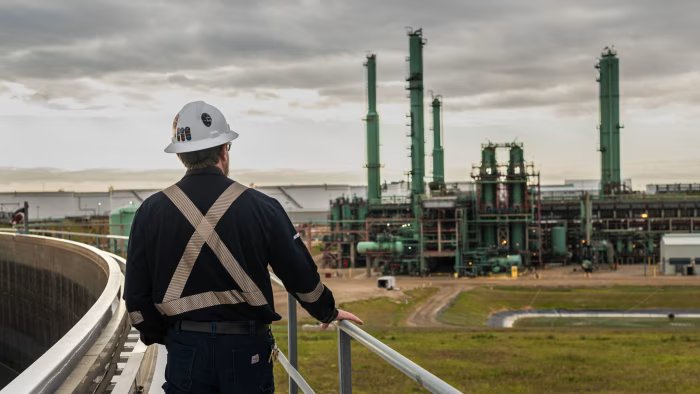
On the outskirts of Edmonton, the Enbridge oil terminal is a maze of pipes and tanks that embodies Canada’s fraught oil ambitions.
“These are gorgeous pipes,” said Norman Omoth, Enbridge’s terminal co-ordinator, gesturing towards North America’s largest crude pipeline system that has sent rivers of Canadian oil to the US since 1950.
But the politics of what moves through those pipes is as tangled as the network itself.
Canada now supplies about 60 per cent of US oil imports, or about 4mn barrels a day. Most of it comes from the giant bitumen-rich oil sands of northern Alberta, home to the world’s third-largest reserve of oil.
The Canadian Association of Petroleum Producers said these shipments, which have doubled in a decade, would generate C$147bn ($105bn) this year.
While Donald Trump’s punishing tariffs on Canada — the US’s second-biggest trading partner — do not affect energy, they have spurred Ottawa to seek new customers.
The old US-Canada trading relationship was “over”, Prime Minister Mark Carney said after taking office in April.

Once a champion of global decarbonisation, the Liberal leader now wants fossil fuels to help him buttress Canada’s economy — turning the country into an “energy superpower” for the Trump era.
Carney has said more pipelines to boost exports are “highly likely”, although he is yet to announce any, and vowed to ease regulations to support more energy production.
If he pulls it off, Carney will have sheltered Canada from the policies of the mercurial US president while easing frictions between Ottawa and Canada’s resource-rich western provinces, and between oil companies and First Nations.
“This is a bold move by Carney to take advantage of Canada’s abundance in energy . . . to reduce the country’s dependence on the United States,” said Brian Rathbun, at the University of Toronto’s Munk School of Global Affairs and Public Policy.
“Yet what is natural economically is not easy politically since this step will generate opposition from environmental circles and indigenous rights advocates,” he said.
The centrepiece of Carney’s “grand bargain” is his home province of Alberta, where conservative politics and suspicions of Ottawa run deep.
Alberta’s oil sands region produces 3.5mn b/d, the bulk of Canada’s output. Extraction of the bitumen is carbon intensive and almost a third of Canada’s emissions stem from its oil and gas sector.

As Bank of England governor, Carney warned of climate risks, and at Brookfield Asset Management he led a multibillion-dollar transition fund shifting capital away from fossil fuels. But since taking office, his own shift has been swift.
Although Canada is missing its climate targets, Carney scrapped an unpopular consumer carbon tax and paused policies promoting electric vehicles.
In his first budget this month, he proposed cutting the contentious emissions cap on the oil sector if the industry and western provinces beefed up their carbon pricing. The moves were viewed favourably by Canada’s fossil fuel producers.
However, Lisa Baiton, president of the Canadian Association of Petroleum Producers, said companies needed “greater clarity” on climate policy before investing.
Under pressure to clean up their operations, Alberta’s big producers have proposed the Pathways Alliance, a $16.5bn carbon capture project to improve the environmental record of the oil sands industry. But progress has been slow while the companies and governments argue over funding.
Kevin Birn, chief Canadian oil markets analyst at S&P Global, said Canada’s oil supply economics “are attractive,” but Ottawa’s stance on emissions was a big unknown.
“Investors are seeking to understand . . . whether an enduring path can be carved out for existing and future investment,” he said.

Another fight is over more export pipelines, especially to Canada’s west coast — infrastructure the industry says is vital for any “energy superpower” ambition.
“To effectively use oil, Canada’s only economic hard power, Carney needs to get not just one, but two pipelines built,” said Adam Waterous, chief executive of Calgary’s Waterous Energy Fund, a major oil sands investor.
Canadian and US trade negotiators have discussed reviving the giant Keystone XL pipeline project to the US Gulf Coast that was killed by the Biden administration. Waterous urged Carney to use it as a bargaining chip to ease Trump’s punishing tariffs on Canadian steel, aluminium and autos — and said he should back a new pipeline to the Pacific too.
“By trading oil but diversifying Canada’s market, Carney will return the country to a more balanced trade relationship with the US” he said.
Previous Canadian leaders have stumbled in promoting an oil industry that accounts for about 20 per cent of the country’s trade, but is concentrated in a province that has its own fringe Brexit-style movement.
Conservative Prime Minister Stephen Harper spoke of Canada as an “emerging energy superpower” in 2006, but his dreams ended in a crude price crash that delayed oil-sands growth for years.
Justin Trudeau, whose father Pierre Trudeau’s 1980s national energy policy still sparks fury in Alberta, ploughed billions of federal dollars into buying a pipeline to the west coast — but angered the industry by focusing on climate change.

Carney also has to consider whether the world needs more emissions-intensive heavy Canadian crude.
While the International Energy Agency expects oil demand to remain strong for decades, it has also warned of a “significant supply glut”.
Andrew Leach, an energy economist at the University of Alberta, noted that even Canada’s own producers were hesitant. “There are no pipeline proposals on the table” to expand capacity, he said.
“The Gulf Coast market in Texas isn’t what it once was for heavy crude,” he added. “Whether you have enough production over the long term given current price outlooks is a difficult question.” All big Canadian oil producers declined to comment.
Alberta’s premier Danielle Smith, who wants Canada to double its oil output of 6mn b/d, says Carney must scrap laws or restrictions such as a ban on crude tankers off northern British Columbia — key to new export routes.
“What good does it do to build a pipeline if you can’t load the boats?” she told the Financial Times.
Smith is hoping for “good news” on Monday with the expected announcement of a memorandum of understanding with Ottawa on a potential pipeline project. But Carney has not clearly stated his position on the matter.

BC’s premier David Eby and some local indigenous groups reject the idea and have urged Ottawa to keep the tanker ban.
“Protecting our coast is not a barrier to economic prosperity — it is the source of it,” said Marilyn Slett, president of the Coastal First Nations.
Canada’s energy minister Tim Hodgson told the FT that a new federal law, Bill C-5, would give Ottawa final say on fast-tracking major infrastructure projects despite environmental regulations.
“If a proponent brings forward a potential project, we’ll deal with it,” he said. “We now have the tools we need.”
For now, proposals remain scant. Enbridge years ago scrapped a plan to build a line to Kitimat, in northern BC and is now focused on boosting capacity on its US lines, with no plan to build a new one, said Max Chan, head of its oil pipeline division.
The existing oil export infrastructure to the west coast is the Trans Mountain system to Vancouver, which allows shipments to Asia. Justin Trudeau’s government bankrolled an expansion, which came online last year at a cost of C$34bn, wildly over budget.
The government-controlled Trans Mountain Corporation’s boss Mark Maki has said there would be “merit” in a new west-coast pipeline, but no new proposal is being discussed.

That may leave an unlikely revival of the Keystone XL project to Texas as a plausible project.
Most Canadian approvals are in place and the industry believes it would help Alberta’s producers fetch higher prices for heavy oil at US Gulf Coast refineries.
It would be a win for Carney in Alberta, but deepen dependence on the US.
“It makes Canada [the] USA’s oil colony instead of using our superior resources to advance our own interests and values geopolitically,” said Heather Exner-Pirot of the Ottawa-based Macdonald-Laurier Institute.
Chan said Enbridge was “cautiously optimistic” for the sector in the Carney era.
“If you have to source your energy from somewhere, Canada should be at the top of the list,” he said.