
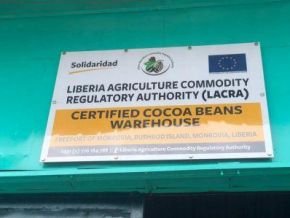
- Liberia is preparing a national agricultural traceability system to comply with the EU Deforestation Regulation (EUDR) due to fully apply in late 2026.
- EU agri-food imports from Liberia more than tripled in five years, reaching €118 million in 2024, with cocoa accounting for nearly 61% of the value.
- Authorities warn that failure to comply with EUDR could block more than 30% of Liberian farm output from international markets.
In Liberia, the Liberia Agriculture Commodity Regulatory Authority (LACRA) is drafting a roadmap to establish a National Agricultural Traceability System designed to track the origin of raw agricultural commodities from farm to market.
Authorities announced the initiative on January 23 during a meeting of the National Steering Committee on Traceability. The meeting brought together representatives from the International Fund for Agricultural Development (IFAD), the International Finance Corporation (IFC), the United Nations Industrial Development Organization (UNIDO), the agriculture committees of the House of Representatives and the Senate, the Forestry Development Authority (FDA), and farmers’ organizations.
According to information reported by local media, the initiative aims primarily to align Liberia’s agricultural production systems with the European Union Deforestation Regulation (EUDR) in order to secure continued access to the European market. The regulation, which will fully enter into force at the end of 2026, will ban imports of cocoa, coffee, soy, palm oil, wood, and meat produced on deforested land.
“If the EUDR is not taken into account, we risk a situation where more than 30% of our farmers’ products will grow and rot in the fields without access to markets,” Dan Saryee, Acting Director General of LACRA, said.
The issue is particularly strategic given that Liberia’s food exports to the European Union consist exclusively of cocoa, edible animal oils, and fats.
According to data from the European Commission, the value of EU agri-food imports from Liberia more than tripled over five years, rising from €31 million ($37 million) in 2020 to €118 million in 2024. Over the past year, cocoa alone accounted for nearly 61% of total import value.
In a report published in September 2025, Ivorian NGO IDEF had already warned about massive deforestation in Liberia driven by cocoa farming. Citing data from the Liberia Land Authority, the organization reported that in Grand Gedeh County alone, primary forest cleared for cocoa cultivation since 2020 was estimated at nearly 500,000 hectares.
In addition, some non-food agricultural sectors also linked to deforestation, such as natural rubber and timber produced in Liberia, could also be affected by the EUDR. Authorities now face the challenge of turning the announced roadmap into a fully operational traceability system before the end of the year.
This article was initially published in French by Stephanas Assocle
Adapted in English by Ange J.A de BERRY QUENUM