
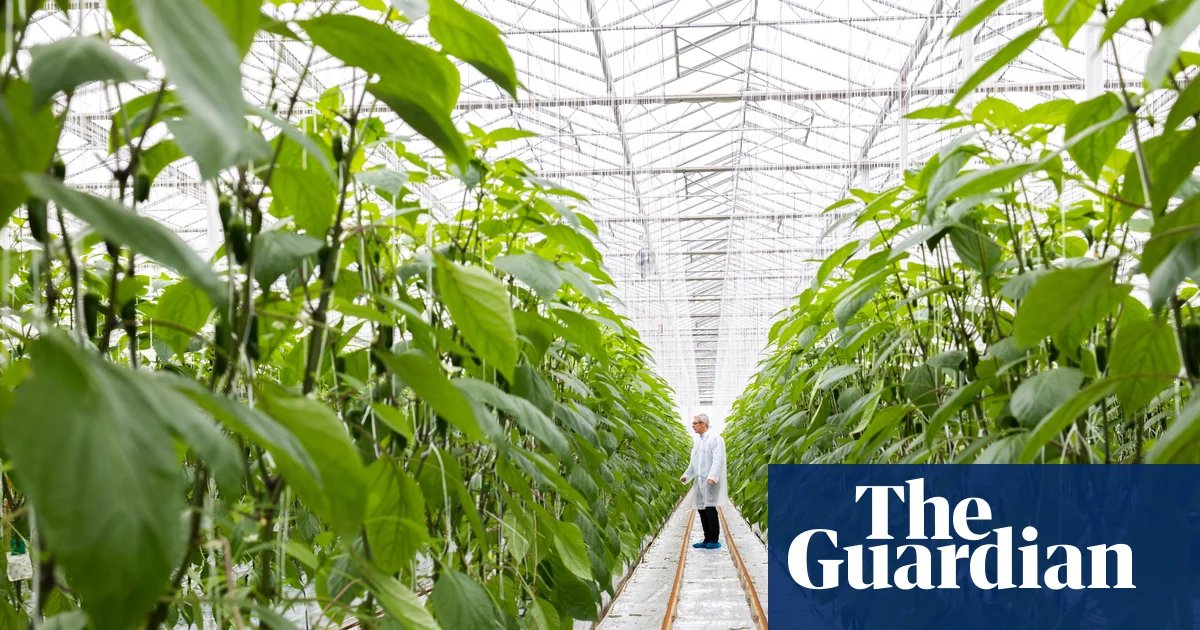
Outside, it’s an overcast and blustery February day in Kent – hardly the ideal conditions for growing tomatoes, cucumbers and peppers. Yet inside the enormous glasshouses run by grower Thanet Earth, the climate has been optimised to a humid 20C, perfect for the regimented rows of small pepper plants poking out of raised trays.
Growing fresh produce indoors in the south of England year-round requires plenty of energy to provide light, warmth and carbon dioxide. But the site’s energy bills are about to grow too, when a significant increase in electricity standing charges comes into force on 1 April.
“It’s a ticking timebomb,” says Rob James, the technical director at Thanet Earth, which supplies most of the UK’s large supermarket chains. The company estimates the rise in standing charges will add £900,000 a year to its existing energy bill, equivalent to a 5% increase in total tomato production costs. Future increases to standing charges will see this rise to £1.6m in additional annual energy costs by 2028.
“These big charges really impact our profitability, our ability to compete and our ability to reinvest,” he adds.
Growers are warning they will be forced to pass on the sharp jump in costs, which will ultimately be felt by consumers at the checkout. It marks the latest challenge for an industry that has tackled labour shortages, poor weather and changes to post-Brexit subsidies.
At Thanet Earth, the jump in bills will coincide with the start of picking for the small snacking peppers – the company expects to harvest 750,000 peppers a week at the height of the season, which runs to November.
Staff members zip along the paths on powered carts, while next door hundreds of tall tomato plants grow under bright pink LED lights, giving the glasshouse the appearance of a plant disco.
The buildings are part of the UK’s largest glasshouse complex – spanning 51.5 hectares (127 acres) of growing area – producing hundreds of millions of each crop annually. Since the first plants were placed in greenhouses in late 2008, Thanet Earth has grown into one of the UK’s largest tomato growers.
Many of the UK’s other indoor growers – in what is known as the protected horticulture sector – are warning they cannot absorb a 60% increase in standing charges, let alone the further increases expected in the coming years. They say this will force them to raise their prices or stop production, which will further fuel food price inflation.
Standing charges are the fixed daily cost included in bills for accessing the UK’s gas and electricity network, regardless of how much energy is used. After April’s rise, the charges are expected to continue to increase to fund the cost of upgrading the grid and transitioning to a low-carbon energy system.
However, industry bodies representing growers say these charges are unfair and are calling on the government to intervene.
Power-hungry industries – including steel, chemicals, cement and glass – that are classed as “energy intensive users” receive support with their energy bills, exempting them from the increase in charges. However, this did not include food producers.
The British Tomato Growers’ Association (BTGA) and the Cucumber and Pepper Growers’ Association (CPGA) blame what they call the outdated system of standard industrial classification (SIC) codes that categorise businesses according to their economic activity.
The associations say growers are not considered manufacturers and remain locked out of the support scheme, despite operating with the same energy intensity as some of the sectors that receive a discount.
Under the “British Industry Supercharger” scheme, introduced in 2024 by the previous Conservative government, a series of measures was launched to bring energy costs for “key industries” in line with other major economies. However, this did not include food producers.
That decision came despite grower complaints over unfairness in the energy system, exemplified by botanical gardens with glasshouses receiving support, while food producers do not.
“These are eye-watering numbers for these individual businesses and they can’t absorb it,” says Simon Conway, the chair of the BTGA.
“The costs will have to go into food inflation. In government spending it isn’t a lot of money, but to these individual businesses it’s a case of: ‘Stop all investment and can we survive?’ It’s that serious.”
Soaring energy bills are just the latest challenge to hit growers and farmers at a time of rising costs, falling wholesale prices for commodities, including dairy, and concerns about food producers’ profitability. It is against this backdrop that farmers will attend the annual gathering of the National Farmers’ Union (NFU) in Birmingham on Tuesday.
Conway and other industry representatives have sounded the alarm to ministers and the energy regulator, Ofgem, warning them about the impact on domestic production of fresh produce in a world buffeted by volatile weather and geopolitical tensions.
During the coldest months of the year, British retailers rely on imports of many fruit and vegetables from countries including Spain and Morocco, or the large glasshouse complexes of the Netherlands.
Devastating winter storms and flooding in Spain and Morocco have badly affected many growing areas and destroyed crops, exposing the fragility of global food supply chains.
However, despite the impending cliff-edge at the start of April and Keir Starmer’s acknowledgment, reflected in the Labour manifesto, that “food security is national security”, many growers feel the government has not been acting with the requisite urgency.
In Kent, Thanet Earth’s seventh glasshouse has just been completed, a project that cost £25m, and it will be planted up in the coming days.
The UK currently only covers 15% to 20% of domestic consumption of fresh produce such as tomatoes, cucumbers and peppers. Thanet Earth believes there is a market for homegrown crops and had planned to apply for outline planning permission for a further two glasshouses, but has currently paused the process.
“It’s frustrating to make a £25m investment and then face higher costs. Plans to grow further have now been called into doubt,” James says. He fears higher energy bills will also put British growers at a disadvantage compared with their Dutch counterparts.
“We are not after subsidy or money, just relief from the charges,” he adds.
The hike in bills is particularly bitter for Thanet Earth as it is a net exporter of energy. The company burns gas to generate electricity, and uses the by-products of heat and CO2 for growing its crops. Most of the electricity it creates is exported to the grid – enough to power 35,000 homes. The company employs about 260 people, but can have up to 900 working on site during seasonal peaks. It made a pre-tax profit of nearly £3m on sales of £164m in the year to April 2025, according to the most recent accounts filed with Companies House.
Growers associations say they accept that businesses and households are all required to fund upgrades to the grid, but caution this is heaping more cost on operators, even those who have invested in renewable energy.
A government spokesperson said: “Fruit and vegetable growers have an important role to play in our mission to drive economic growth and horticulture will be supported as a priority growth sector by our new farming and food partnership board.”
They added that investment in energy infrastructure would help to get more renewables on the grid, end reliance on fossil fuels and bring down bills.
The government has previously committed to looking this year at the businesses that qualify for the supercharger scheme to ensure support is directed at the most energy and trade intensive sectors of the economy.