
Stay informed with free updates
Simply sign up to the EU energy myFT Digest — delivered directly to your inbox.
The writer is former Nato deputy supreme allied commander Europe and a member of the Energy Security Leadership Council — Europe
It was the great American general Omar Bradley who memorably said: “Amateurs talk tactics, professionals talk logistics.” Europe is, at last, relearning that foundational military principle. Logistics determine the outcome of every major conflict, often before combat even begins. For any developed nation, the most critical logistics system is energy infrastructure. When power fails, production stalls, essential services from hospitals to railways and communications are disrupted, and failed supply lines can put the capability of a nation’s armed forces at risk.
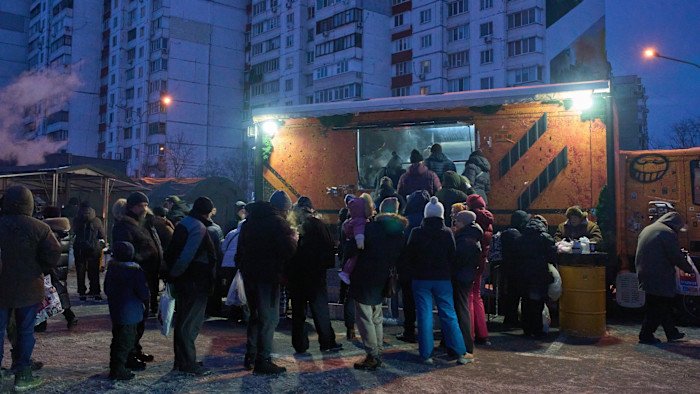
In Ukraine, this has been a reality since Russia’s full-scale invasion. The campaign against its energy infrastructure is one of the Kremlin’s core strategies. Ukraine has had to manage acute power deficits: the occupation of the Zaporizhzhia nuclear plant and waves of strikes left it with only about one-third of its prewar generation capacity by mid-2024. Going into this winter, Ukraine’s energy ministry anticipated only 17.6GW of generation capacity would be available, even before the recent attacks on energy infrastructure that have left millions suffering in extreme sub-zero temperatures.
Russia’s tactics extend beyond Ukraine, blending cyber and kinetic attacks on energy grids to deliberately probe Europe’s defences. In December, a Russia-linked cyber attack on Poland’s electricity grid disabled communications systems at around 30 energy facilities. This means that already, energy infrastructure is a strategic target in Europe. We face a battle to keep the lights on — and the data flowing. As European Commission president Ursula von der Leyen warned after damage to critical undersea links in the Baltic in 2023, “our pipelines and underwater cables are lifelines”.
Europe’s exposure is further amplified by an uncomfortable fact: the old assumptions about guaranteed external protection have been fatally weakened. As the Munich Security Report 2026 argues, Europeans have postponed the hard task of preparing for a future in which the US pivots away from the continent regardless of Europe’s preparedness. If that is true for the battlefield, it is also true for the power system that underpins Europe’s resilience.
We should treat energy security as de facto defence policy. That means moving beyond thinking about energy solely in terms of efficiency and decarbonisation, and prioritising resilience and strength in the face of aggression.
In addition to ensuring that supply chain risks for fossil fuels are effectively managed, we must also fortify, modernise and decentralise Europe’s electricity infrastructure. This includes low-carbon technologies that generate domestic energy such as solar, wind, nuclear and geothermal and grid-scale batteries for energy storage. Ultimately, if we cannot power our economies, we cannot defend our borders.
Ukraine has shown that centralised systems can be easy to disrupt. To prepare for this, Europe should shift to more distributed energy systems so that, if one node is disabled physically or digitally, the rest of the system can remain online. Resilient interconnection means more cross-border links, more routing options and faster isolation of compromised segments — preventing severe blackouts like the one that hit Spain and Portugal last summer.
Protecting a power system requires air defence, counter-drone measures, deception, dispersion and robust cyber security. Ukraine’s grid operators have remained functional due to strong cyber defences, splitting the network into smaller segments, and the ability to run the system manually when digital systems fail. Europe must learn from this and reduce strategic digital dependencies. The EU’s recent move to restrict high-risk suppliers in critical sectors such as electricity and cloud services should accelerate.
Finally, the most politically challenging necessity is ending dependencies that could be weaponised. Europe learnt from Russian gas that dependencies can lead to coercion. Europe’s reliance on US energy and technology in the wake of a breach of transatlantic trust is also a vulnerability. A clean, homegrown energy system with resilient infrastructure and storage is critical to securing the continent’s sovereignty.
Some will object that this is expensive. It is, but the alternative is costlier. Europe needs to be ready to function under crisis conditions. That means planning for prolonged disruption and building grids and energy systems in the face of an adversary who is actively trying to break it. Energy is no longer just a commodity for economic prosperity; it is the frontline of defence.