
ASEAN’s clean energy transition is emerging as a significant driver of long-term growth, shaped by rising energy demand and the infrastructure requirements to support it. According to the International Energy Agency, Southeast Asia will account for 25% of the increase in global energy demand by 2035. Meeting future needs will require a major scale-up in renewable power capacity, from just over 100 GW today to around 3,000 GW by 2050 in line with broader decarbonization pathways.
While the majority of ASEAN’s 10 member states have announced net-zero emissions targets, the region remains behind schedule and will require sustained effort from stakeholders to close the gap. With decades of experience in urban development and infrastructure, along with expanding renewable energy partnerships across the region, Gamuda, a global engineering and construction company with its headquarters in Malaysia, is stepping up to play a stronger role in supporting the shift toward a more resilient energy future.
For decades, Gamuda has delivered large-scale civil and infrastructure works such as the Storm Water Management and Road Tunnel (SMART), the world’s first dual-purpose stormwater and motorway tunnel in Kuala Lumpur and mass rapid transit lines in Malaysia, Taiwan, and Singapore, before making a strategic shift toward renewable energy.
“We began our renewable energy journey just over three years ago, and it was a natural and seamless progression for a major infrastructure player like us. The same end-to-end delivery expertise in civil engineering, design, M&E, interface project management and financial modeling is now being deployed to develop and build large-scale solar, wind, battery storage and transmission assets across the region,” says Justin Chin Jing Ho, managing director of Gamuda Engineering.

Gamuda’s shift has created a growing 3-GW pipeline across multiple markets, including some of Australia’s largest renewable projects, such as the 585-MWp Goulburn River Solar Farm. The company’s wholly-owned subsidiary, DT Infrastructure, as part of the TasVic Greenlink joint venture with Samsung C&T, has secured the contract to deliver the Balance of Work package for the circa AUD994 million (approximately $657 million) Marinus Link Stage 1; a planned undersea and underground electricity and data interconnector between Tasmania and Victoria.
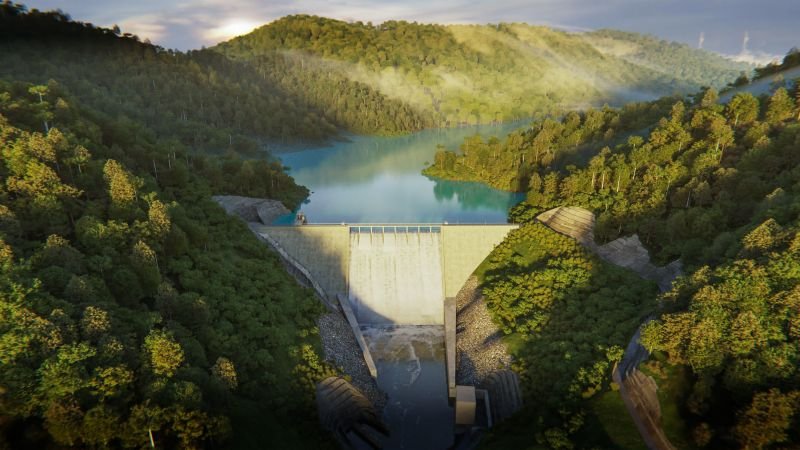
In Malaysia, Gamuda is constructing the Ulu Padas Hydroelectric Dam and is on track to become the country’s first and largest hydro independent power producer (IPP). Meanwhile, in Singapore, it has delivered the Gali Batu Multi-Storey Bus Depot, including the electrical and charging infrastructure required to support a fully electric bus fleet.
Supported by a 30-year history of public–private partnerships (PPPs) across the Asia-Pacific, Gamuda’s approach centers on building collaborative ecosystems to accelerate renewable deployment, including alignment with Malaysia’s Corporate Renewable Energy Scheme (CRESS), which enables corporate consumers to purchase renewable energy directly from IPPs.

Gamuda is also deepening its partnership with clean energy solutions company Gentari, with both parties working together to develop 1.5 GW of solar and battery storage projects. “This partnership brings together Gentari’s renewable expertise and Gamuda’s engineering capabilities to deliver scalable, low-carbon energy that supports both economic growth and Malaysia’s net-zero aspirations,” says Low Kian Min, chief renewables officer of Gentari.
In addition, Gamuda has also partnered with SD Guthrie Berhad (Guthrie) to develop, own and operate solar power assets, including energy storage systems, with an accumulated target capacity of 1.2 GW, leveraging Guthrie’s vast land bank across Malaysia to support the country’s National Energy Transition Roadmap (NETR), which targets 70% renewable energy capacity in the energy mix by 2050.
In Australia, Gamuda, through DT Infrastructure, is collaborating with energy leaders, including Aula Energy and Lightsource bp, as a long-term delivery partner. “DT Infrastructure is positioning itself as a delivery partner of choice in the renewables sector,” says Tom Perkin, general manager of strategy of DT Infrastructure. “Our focus on early and genuine collaboration has secured signature projects like the Goulburn River Solar Farm and Boulder Creek Wind Farm, with a strong pipeline of renewable projects to commence in 2026. This combined with the recent contract award of Marinus Link has positioned DT Infrastructure as a leading renewables delivery partner in Australia.”
Beyond construction, Gamuda is also investing renewable energy development in Australia, including a partnership with Alternate Path in Tasmania on the Weasel Solar Farm and Cellars Hill Wind Farm projects, which have a combined capacity of up to 600 MW of wind and solar and up to 600 MW of battery storage. “We are planning to invest up to 40% equity in solar and wind assets to build a portfolio through 2029, signifying our commitment to long-term participation in the region’s clean-energy landscape,” says Jarred Hardman, chief strategy and growth officer of Gamuda Australia.

A key focus of the ASEAN Energy Business Forum (AEBF-25) held in Malaysia in October 2025 was strengthening regional collaboration, highlighted by the ceremonial launch of the ASEAN Power Grid (APG) Enhanced Memorandum of Understanding (MoU) and in new agreements between the ASEAN Center for Energy (ACE) and international and academic institutions.By pairing technical capability with a collaborative approach, Gamuda is contributing to the infrastructure needed for a lower-carbon future and supporting progress toward a more secure, interconnected, and sustainable energy future.
Discover the latest news about Gamuda here.