

Households and businesses will have to wait for energy bills to fall significantly because “there’s no shortcut” to bringing down prices, the energy minister has told Sky News.
Speaking as Chancellor Rachel Reeves considers ways of easing the pressure on households in next week’s budget, energy minister Michael Shanks conceded that Labour’s election pledge to cut bills by £300 by converting the UK to clean power has not been delivered.
It comes as Ofgem announced the average annual energy bill will rise by 0.2% in January, despite wholesale costs falling.
Major forecasters Cornwall Insight had predicted a 1% drop – but the energy regulator has moved in the opposite direction. Between January and March, the typical annual dual fuel bill will be £1,758 – up from the current £1,755 cap.
The UK has the second-highest domestic and the highest industrial electricity prices among developed nations, despite renewable sources providing more than 50% of UK electricity last year.
“The truth is, we do have to build that infrastructure in order to remove the volatility of fossil fuels from people’s bills,” Mr Shanks said.
“We obviously hope that that will happen as quickly as possible, but there’s no shortcut to this, and there’s not an easy solution to building the clean power system that brings down bills.”
His comments come amid growing scepticism about the compatibility of cutting bills as well as carbon emissions, and growing evidence that the government’s pursuit of a clean power grid by 2030 is contributing to higher bills.
While wholesale gas prices have fallen from their peak following the Russian invasion of Ukraine in 2022, energy bills remain around 35% higher than before the war, inflated by the rising cost of reducing reliance on fossil fuels.
The price of subsidising offshore wind and building and managing the grid has increased sharply, driven by supply chain inflation and the rising cost of financing major capital projects.
In response, the government has had to increase the maximum price it will pay for offshore wind by more than 10% in the latest renewables auction, and extend price guarantees from 15 years to 20.
The auction concludes early next year, but it’s possible it could see the price of new wind power set higher than the current average wholesale cost of electricity, primarily set by gas.
Renewable subsidies and network costs make up more than a third of bills and are set to grow. The cost of new nuclear power generation will be added to bills from January.
The government has also increased so-called social costs funded through bills, including the warm home discount, a £150 payment made to around six million of the least-affluent households.
Gas remains central to the UK’s power network, with around 50 active gas-fired power stations underpinning an increasingly renewable grid, and is also crucial to pricing.
Because of the way the energy market works, wholesale gas sets the price for all sources of electricity, the majority of the time.
At Connah’s Quay, a gas-fired power station run by the German state-owned energy company Uniper on the Dee estuary in north Wales, four giant turbines, each capable of powering 300,000 homes, are fired up on demand when the grid needs them.
Energy boss: Remove policy costs from bills
Because renewables are intermittent, the UK will need to maintain and pay for a full gas network, even when renewables make up the majority of generation, and we use it a fraction of the time.
“The fundamental problem is we cannot store electricity in very large volumes, and so we have to have these plants ready to generate when customers need it,” says Michael Lewis, chief executive of Uniper.
“You’re paying for hundreds of hours when they are not used, but they’re still there and they’re ready to go at a moment’s notice.”
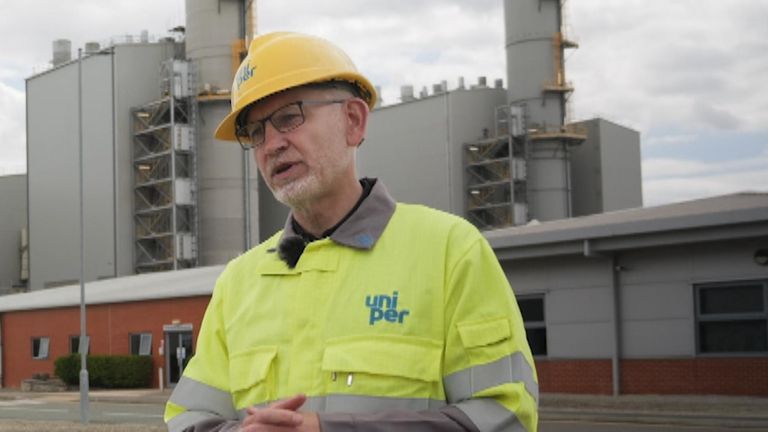
Michael Lewis, chief executive of Uniper
He agrees that shifting away from gas will ultimately reduce costs, but there are measures the government can take in the short term.
“We have quite a lot of policy costs on our energy bills in the UK, for instance, renewables incentives, a warm home discount and other taxes. If we remove those from energy bills and put them into general taxation, that will have a big dampening effect on energy prices, but fundamentally it is about gas.”
The chancellor is understood to be considering a range of options to cut bills in the short term, including shifting some policy costs and green levies from bills into general taxation, as well as cutting VAT.
Read more from Sky News:
What deleted post reveals about ‘secret’ plan to end Ukraine war
Starmer preparing for China trip in new year
Tories and Reform against green energy
Stubbornly high energy bills have already fractured the political consensus on net zero among the major parties.
Under Kemi Badenoch, the Conservatives have reversed a policy introduced by Theresa May. Shadow energy secretary Claire Coutinho, who held the post in the last Conservative government, explained why: “Net zero is now forcing people to make decisions which are making people poorer. And that’s not what people signed up to.
“So when it comes to energy bills, we know that they’re going up over the next five years to pay for green levies.
“We are losing jobs to other countries, industry is going, and that not only is a bad thing for our country, but it also is a bad thing for climate change.”

Claire Coutinho tells Sky News net zero is ‘making people poorer’
Reform UK, meanwhile, have made opposition to net zero a central theme.
“No more renewables,” says Reform’s deputy leader Richard Tice. “They’ve been a catastrophe… that’s the reason why we’ve got the highest electricity prices in the developed world because of the scandal and the lies told about renewables.
“They haven’t made our energy cheaper, they haven’t brought down the bills.”
Mr Shanks says his opponents are wrong and insists renewables remain the only long-term choice: “The cost of subsidy is increasing because of the global cost of building things, but it’s still significantly cheaper than it would be to build gas.
“And look, there’s a bigger argument here, that we’re all still paying the price of the volatility of fossil fuels. And in the past 50 years, more than half of the economic shocks this country’s faced have been the direct result of fossil fuel crises across the world.”