
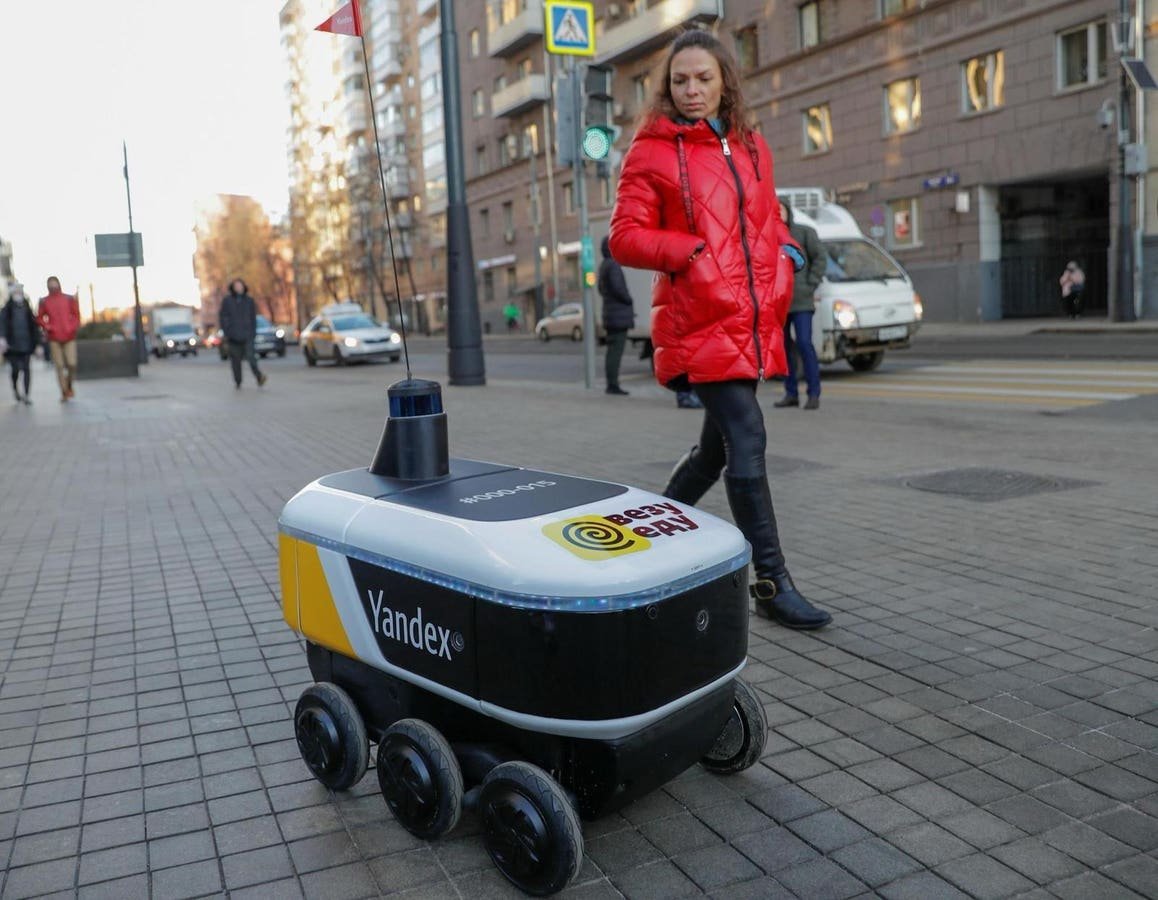
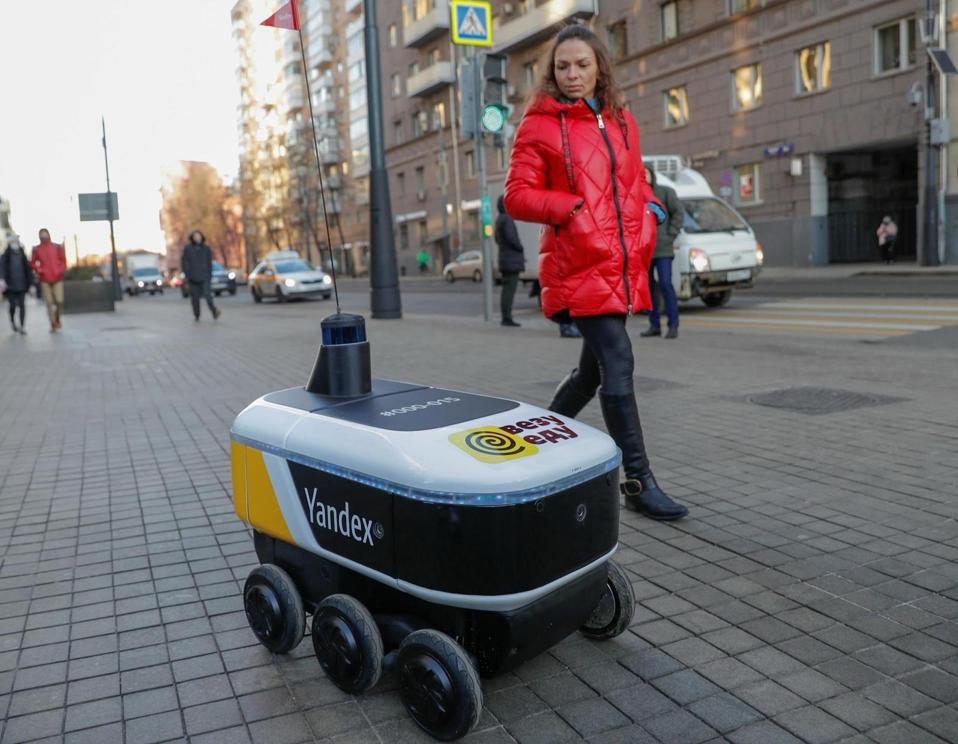
Smart cities integrate advanced technologies, such as robots tasked with food and package delivery in Moscow. Russia’s current electricity generation and distribution strategy is unlikely to sustain the expansion of cloud city development.
CNN
The U.S.-China competition for AI dominance is on, and one key arena where China has so far outrun the competition is the emergence of “cloud cities” or “smart cities” – mega-cities that integrate AI-run capabilities and robotics to run things more efficiently, and help to mitigate negative impacts on the environment, improving the quality of life for citizens. The negative aspect of this trend from the citizen’s eye view may involve concerns about privacy and monitoring, which has required advanced thinking and preparation in countries where individual freedom ranks high on the value scale, such as the U.S. and the EU.
From an engineering perspective, AI integration in cities requires ambitious countries to generate or supply vast quantities of energy. As part of their early work on the smart city concept, China began putting in the massive infrastructure that would be needed to supply the increased demands involved. The Chinese government, with its top-down, centralized approach, invested heavily in nuclear, coal, gas and renewables generation supplemented by innovative grid technologies to increase the efficient generation and distribution of energy, especially near large cities.
Capitals well beyond Washington and Beijing are also interested in the “cloud cities” trend and seeking ways to jump on board. One of these is Moscow, which hosted the annual BRICS Urban Future Forum, meeting for the third time this past September, with delegations from China to Saudi Arabia trading playbooks on robotics, big data and AI for megacities.
Sometimes this looks like a sci-fi movie. Robots deliver packages; autonomous cleaning machines tidy up the parks. A 3D “digital twin” model manages 1,000 square miles of streets and utilities, aware and providing solutions for road closures, repairs, and renovation to minimize local traffic jams.
Chinese cities, like Shenzhen, are paving the way for cloud cities, integrating various sources of power to ensure the country’s energy supply can meet the demand these cities generate. (Photo by VCG/VCG via Getty Images)
VCG via Getty Images
A citywide camera network provides real-time data to AI analytics about traffic and the movement of people. In the Russian capital, half a million passengers ride the subway without any “ticketing”, as facial recognition automatically charges their fares (as well as collecting data on their locations, for those interested in the darker side of mass surveillance). This isn’t a futuristic novel; it’s Moscow presenting itself to the Global South as a model of urban development.
The geopolitical message is clear: watch a robot called “Pixel” cleaning the streets and see Moscow not as the capital of a wannabe empire at war with its “brotherly” neighbor, but as a shining metropolis of the future, a hub for exchanging ideas on robotics and AI-powered urban transformation. However, one needs a lot of electricity to shine, and this may turn out to be an insurmountable ambition.
The International Energy Agency projects data‑center electricity demand will more than double by 2030 to approximately 945 Terawatt-hours, which is a bit more than Japan’s current consumption. Demand may already top 1,000 TWh by 2026 when crypto is included in the mix. Analysts have warned that as early as 2027, 40% of AI‑focused data centers in the world could hit power constraints. More computer-operated cameras on cars and trains, autonomous robots, e‑health, citywide analytics, blockchain, cryptocurrencies, creative industries where AI is cranking out not just manga, but whole lifelike TV series, and innovation hubs boosting GDP with the help of chips and semiconductors, means there must be a sharp increase in readily available local gigawatts. This at a time when, ironically, energy-rich Russia may be facing a looming power crunch.
Moscow’s power system may run into capacity problems in the relatively near term. Measures planned to alleviate the situation include about 950 MW of new thermal units in or near Moscow; with two 750 kV lines planned to run into the city by 2030; followed by a 1.5 GW high‑voltage DC link to pull power from the Novovoronezh nuclear plant by 2032. These will not be cheap (over $5 billion or 460.7 billion Rubles) and may not prove either sufficient or reliable. Given the pace of growth of digital demand, these additions may be too little, too late, and also too vulnerable in the face of potential Ukrainian drone attacks, which are already wreaking havoc on Russia’s energy infrastructure.
Damage inflicted upon Russian power generation capacity by Ukraine is a major obstacle to integrating cloud city technology.
The War Zone
Even the planned big national build‑out won’t be a silver bullet.
The approved General Scheme to 2042 to boost power generation adds 88.1 GW gross generation (about +45 GW net after retirements) to the national total. But cloud services and data centers aren’t spread over the vast space of Russia’s territory; they are clustered in the cities. Roughly three‑quarters of Russia’s commercial data‑center racks are in Moscow and the surrounding region. Increasing the number of gigawatts produced by the entire nation won’t relieve the urban centers if the energy is produced hundreds of kilometers from where demand is at new heights.
Another big question is whether Russia can actually deliver on its announced power capacity additions. With the Central Bank key rate at 17% and the economy projected to slow, attracting private capital to the low-margin power generation sector is a tough sell. The public purse is also feeling the pinch, as defense outlays have surged to about 6.3% of GDP, and the 2025 deficit target (1.7% of GDP) was effectively reached by mid‑year.
Nor is Russia able to reroute its electrons from the export market to domestic consumption. Electricity exports to China have all but collapsed (down over 70% from 2024 levels). The system operator now openly floats importing power from China to keep the lights on in the east while new plants and lines are built.
Moscow’s “shiny” futuristic solutions to urban development challenges rely on borrowing power from afar, where it may not be built at all, and/or may not be built in time. In a world where data‑center load could easily lead to energy deficits and blackouts, Moscow’s dream of being a “cloud city” is bold. It may also prove fragile.