
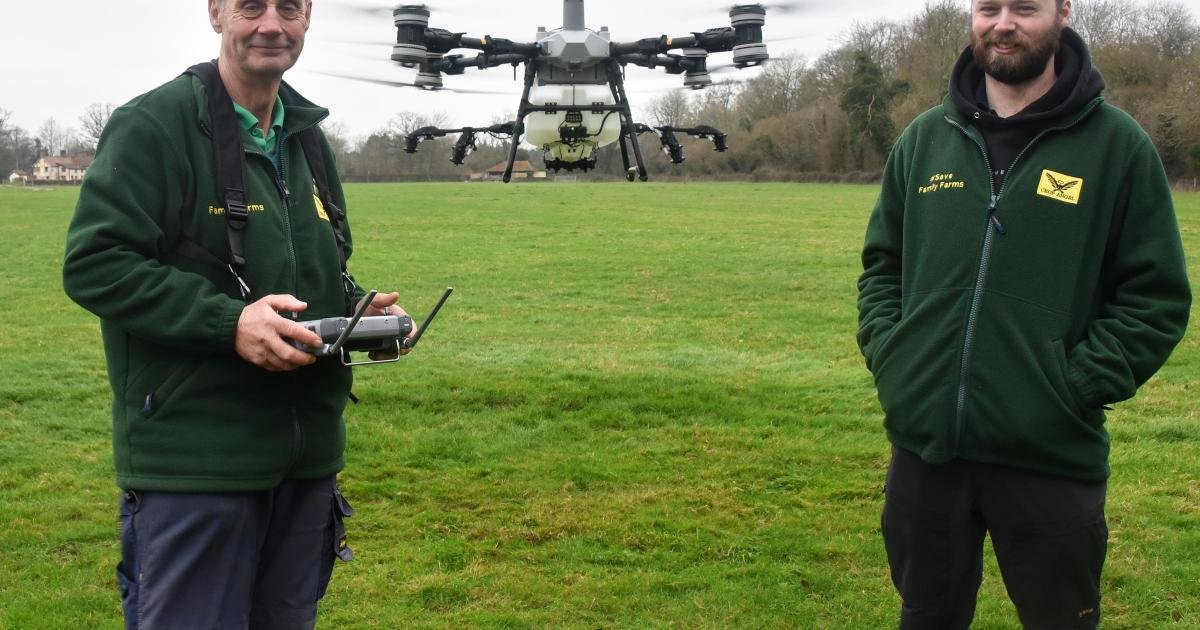
Chris Eglington, who farms at Letton near Shipdham, is also a director of farm technology supplier Crop Angel.
The company has taken delivery of its first DJI Agras T100, which is being put through its paces before being demonstrated to potential customers at the LAMMA farm machinery show in Birmingham on January 14-15.

The powerful Chinese-made drone has a wingspan of 3.2m between the tips of its eight rotors, and a 100kg payload capacity.
The autonomous, satellite-guided machine is capable of spraying crops, but its use for chemicals is currently restricted by the Civil Aviation Authority (CAA) and Chemical Regulations Directorate (CRD).
So its main purpose at the moment is spreading seeds into standing crops to establish cover or companion crops.
Mr Eglington said there was a growing demand for this, with government grants available for drone technology, and incentives for growing cover crops during the winter to protect soil health and structure between cash crops.

“At the moment chemicals cannot be sprayed through it, so the main use is cover crops and companion crops,” he said.
“Through the Sustainable Farming Incentive (SFI), the government is paying farmers to put in cover crops. There are also grants for drones, so that is encouraging people to use technology.
“This drone can carry 100kg – with cover crop seeds you will probably put on somewhere between 7kg and 15kg per hectare so, as long as the battery can cope, you can do quite a big area per tankful.
“There is no compaction, you don’t have to worry about tramlines or spreading width.”

The T100 is an updated version of the previous T50 model – eight of which have already been sold to farmers by Crop Angel.
Mr Eglington said the new drone costs less than £20,000 with all the available hardware, and the company also provides training and technical support to customers.
Technical manager Harry Shephard said safety features include on-board cameras, radar and LiDAR – a remote-sensing technology using beams of laser light – to detect and avoid obstacles in the landscape.

Crop Angel is part of a group of similar companies speaking to the CAA and CRD hoping to remove the “stumbling blocks” to using drone technology for agrochemical sprays.
Mr Shephard said: “We were originally classified as aerial application, the same as if you were doing it [spraying] with a plane or a helicopter, which was banned a while ago. Now they are changing it so drones have their own classification, which will hopefully soon allow us to do chemicals.”

